Skip to content
JACK & TORQUE

Comparison

Jack Stands vs QuickJack

One costs about as much as a used car's brakes. The other is the thing you must own either way.

By Ryder M. · Published September 29, 2026 · Last reviewed September 29, 2026

We earn a commission when you buy through the Amazon links on this page, at no extra cost to you. It never changes which tool we put first, and we publish no price we have not verified. How this site is funded.

Jack Stands vs QuickJack — ranked picks with scores and a price check for each
#PickCapacityScorePrice
1
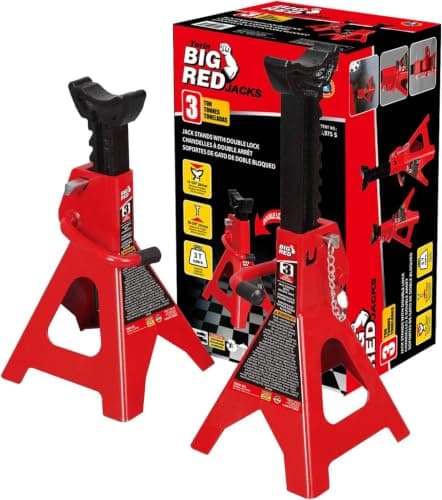
BIG RED T43002A 3-Ton Double-Locking Jack Stands, Amazon product photo
BIG RED T43002A 3-Ton Double-Locking Jack StandsThe stands to buy either way
3 ton (6,000 lb) per pair9.1
2
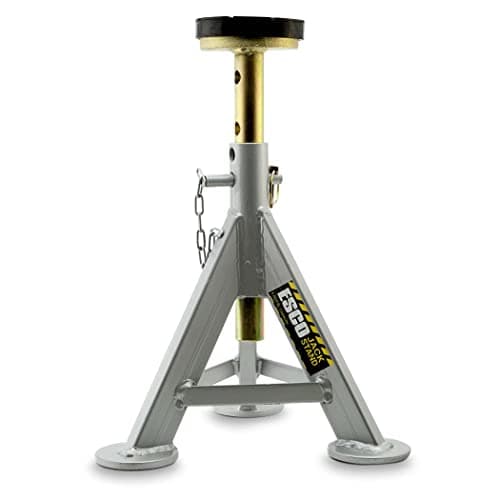
ESCO 10498 3-Ton Performance Jack Stand, Amazon product photo
ESCO 10498 3-Ton Performance Jack StandThe stands to buy if you want the best
3 ton per stand8.8

Product photographs come from each product's own Amazon listing via the Associates program. They are the seller's images, not photographs of anything we own — we have no test rig and claim none.

BIG RED T43002A 3-Ton Double-Locking Jack Stands, Amazon product photo

Verdict first: these are not alternatives. A QuickJack is a portable scissor lift that raises both ends of a car about 21 in and holds it on its own mechanical locks; a pair of jack stands is the fundamental support tool that every garage needs and that costs a rounding error by comparison. If you are choosing between them for a first home garage, buy the stands. Buy the lift later, if the volume of work justifies it — and you will still own the stands, because there are jobs a lift cannot do and days the lift is packed away.

What each one actually does

A QuickJack portable lift against a pair of jack stands, on published figures
QuickJack 3500SLXQuickJack 6000TLA pair of jack stands
Lifting capacity3,500 lb6,000 lb2 – 6 ton, rated per pair or per stand
Lifting height17.5 in (21 in with stacked blocks)21 in (24 in with stacked blocks)Up to the stand's top notch — 16-3/4 to 23-13/16 in
Lowered height3.5 in with 2 in block3.5 in with 2 in blockNot applicable
Frame length62.5 in70 inNot applicable
Frame weight60 lb each78 lb eachA few pounds each
Needs a power unitYesYesNo
Lifts both ends at onceYesYesNo — one end at a time
A QuickJack portable lift against a pair of jack stands, on published figures

Where the QuickJack genuinely wins

It lifts both sides of the car together and holds them on automatic mechanical locks, which means the whole side of the vehicle is open instead of one corner at a time. QuickJack publishes a 30-second time to full rise on the 3500SLX. For anyone doing exhaust work, a full brake refresh or repeated track-day wheel swaps, that changes the day rather than just the job.

It also collapses to 3.5 in with the standard block, so it stores flat against a wall in a way that a two-post lift never will.

Where the stands win

Cost, first and most honestly: the price gap is enormous and a pair of stands is the cheapest safety-critical item in the garage. But also flexibility. Stands go where the car is — a driveway, a parking space, a friend's garage — with no power unit, no hoses and no 62 in frames to position. And a lift still needs the right lift points under it, which is the same problem stands have and the same jack points reading.

Who should actually buy a lift

The short version

  • You work on the same car most weekends, not twice a year
  • You have a flat, load-bearing floor and about 8 x 6 ft of clear space
  • You already own stands, a jack and chocks, and the lift is the next purchase rather than the first
  • The jobs you do involve both sides of the car at once — exhausts, full brake systems, suspension refreshes

If more than one of those is not true, the money is better spent on a good pair of stands, a jack that fits your car and the rest of the starting kit.

The picks in full

Every pick, in detail

BIG RED T43002A 3-Ton Double-Locking Jack Stands, Amazon product photo

1. The stands to buy either way

BIG RED T43002A 3-Ton Double-Locking Jack Stands

Torin (BIG RED) · score 9.1/10

A ratchet bar plus a separate safety pin — two independent locks instead of one — at the height range a car actually needs, and Torin states they meet ASME safety standards.

Two independent locks — a ratchet bar plus a separate safety pin — at 11-1/4 in to 16-3/4 in, which is the range a car needs, and Torin states they meet ASME safety standards. This is the purchase that has to happen regardless of what else is in the garage, because a jack is not a support and a lift is not always the right tool. Rated 3 ton per pair, not per stand.

Published specifications

Capacity
3 ton (6,000 lb) per pair Torin
Min height
11-1/4 in Torin
Max height
16-3/4 in Torin
Base footprint
7-11/16 in x 6-7/8 in Torin
Standards
Meets ASME safety standards Torin

What works

  • Two independent locking mechanisms, not one
  • 11-1/4 in to 16-3/4 in matches what a 3-ton floor jack can reach
  • The cheapest way to buy a genuinely double-locked stand

What you give up

  • Rated per pair, not per stand — read the rating before loading two corners
  • 11-1/4 in minimum is taller than some low cars want
  • Torin's own listing says this size is not intended for SUVs or trucks

Our scoring

  • Fit & reach8.6
  • Safety margin9.2
  • Beginner ease9.0
  • Build quality8.2
  • Value9.4
$35.99 · View on Amazon

#ad Price as of October 16, 2026. How this is funded

Specifications published by Torin (BIG RED) — we earn nothing from that link.

ESCO 10498 3-Ton Performance Jack Stand, Amazon product photo

2. The stands to buy if you want the best

ESCO 10498 3-Ton Performance Jack Stand

ESCO · score 8.8/10

A removable flat rubber saddle instead of the usual curved axle cradle, rated 3 ton per stand and tested to ASME standards by an A2LA-certified lab.

Rated 3 ton per stand, 13.2 in to 21.5 in across ten positions, with a removable flat rubber saddle that suits a sill or subframe rather than an axle, and ESCO states the design is tested to ASME standards by an A2LA-certified facility. The most expensive stands we cover, and the ones with the clearest published testing provenance.

Published specifications

Capacity
3 ton per stand ESCO
Height range
13.2 in – 21.5 in ESCO
Positions
10 adjustable positions ESCO
Saddle
Removable flat-top rubber cushion ESCO
Weight
11.4 lb ESCO
Testing
Tested to ASME standards by an A2LA-certified facility ESCO

What works

  • Flat rubber saddle sits against a sill or subframe without digging in
  • Rated per stand rather than per pair — easier to reason about
  • Third-party ASME testing named on the manufacturer listing

What you give up

  • 13.2 in minimum is the tallest low setting of the car stands here
  • Pin-and-post adjustment is slower than a ratchet
  • The most expensive stand in this set

Our scoring

  • Fit & reach8.4
  • Safety margin9.4
  • Beginner ease8.2
  • Build quality9.2
  • Value7.8
$69.99 · View on Amazon

#ad Price as of October 16, 2026. How this is funded

Specifications published by ESCO — we earn nothing from that link.

Method

How these picks were chosen

We did not test these tools. We do not run a laboratory, we have not loaded a jack to failure or checked a wrench on a calibration bench, and we will not tell you otherwise. What we did instead is read the published manufacturer specifications, check the figures that matter against the safety standard that applies to portable automotive lifting equipment, and work out which tool suits which job. Every number on this page links to where it came from, so you can check us.

The five things we score are the five that decide a first purchase: will it fit under and lift your car, how much safety margin the rating and the locking mechanism leave you, how hard it is to get right alone in a driveway, what the materials and published standards say about how long it lasts, and what the money buys against the rest of the field.

Read the full method — including how we pick a top pick, and how prices get on the page.

Questions

Frequently asked questions

+Is a QuickJack safer than jack stands?

Both hold on mechanical locks rather than hydraulics when used correctly, which is the property that matters. A lift is more stable across both sides of the car at once; stands depend on you setting them level on solid ground. The bigger safety difference is the operator, not the tool.

+How high does a QuickJack lift a car?

QuickJack publishes 17.5 in on the 3500SLX with the 2 in block, rising to 21 in with stacked blocks, and 21 in on the 6000TL rising to 24 in with stacked blocks. That is comparable to a tall jack stand, not to a two-post shop lift.

+Do I still need jack stands if I have a QuickJack?

Yes. The lift is not always set up, it is not always where the car is, and there are jobs — a roadside wheel change, a driveway brake pad swap — where a jack and a pair of stands is simply the right tool.

+Is a QuickJack worth it for a home garage?

If you work on the same car most weekends and have the floor space, it changes how the work feels. For a first home garage doing a few jobs a year it is a large amount of money spent before the cheap, essential tools are all owned.

Sources

Where these figures come from

Read next

Related reading