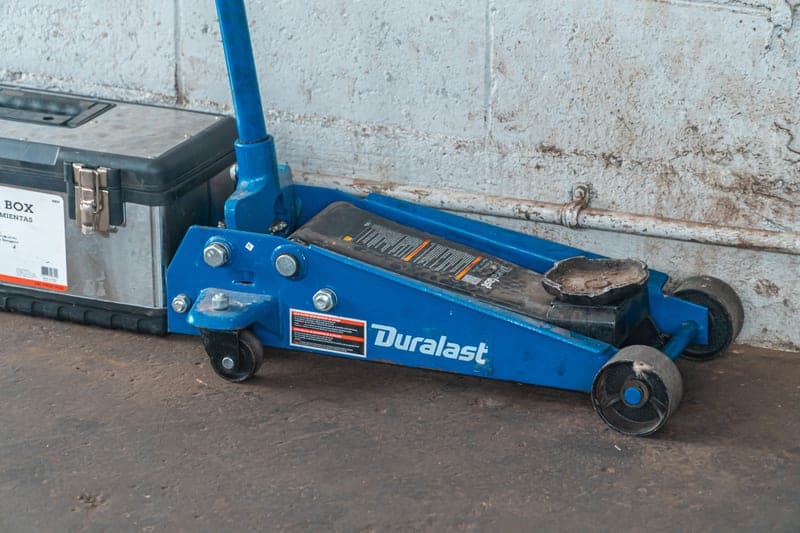
The specification that dominates most floor-jack advice — weight — is almost irrelevant if the jack lives on a garage floor. You roll it to the car and roll it back. Nobody lifts a floor jack in a garage.
Once you drop weight from the criteria, three things move up: how many pump strokes it takes to reach working height, how much range you have if a second vehicle arrives, and how the tool will survive a decade of being pushed across concrete.
Start with the floor, not the jack
A floor jack has small hard wheels and it needs to roll while loaded, as the saddle arcs and the jack tracks slightly forward and back. On smooth sealed concrete that happens effortlessly. On a rough, cracked or painted-and-peeling floor it does not, and a jack that cannot roll under load drags the car sideways on the saddle — which is how lift points get damaged.
If your garage floor is rough, that is worth more attention than which jack you buy. Sweeping it matters. A sheet of plywood or a smooth board under the jack's travel path matters more than 5 lb of aluminum.
Pump strokes are the thing you feel
| Design | Published behavior | What you notice |
|---|---|---|
| Dual piston / rapid rise | Sunex: max height in under 6 pumps | Noticeably fewer strokes per corner |
| Single piston quick-lift | Torin: single-piston quick-lift pump | More strokes, simpler mechanism |
| Dual pump pistons (aluminum service) | Arcan: dual pump pistons | Between the two, on a lighter chassis |
This sounds trivial until you do a brake job, where each corner goes up and down more than once. It is the most common reason a garage owner upgrades a jack they otherwise had no complaint about.
One car, or one car and a truck
If the garage holds one low or normal-height car, buy for minimum height and stop thinking about it. If it holds a car and a pickup, you either buy for the truck's height and use ramps to get under the car, or you accept two jacks. Trying to cover both extremes with one jack generally means compromising on the spec that fails silently — minimum height.
Store it so it lasts
Lower the saddle fully when you put it away, which takes the load off the seals and keeps the ram protected. Keep it off a damp floor if you can — a pallet or a shelf is enough. If the handle detaches, store it with the jack rather than somewhere clever, because a floor jack with a missing handle is a paperweight.
For what else belongs in a first garage, in what order, see the beginner mechanic tool kit, and for the safety kit specifically, wheel chocks and pinch weld pads.