

Skip to content
JACK & TORQUE

Pillar guide

Car Maintenance for Beginners

Three checks anyone can do without tools, three jobs worth learning, and an honest line for where to stop.

By Ryder M. · Published September 26, 2026 · Last reviewed September 26, 2026

We earn a commission when you buy through the Amazon links on this page, at no extra cost to you. It never changes which tool we put first, and we publish no price we have not verified. How this site is funded.

Car Maintenance for Beginners — ranked picks with scores and a price check for each
#PickCapacityScorePrice
1
An auto mechanic inspecting a car engine in a garage
Autel AutoLink AL319First diagnostic tool
TFT color, 220 x 1768.5
2
Close view of a car suspension assembly during a repair in a garage
BIG RED T43002A 3-Ton Double-Locking Jack StandsFirst lifting purchase
3 ton (6,000 lb) per pair9.1
3
A blue hydraulic floor jack standing beside an open toolbox on a garage floor
Arcan 3-Ton Aluminum Floor Jack (A20018)First jack
3 ton9.0
4
A chrome socket wrench set photographed against a dark background
TEKTON 1/2 in Drive Micrometer Torque Wrench (TRQ52402)First torque wrench
1/2 in8.9

Photographs on this page are licensed stock images that show the category, not the exact model, and not anything we own. We have no test rig and claim none.

A gray car parked indoors in a dimly lit garage

Car maintenance has a reputation problem. It sounds like a hobby that requires a workshop, and most of it is closer to housekeeping: looking at things regularly, noticing changes, and replacing a small number of consumables on a schedule.

This page is the orientation. It assumes you have never opened a hood, and it tries to be honest about where the line between "anyone can do this" and "pay someone" actually falls.

Three checks that need no tools

  1. 1.Tire pressure, monthly and before long trips

    The single highest-value check there is. Your correct pressures are on a sticker in the driver's door jamb — not on the tire sidewall, which shows the tire's maximum. Check when the tires are cold. Low pressure costs fuel, wears the tire edges and handles worse.

  2. 2.Engine oil level, monthly

    Cold engine, car level, pull the dipstick, wipe it, reinsert fully, pull again and read. Between the marks is fine; below the lower mark needs topping up with the grade your manual specifies. A car that consistently drops is telling you something worth investigating.

  3. 3.Lights and tread, monthly

    Walk around with the lights on, brake lights included — ask someone to press the pedal, or reverse toward a wall and watch the reflection. Check tread depth with the wear indicators molded into the grooves, and look for uneven wear, which points at pressure or alignment.

When a warning light comes on

Do not guess, and do not ignore it. A cheap OBD2 scanner turns "something is wrong" into a specific code in two minutes, which is worth it even if you then hand the car to a shop — you arrive knowing what the car reported rather than accepting whatever you are told.

One distinction to internalize: a steady check-engine light means a stored fault and generally allows careful driving to get it looked at. A flashing one generally indicates a misfire severe enough to damage the catalytic converter, and driving on turns a modest repair into an expensive one.

The first three jobs worth learning

First DIY jobs, in order of difficulty
JobWhat it teachesTools needed
Oil changeDraining, filters, fill levels, working under a carRamps or jack and stands, drain pan, filter wrench, socket
Wheel or tire changeLifting, supporting, torque, the star patternJack, stands, chock, breaker bar, torque wrench
Brake padsCaliper work, measuring wear, torque on safety-critical partsAll of the above, plus caliper tools and possibly a scanner
First DIY jobs, in order of difficulty

Each has its own page: the first oil change tool list, how to change a tire, and the brake job tool list.

Where we would stop

This is the part most beginner guides avoid, so here is a clear line. Jobs we would not take on as a first-year DIY owner without help:

  • Anything involving brake hydraulics. Replacing pads is reasonable; opening the hydraulic system, bleeding it, or replacing lines is a different level of consequence.
  • Airbags and SRS components. Stored energy, and a system you cannot test.
  • Timing belts and internal engine work. Expensive to get wrong, and a mistake is often terminal.
  • Suspension springs. A compressed coil spring stores a genuinely dangerous amount of energy.
  • High-voltage hybrid and EV systems. Orange cables mean stop.

None of this is gatekeeping — plenty of home mechanics do all of it. It is about the order in which to learn things, and these are poor choices for job number two.

Build a simple schedule

Your manual has a maintenance schedule and it is the authority for your car. Rather than memorizing it, do this: write down the four or five items that recur — oil and filter, air filter, cabin filter, brake fluid, coolant — with their intervals, and keep it in the glovebox with the mileage you last did each one. A car with a written record is easier to own and worth more to sell.

What to buy, in what order

The short version

  • A tire pressure gauge, immediately — it costs almost nothing
  • A pair of jack stands and two chocks
  • A floor jack matched to those stands
  • A 1/2 in torque wrench for wheels
  • A cheap OBD2 scanner, the first time a light comes on
  • Job-specific tools only when you commit to that job

The beginner mechanic tool kit works through that list with the reasoning for the order.

The picks in full

Every pick, in detail

An auto mechanic inspecting a car engine in a garage

1. First diagnostic tool

Autel AutoLink AL319

Autel · score 8.5/10

A one-button emissions-readiness check, live PCM data and freeze frame on a color screen — everything a first check-engine light actually requires.

One-click emissions readiness, code definitions on screen, freeze frame and live PCM data. When a warning light appears, this turns a worry into a fact for very little money.

Published specifications

Display
TFT color, 220 x 176 Autel
Codes
Generic, manufacturer-specific and pending Autel
Live data
Live PCM datastream Autel
Freeze frame
Yes Autel
Vehicle info
VIN, CIN, CVN Autel
Coverage
OBD2-compliant vehicles, 1996 and newer Autel

What works

  • One-click I/M readiness key answers the pre-smog-test question instantly
  • No phone, no app, no pairing — plug in and read
  • Color-coded pass/fail display plus an audible tone

What you give up

  • Engine and emissions only — it will not read ABS or airbag codes
  • No bi-directional control
  • 220 x 176 screen shows very little live data at once

Our scoring

  • Fit & reach7.4
  • Safety margin8.0
  • Beginner ease9.6
  • Build quality8.2
  • Value9.4
Check price on Amazon

#ad No price shown — we have no live feed. How this is funded

Specifications published by Autel — we earn nothing from that link.

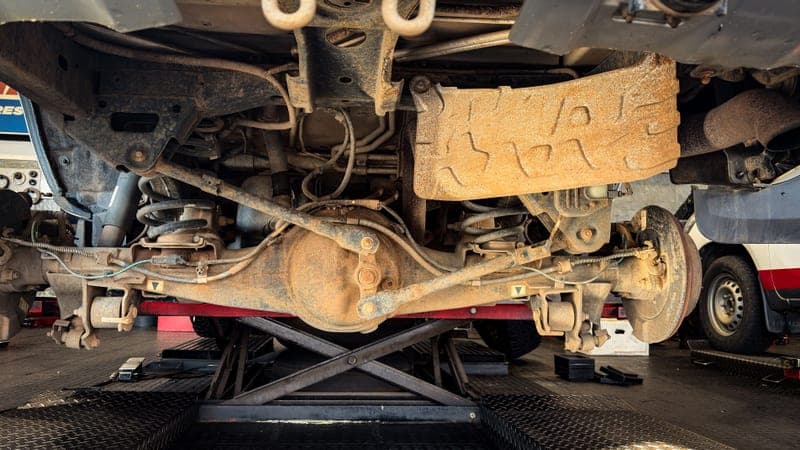
Close view of a car suspension assembly during a repair in a garage

2. First lifting purchase

BIG RED T43002A 3-Ton Double-Locking Jack Stands

Torin (BIG RED) · score 9.1/10

A ratchet bar plus a separate safety pin — two independent locks instead of one — at the height range a car actually needs, and Torin states they meet ASME safety standards.

Double locking, 11-1/4 in to 16-3/4 in, ASME compliance stated by Torin. Buy stands before a jack — you can lift with the scissor jack in your trunk, but you cannot support with it.

Published specifications

Capacity
3 ton (6,000 lb) per pair Torin
Min height
11-1/4 in Torin
Max height
16-3/4 in Torin
Base footprint
7-11/16 in x 6-7/8 in Torin
Standards
Meets ASME safety standards Torin

What works

  • Two independent locking mechanisms, not one
  • 11-1/4 in to 16-3/4 in matches what a 3-ton floor jack can reach
  • The cheapest way to buy a genuinely double-locked stand

What you give up

  • Rated per pair, not per stand — read the rating before loading two corners
  • 11-1/4 in minimum is taller than some low cars want
  • Torin's own listing says this size is not intended for SUVs or trucks

Our scoring

  • Fit & reach8.6
  • Safety margin9.2
  • Beginner ease9.0
  • Build quality8.2
  • Value9.4
Check price on Amazon

#ad No price shown — we have no live feed. How this is funded

Specifications published by Torin (BIG RED) — we earn nothing from that link.

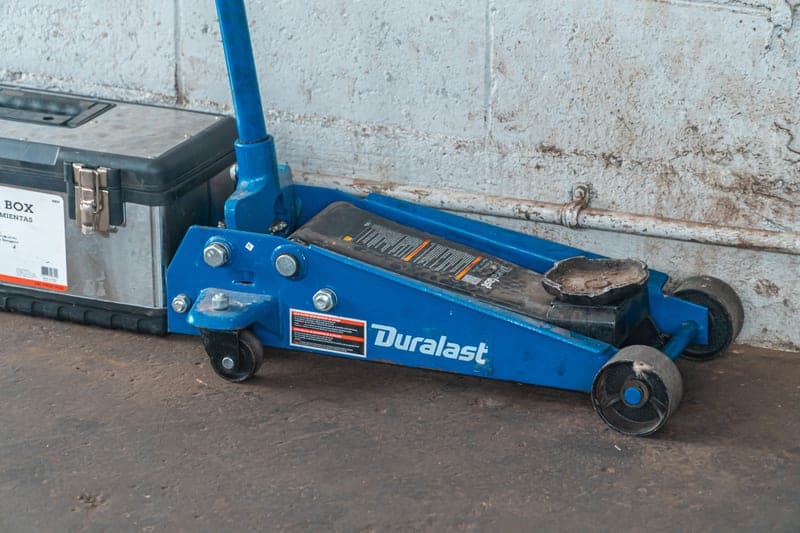
A blue hydraulic floor jack standing beside an open toolbox on a garage floor

3. First jack

Arcan 3-Ton Aluminum Floor Jack (A20018)

Arcan · score 9.0/10

A 3-ton aluminum service jack that slides under a stock sedan at 3.78 in and still reaches 18.9 in — the widest useful range a beginner can buy at one weight they can actually move.

3.78 in to 18.9 in, 52.91 lb of aluminum. Wide enough range to cover most household vehicles and light enough to move around.

Published specifications

Min saddle height
3.78 in Arcan Professional Tools
Max lift height
18.9 in Arcan Professional Tools
Material
Aluminum Arcan Professional Tools

What works

  • Fits under most unmodified sedans without ramps or boards
  • 18.9 in of lift clears a wheel on a crossover, not just a car
  • Aluminum keeps it at a weight one person can lift into a trunk

What you give up

  • Costs noticeably more than a steel jack of the same capacity
  • Arcan does not publish an ASME PASE compliance statement for this model
  • 52.91 lb is light for the class, not light in absolute terms

Our scoring

  • Fit & reach9.4
  • Safety margin8.8
  • Beginner ease9.0
  • Build quality8.8
  • Value8.0
Check price on Amazon

#ad No price shown — we have no live feed. How this is funded

Specifications published by Arcan — we earn nothing from that link.

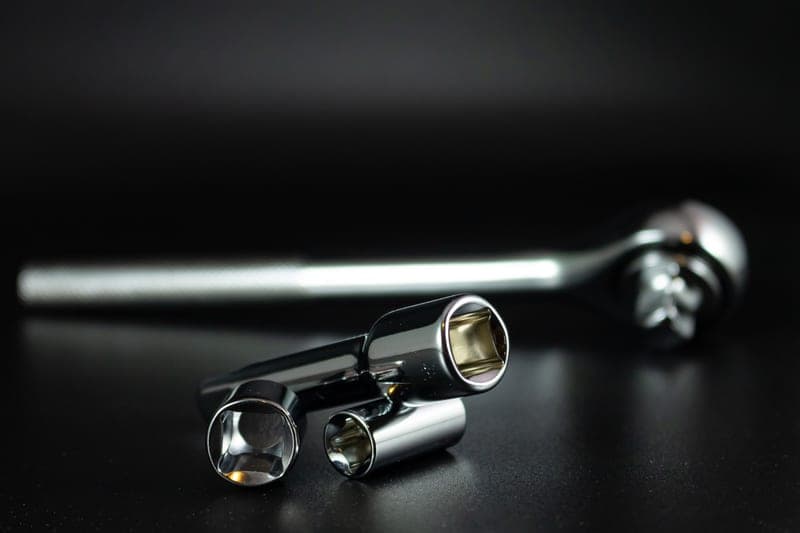
A chrome socket wrench set photographed against a dark background

4. First torque wrench

TEKTON 1/2 in Drive Micrometer Torque Wrench (TRQ52402)

TEKTON · score 8.9/10

40-200 ft-lb on a 90-tooth head covers every lug-nut spec a normal car will ask for, and it clicks loudly enough that a beginner can hear it.

40-200 ft-lb on a 1/2 in drive, which brackets almost every passenger-car wheel specification with the target mid-scale.

Published specifications

Drive
1/2 in TEKTON
Range
40 – 200 ft-lb TEKTON
Head
90-tooth, dual direction TEKTON
Included
Storage case TEKTON

What works

  • 40-200 ft-lb brackets the 80-100 ft-lb most cars want at the wheel
  • 90-tooth ratchet needs only a small swing in a wheel well
  • Loud, unambiguous click — the thing beginners most need

What you give up

  • TEKTON does not publish an accuracy percentage for this model
  • Cannot do low-torque work — the range starts at 40 ft-lb
  • Must be wound back to its lowest setting after every use

Our scoring

  • Fit & reach9.0
  • Safety margin8.4
  • Beginner ease9.2
  • Build quality8.4
  • Value9.2
Check price on Amazon

#ad No price shown — we have no live feed. How this is funded

Specifications published by TEKTON — we earn nothing from that link.

Method

How these picks were chosen

We did not test these tools. We do not run a laboratory, we have not loaded a jack to failure or checked a wrench on a calibration bench, and we will not tell you otherwise. What we did instead is read the published manufacturer specifications, check the figures that matter against the safety standard that applies to portable automotive lifting equipment, and work out which tool suits which job. Every number on this page links to where it came from, so you can check us.

The five things we score are the five that decide a first purchase: will it fit under and lift your car, how much safety margin the rating and the locking mechanism leave you, how hard it is to get right alone in a driveway, what the materials and published standards say about how long it lasts, and what the money buys against the rest of the field.

Read the full method — including how we pick a top pick, and why we publish no prices.

Questions

Frequently asked questions

+What car maintenance should a beginner do themselves?

Tire pressures, oil level and light checks need no tools and matter most. The first three jobs worth learning are an oil change, a wheel change, and brake pads — in that order.

+How often should I check my oil?

Monthly is a reasonable habit, plus before any long trip. Check on a cold engine with the car level. A level that consistently drops between checks is worth investigating rather than just topping up.

+What is the first tool a beginner should buy?

A tire pressure gauge, then a pair of jack stands and chocks. Stands before a jack, because you can lift with the scissor jack that came with the car but you cannot safely support with it.

+Should I do my own brake work?

Replacing pads is within reach for a careful beginner with the right tools — including, on many modern cars, a bidirectional scanner for the electronic parking brake. Opening the hydraulic system is a step further and worth help the first time.

+Where do I find my car's maintenance schedule?

In the owner's manual, and usually also in the manufacturer's online owner portal. That is the authority for intervals, fluid grades and capacities for your specific vehicle.

Sources

Where these figures come from

Read next

Related reading