


Skip to content
JACK & TORQUE

Roundup

Best Car Ramps

Capacity, approach angle, lift height. Get those three right and ramps are the easiest way to get under a car.

By Ryder M. · Published September 26, 2026 · Last reviewed September 26, 2026

We earn a commission when you buy through the Amazon links on this page, at no extra cost to you. It never changes which tool we put first, and we publish no price we have not verified. How this site is funded.

Best Car Ramps — ranked picks with scores and a price check for each
#PickCapacityScorePrice
1
A car at the entrance of a service station lit at night
RhinoGear RhinoRamps MAX (11912)Best first pair of ramps
16,000 lb GVW per pair8.9
2
Low-angle view of a low-slung sports car sitting close to the ground
Race Ramps RR-56-2 (56 in, Two-Piece)Best for low cars and most lift
1,500 lb per ramp (6,000 lb vehicle)8.8
3
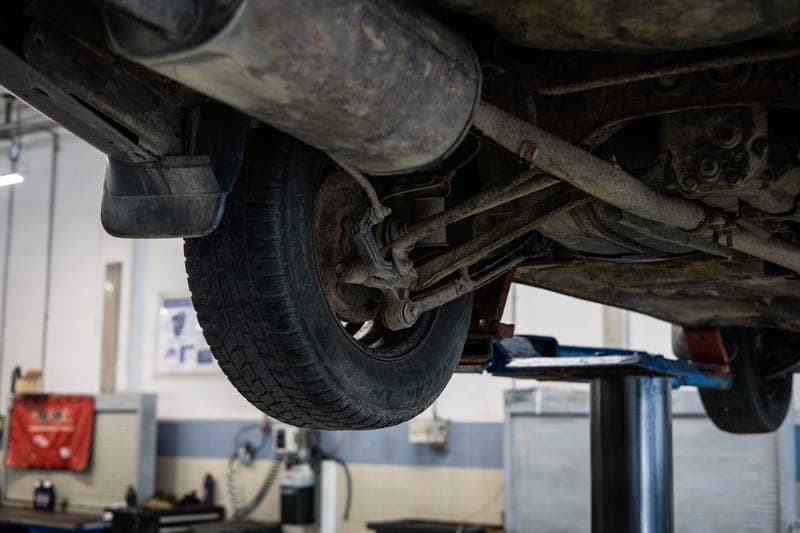
Close view of a car undercarriage at a service station
Black Widow Plastic Low-Profile Car Ramps (TS265)Best for getting a jack underneath
10,000 lb per pair8.2
4
Low sports cars parked in a modern automotive workshop
Black Widow Low-Profile Plastic Service Ramps (6009-V2)Best shallow angle on a budget
4,400 lb8.0

Photographs on this page are licensed stock images that show the category, not the exact model, and not anything we own. We have no test rig and claim none.

A car at the entrance of a service station lit at night

Ramps are the most under-recommended tool in a first home garage. For an oil change they are faster than a jack, simpler to use, and there is no hydraulic system to fail progressively while you are lying under the car. Drive up, secure the car, work.

They also have one absolute limit — the wheels stay on the ground — and that limit is the whole reason you cannot own only ramps.

The three specs that decide everything

Published specifications for the four ramps compared
RampCapacityApproach angleLift height
RhinoRamps MAX16,000 lb GVW per pair17 degreesNot published
Race Ramps RR-56-21,500 lb per ramp10.8 degrees8 in
Black Widow TS26510,000 lb per pair17 degreesUp to 3 in
Black Widow 6009-V24,400 lb9.05 degrees2-1/2 in
Published specifications for the four ramps compared

Capacity, quoted three different ways

This is the category's worst inconsistency. GVW for the pair, load per ramp, or total vehicle weight — all appear, and they are not interchangeable. RhinoRamps MAX at 16,000 lb GVW sounds vastly stronger than Race Ramps at 1,500 lb per ramp, but they are describing the limit from different directions. The conservative approach: find the most restrictive figure given, and compare it against the rating on your door-jamb sticker.

Approach angle, which is really about your bumper

A steeper ramp is shorter and cheaper. A shallower one is long, expensive and the only thing a low car can climb without dragging. If your car scrapes on driveway aprons or speed humps, buy for angle and treat everything else as secondary. Ramp angle and clearance shows how to check before you buy.

Lift height, which decides what you can do

Eight inches of lift is enough to work under a car comfortably. Three inches is enough to get a jack under it. Two and a half inches is enough to reach a drain plug on some cars and not others. Decide what job you are buying for before you compare prices.

The surface matters more than with a jack

A ramp works by not moving while a tire climbs it, and that depends on friction at its base. Clean dry concrete is easy. Dusty concrete, wet asphalt or gravel is not, and the classic incident is the ramp skidding away as the tire first touches it — which prompts a little more throttle and then a genuine problem.

A non-skid base helps genuinely; RhinoGear's CoreTRAC exists for exactly this. Sweeping the floor first helps as much and costs nothing.

Ramps are covered by the same standard as jacks

ASME PASE, currently the 2024 edition, explicitly covers automotive ramps alongside hand jacks and stands. None of the ramps above publishes a PASE compliance statement on its retail listing, which is worth knowing rather than worrying about — the standard applies to the product class whether or not a maker advertises compliance. Where a maker does publish one, we quote it.

Who should buy ramps at all

The short version

  • You want to do your own oil changes and nothing more — ramps are the whole answer
  • You want a fast way to get under the front of the car without hydraulics
  • Your car is too low for any affordable jack — short wedges plus a normal jack
  • You should NOT buy ramps expecting to do brakes, wheels or tires with them

If your list includes anything wheel-off, read car ramps vs jack stands before you buy either.

The picks in full

Every pick, in detail

A car at the entrance of a service station lit at night

1. Best first pair of ramps

RhinoGear RhinoRamps MAX (11912)

RhinoGear · score 8.9/10

16,000 lb GVW rating, a 17-degree incline and a non-skid base — the default answer for oil changes on anything that is not slammed.

16,000 lb GVW for the pair covers essentially any car, crossover or half-ton pickup, and the CoreTRAC non-skid base addresses the one failure mode people actually experience — the ramp sliding forward as the tire meets it. The 17-degree incline is the trade-off: fine for a normal car, too steep for a lowered one. They also nest for storage, which matters in a garage.

Published specifications

Capacity
16,000 lb GVW per pair Retail listing
Incline
17 degrees Retail listing
Base
CoreTRAC non-skid Retail listing
Material
Reinforced resin Retail listing

What works

  • GVW rating covers almost any car, crossover or half-ton pickup
  • Non-skid base is the feature that stops the classic ramp-slides-away scare
  • Nesting shape stores against a garage wall

What you give up

  • A 17-degree incline is too steep for low front bumpers
  • Ramps only ever support the front axle — wheels stay on
  • Resin ramps need a flat, clean surface to be trustworthy

Our scoring

  • Fit & reach8.4
  • Safety margin8.8
  • Beginner ease9.4
  • Build quality8.4
  • Value9.2
Check price on Amazon

#ad No price shown — we have no live feed. How this is funded

Specifications published by RhinoGear — we earn nothing from that link.

Low-angle view of a low-slung sports car sitting close to the ground

2. Best for low cars and most lift

Race Ramps RR-56-2 (56 in, Two-Piece)

Race Ramps · score 8.8/10

A 10.8-degree approach angle and 8 in of lift on solid high-density foam — the ramp for a car that scrapes on everything else.

A 10.8-degree approach angle and 8 in of lift, which is both the gentlest angle and the most height here. Solid high-density foam with an anti-slip coating, and the two-piece design lets you pull the ramp section away once the car is up for proper side access. The constraint is 1,500 lb per ramp for a 6,000 lb vehicle — check your front axle weight — and 56 in of ramp needs garage depth.

Published specifications

Capacity
1,500 lb per ramp (6,000 lb vehicle) Race Ramps
Approach angle
10.8 degrees Race Ramps
Lift height
8 in Race Ramps
Length
56 in Race Ramps
Material
Solid high-density foam, anti-slip coating Race Ramps

What works

  • Shallowest approach angle here — clears low front lips
  • Two-piece design lets you remove the ramp section for side access
  • 8 in of lift is more than any plastic ramp in this set

What you give up

  • 1,500 lb per ramp limits it to lighter vehicles — check your axle weight
  • 56 in of ramp needs real garage depth
  • By far the most expensive ramps here

Our scoring

  • Fit & reach9.6
  • Safety margin8.6
  • Beginner ease9.0
  • Build quality9.2
  • Value6.8
Check price on Amazon

#ad No price shown — we have no live feed. How this is funded

Specifications published by Race Ramps — we earn nothing from that link.

Close view of a car undercarriage at a service station

3. Best for getting a jack underneath

Black Widow Plastic Low-Profile Car Ramps (TS265)

Black Widow · score 8.2/10

3 in of lift from a 17.5 in ramp — not a service ramp, a way to get a low car high enough that a floor jack finally fits underneath.

Not really a service ramp: 3 in of lift from a 17.5 in wedge at 5 lb per ramp, rated 10,000 lb per pair. What it does is raise a low car just enough that an ordinary floor jack fits under the sill, which is a cheaper fix for the low-car problem than a specialist jack.

Published specifications

Capacity
10,000 lb per pair Retail listing
Lift height
Up to 3 in Retail listing
Loading angle
17 degrees Retail listing
Dimensions
17.5 in x 9.75 in x 3 in Retail listing
Weight
5 lb per ramp Retail listing

What works

  • Solves the low-car problem for jacks that need 3.5 in of clearance
  • 5 lb each — they live in a trunk, not a garage
  • Cheapest useful lifting aid on the site

What you give up

  • 3 in of lift is not enough to work under the car
  • 17-degree angle is steep for a very low bumper
  • Small footprint needs flat, clean ground

Our scoring

  • Fit & reach7.6
  • Safety margin8.0
  • Beginner ease9.2
  • Build quality7.8
  • Value9.4
Check price on Amazon

#ad No price shown — we have no live feed. How this is funded

Specifications published by Black Widow — we earn nothing from that link.

Low sports cars parked in a modern automotive workshop

4. Best shallow angle on a budget

Black Widow Low-Profile Plastic Service Ramps (6009-V2)

Black Widow · score 8.0/10

A 9.05-degree loading angle at 4-1/2 lb per ramp — the gentlest approach angle you can buy cheaply, at the cost of only 2-1/2 in of lift.

A 9.05-degree loading angle at 4-1/2 lb per ramp — gentler than ramps costing many times more. You pay for it in lift (2-1/2 in) and capacity (4,400 lb), so check your vehicle weight. Honeycomb channels stop water pooling in storage.

Published specifications

Capacity
4,400 lb Retail listing
Lift height
2-1/2 in Retail listing
Loading angle
9.05 degrees Retail listing
Dimensions
27-1/2 in x 7-3/4 in x 2-1/2 in Retail listing
Weight
4-1/2 lb per ramp Retail listing

What works

  • 9.05-degree angle is gentler than most ramps costing many times more
  • Honeycomb channels stop water pooling in storage
  • Light enough to carry in one hand

What you give up

  • 4,400 lb capacity is the lowest here — check your vehicle's weight first
  • 2-1/2 in of lift is a clearance aid, not a working height
  • Long and thin, so it needs a flat run-up

Our scoring

  • Fit & reach7.8
  • Safety margin7.4
  • Beginner ease9.0
  • Build quality7.6
  • Value9.0
Check price on Amazon

#ad No price shown — we have no live feed. How this is funded

Specifications published by Black Widow — we earn nothing from that link.

Method

How these picks were chosen

We did not test these tools. We do not run a laboratory, we have not loaded a jack to failure or checked a wrench on a calibration bench, and we will not tell you otherwise. What we did instead is read the published manufacturer specifications, check the figures that matter against the safety standard that applies to portable automotive lifting equipment, and work out which tool suits which job. Every number on this page links to where it came from, so you can check us.

The five things we score are the five that decide a first purchase: will it fit under and lift your car, how much safety margin the rating and the locking mechanism leave you, how hard it is to get right alone in a driveway, what the materials and published standards say about how long it lasts, and what the money buys against the rest of the field.

Read the full method — including how we pick a top pick, and why we publish no prices.

Questions

Frequently asked questions

+What capacity car ramps do I need?

Find the most restrictive published figure and compare it to your door-jamb sticker. If the ramp gives a per-ramp figure, compare it against roughly half your front axle rating. If it gives a GVW figure for the pair, compare against your gross vehicle weight rating.

+Can I do a brake job on car ramps?

No. Brakes mean taking a wheel off, and on ramps the wheel carries the car. Use a jack and stands.

+Are plastic car ramps strong enough?

Within their published rating, yes — 16,000 lb GVW is a common figure for reinforced resin. The difference from steel is margin for misuse: plastic tolerates point loading, uneven ground and crooked approaches less well.

+Do I need ramps if I already have a jack and stands?

Not strictly, but they make oil changes noticeably faster and involve no load transfer. Plenty of people own both and use the ramps far more often.

+Can I use car ramps on a gravel driveway?

It is the surface ramps handle worst — the base cannot grip and the load is concentrated. If gravel is all you have, see jacking up a car on gravel, which covers load spreading, and consider whether you can move the car to concrete instead.

Sources

Where these figures come from

Read next

Related reading