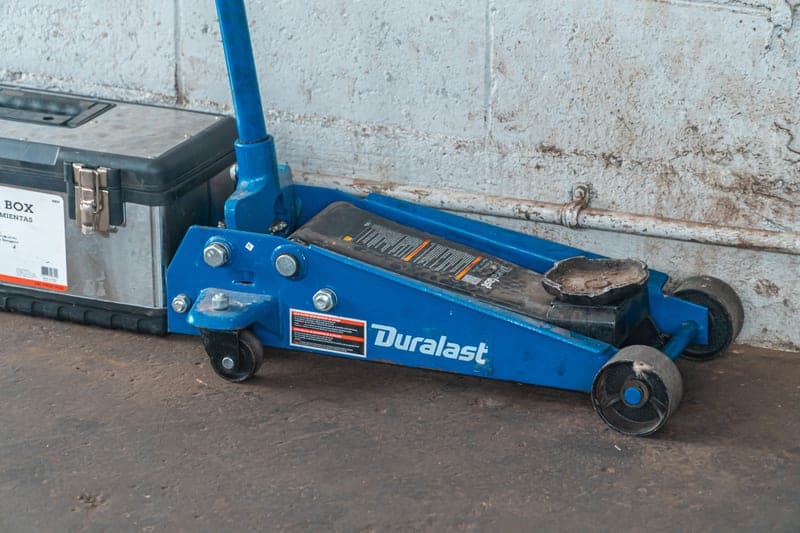

Short answer: buy a floor jack for a car and a bottle jack for a truck, van or anything with real ground clearance. A floor jack is thin enough to slide under a low vehicle and rolls to where you need it. A bottle jack is a vertical ram in a compact housing that lifts higher and stores smaller, but needs 11 in or so of clearance before it will even fit underneath. Capacity is not the deciding factor — both formats are sold at ratings far above what one corner of a car weighs.
The differences that matter
| Floor jack | Bottle jack | |
|---|---|---|
| Typical minimum height | 3.5 - 6 in | About 9 - 11 in |
| Typical maximum lift | 14 - 21 in | Often 18 - 21 in from a shorter body |
| Fits under a low car | Yes | No |
| Footprint in storage | Large, wheeled chassis | Small, stands upright |
| Positioning | Rolls, self-tracks as it lifts | Must be placed precisely, does not roll |
| Stability | Wide wheeled base | Narrow base, needs a flat lift point |
| Lift point needed | Sill or subframe | Flat, strong, usually a frame rail or axle |
When the floor jack wins
Any modern unibody car. The lift points are reinforced sections of the sill a few inches off the ground, and a bottle jack is simply too tall to get under them. The wheeled chassis also matters more than it sounds: as the lifting arm swings through its arc, the jack tracks slightly forward and back, and it needs to roll to do that. A bottle jack cannot, so it must be positioned exactly right and stay there.
A floor jack also gives you a much larger, more stable base. On a driveway with any imperfection at all, that is a meaningful advantage.
When the bottle jack wins
Trucks, vans, body-on-frame SUVs and trailers. These have the clearance to accept a bottle jack and often have a strong flat frame rail — exactly the lift point a bottle jack wants. You also get more lift from a much smaller object, which is why a bottle jack is the sensible thing to keep behind the seat of a pickup and a floor jack is not.
The Powerbuilt design above is worth singling out because it removes the bottle jack's biggest weakness. A plain bottle jack holds the load on hydraulics alone, and a hydraulic seal is not something to rest a truck on. An integrated locking bar means the load sits on steel, which is the same principle as a jack stand.
What beginners get wrong about this choice
Two things. First, they compare tonnage: a 6-ton bottle jack sounds far more serious than a 3-ton floor jack, when in fact neither is remotely near its limit lifting one corner of a car. Second, they assume a bottle jack is a compact floor jack. It is not — the narrow base and the requirement for a flat, strong lift point make it a genuinely different tool with different placement rules.
The case for owning both
If you have a car and a truck, you will end up with both, and they are cheap enough that this is not extravagant. The bottle jack lives in the truck as the roadside tool; the floor jack lives in the garage as the maintenance tool. If you have only a car, a floor jack plus stands is the complete answer and a bottle jack adds nothing.
For the third format people ask about — the scissor jack in the trunk — see floor jack vs scissor jack.