The tool that lifts the car. Two numbers decide whether it fits yours: how low it starts, and how high it reaches.
We earn a commission when you buy through the Amazon links on this page, at no extra cost to you. It never changes which tool we put first, and we publish no price we have not verified. How this site is funded.
Start here
Our top pick in this category
1. Best overall first jack
Arcan 3-Ton Aluminum Floor Jack (A20018)
Arcan · score 9.0/10
A 3-ton aluminum service jack that slides under a stock sedan at 3.78 in and still reaches 18.9 in — the widest useful range a beginner can buy at one weight they can actually move.
It wins because of the gap between two published numbers: 3.78 in at its lowest and 18.9 in at full lift. That range is wide enough to slide under a stock sedan and reach the sill of a crossover, which means one jack covers most of what a household actually parks. At 52.91 lb it is also light enough to move around a garage without resentment. It is not the cheapest jack here and Arcan does not publish an ASME PASE compliance statement for it, both of which we weigh below.
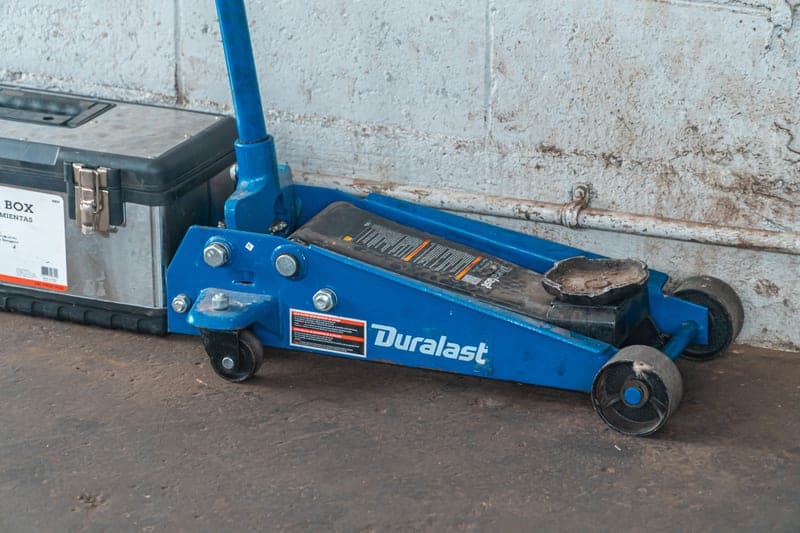
Photographs on this page are licensed stock images that show the category, not the exact model, and not anything we own. We have no test rig and claim none.
A floor jack is a wheeled hydraulic ram with a saddle on top. You slide it under a reinforced point on the car, pump the handle, and the car goes up. That is the whole idea, and it is genuinely simple. The part that trips up first-time buyers is that a jack which works beautifully on a neighbor's pickup may not physically fit under their own sedan, and no amount of capacity fixes that.
The four numbers that actually matter
Ignore the marketing copy on the box and read four figures. Every jack publishes them, and between them they decide whether the tool will work on your car in your driveway.
The four floor-jack specifications that decide a purchase
Spec
What it means
What to look for
Minimum height
How thick the jack is when fully lowered
Must be lower than your car's lift point clearance. Under 3.5 in for most sedans
Maximum lift
How high the saddle rises
14 in is fine for a car; an SUV or truck usually needs 18-21 in
Capacity
Rated load in tons
2 ton is enough for one corner of most cars; 3 ton buys headroom
Weight
How heavy the jack itself is
Aluminum ~50 lb, steel often more. You have to move it
The four floor-jack specifications that decide a purchase
Capacity is the figure people fixate on, and it is the least interesting. A jack only ever lifts one corner of the car at a time, so a 2-ton jack is not "half a car" short — it is carrying roughly a quarter of the vehicle's weight plus a margin. A 3,500 lb sedan puts under 1,000 lb on a single jack. We still recommend 3 ton for a first purchase, but the reason is headroom and stiffness under load, not arithmetic.
Minimum height is the spec that fails silently
Capacity errors are obvious — the jack will not lift. Fit errors are worse, because you only discover them once the jack is in your hands and the box is open. Measure before you buy. Park on flat ground, find the manufacturer's lift point under the sill, and measure the gap from the floor to that point. If the number is 4 in, a jack with a 5-7/8 in minimum height will never get under it, regardless of what it is rated to lift.
If your car is already too low for any jack you can afford, you are not stuck. A pair of shallow-angle ramps or low plastic wedges lifts the front wheels 2-3 in, which is usually enough to slide a normal jack underneath. That two-step approach is cheaper than buying a specialist low-profile jack.
Steel or aluminum
Steel is cheaper and takes abuse. Aluminum costs more and is light enough to lift into a trunk one-handed, which matters if the jack lives in a car rather than a garage. Both are strong enough — the load rating is the load rating, and the material does not change it. The real decision is whether you will be carrying it. We break the trade-off down in aluminum vs steel floor jacks.
What the standard covers
Portable automotive lifting equipment in the US is covered by ASME PASE, the Safety Standard for Portable Automotive Service Equipment, currently in its 2024 edition. It sets design, construction, marking and inspection requirements for hand jacks, automotive stands and ramps alike. Some manufacturers state compliance on the product page and some do not. Where a maker publishes a compliance statement, we quote it and link it. Where they do not, we say the statement is absent rather than implying one exists.
+−Is a 2-ton or 3-ton floor jack better for a first purchase?
Three ton, in most cases. A jack lifts one corner, so 2 ton is arithmetically sufficient for almost any car, but the 3-ton versions of the same model usually also reach higher and flex less under load. The exception is if weight or storage space is your binding constraint, in which case a 2-ton low-profile jack is a sensible choice.
+−Can I leave a car on a floor jack while I work?
No. A hydraulic jack is a lifting device, not a support device. The weight goes onto jack stands before you go under the car, every time. See how to jack up a car safely.
+−How do I know where to put the jack?
Your owner's manual shows the manufacturer's lift points, and on most unibody cars they are reinforced sections of the sill called pinch welds. Car jack points walks through how to find them and what to avoid.