Skip to content
JACK & TORQUE

Roundup

Best Automotive Multimeters

A scanner tells you which circuit is unhappy. A multimeter tells you why — if it is the right kind of meter.

By Ryder M. · Published September 28, 2026 · Last reviewed September 28, 2026

We earn a commission when you buy through the Amazon links on this page, at no extra cost to you. It never changes which tool we put first, and we publish no price we have not verified. How this site is funded.

Best Automotive Multimeters — ranked picks with scores and a price check for each
#PickKey capabilityScorePrice
1
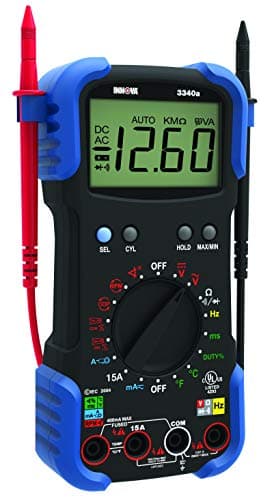
INNOVA 3340 Professional Automotive Multimeter, Amazon product photo
INNOVA 3340 Professional Automotive MultimeterBest automotive multimeter overall
10 MΩ9.0
2
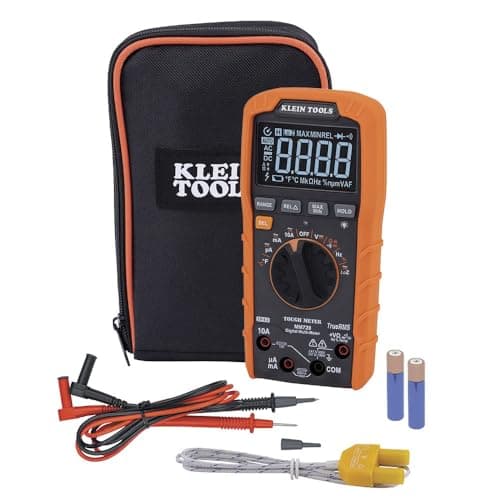
Klein Tools MM720 Auto-Ranging TRMS Multimeter, Amazon product photo
Klein Tools MM720 Auto-Ranging TRMS MultimeterBest published safety rating
CAT IV 600 V / CAT III 1000 V8.9
3
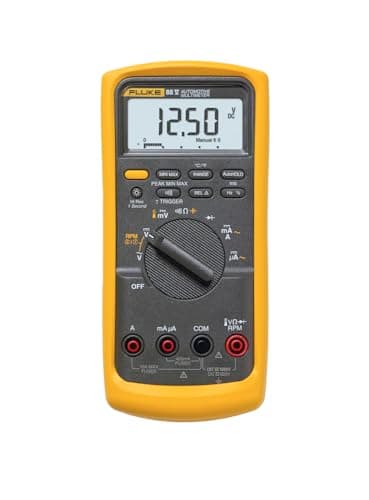
Fluke 88V Deluxe Automotive Multimeter, Amazon product photo
Fluke 88V Deluxe Automotive MultimeterBest buy-it-once meter
±(0.1% + 1)8.8
4
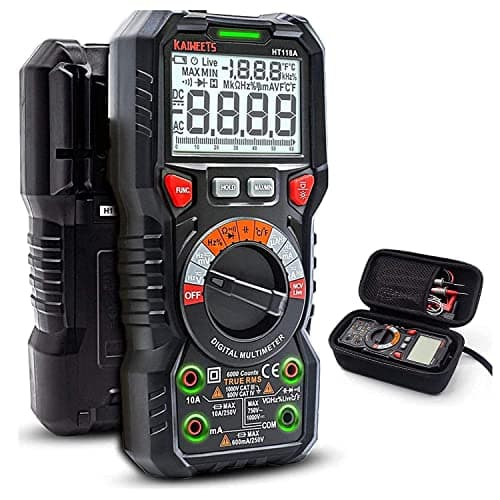
KAIWEETS HT118A True-RMS Digital Multimeter, Amazon product photo
KAIWEETS HT118A True-RMS Digital MultimeterBest budget true-RMS meter
CAT III 1000 V / CAT IV 600 V8.6
5
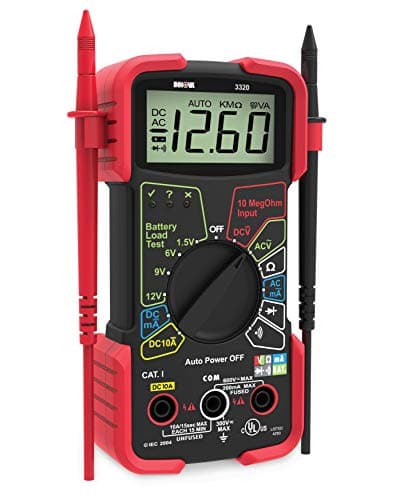
INNOVA 3320 Auto-Ranging Digital Multimeter, Amazon product photo
INNOVA 3320 Auto-Ranging Digital MultimeterCheapest meter that is still ECU-safe
10 MΩ8.4

Product photographs come from each product's own Amazon listing via the Associates program. They are the seller's images, not photographs of anything we own — we have no test rig and claim none.

INNOVA 3340 Professional Automotive Multimeter, Amazon product photo

An OBD2 scanner tells you which circuit the car is unhappy about. It does not tell you whether the sensor is dead, the connector is corroded, or the wire between them is broken — and that is the difference between replacing the right part and replacing three. A multimeter is what closes that gap, and it is the cheapest genuinely diagnostic tool you can own.

The catch is that most multimeters sold are not built with a car in mind, and one specification decides whether yours is safe to point at a modern vehicle at all.

The four specs that decide this purchase

1. Input impedance — the one not to compromise

A meter does not measure a circuit for free: it draws a small current to do it. On a household outlet that is irrelevant. On a five-volt sensor reference line being watched by an engine computer, a low-impedance meter loads the circuit enough to change the reading — and in the worst case to disturb what the ECU sees.

Ten megohms is the figure to look for, and Innova states it plainly for both of its meters here, describing it as safe for automotive use and intended to prevent damage to the vehicle's ECU. Fluke publishes the same 10 MΩ for the 88V, noting it "won't damage computer circuits". Klein and Kaiweets do not publish the figure at all — which does not make their meters low-impedance, but does mean you cannot check.

Published input impedance, where the manufacturer states it
MeterInput impedancePublished?
INNOVA 334010 MΩYes
INNOVA 332010 MΩYes
Fluke 88V10 MΩYes
Klein MM720Not publishedNo
KAIWEETS HT118ANot publishedNo
Published input impedance, where the manufacturer states it

2. What "automotive" actually adds

An automotive multimeter is a general meter plus a handful of functions that only make sense on an engine. They are worth paying for only if you will use them, so here is what each one is actually for:

Automotive-specific multimeter functions and what each is for
FunctionWhat it readsWhen you need it
RPM (inductive pickup)Engine speed, clamped around a plug lead or coilSetting idle, diagnosing a tachometer, checking a surge
DwellDistributor contact closure angleOlder ignition systems; largely historic on modern cars
Pulse widthHow long an injector or solenoid stays openFuel-mixture and injector behavior
Duty cyclePercentage of a cycle a signal is onIdle air valves, purge solenoids, variable-output sensors
TemperatureThermocouple probe readingCoolant, intake and brake temperatures
High current range15 A rather than the usual 10 AIn-line draw tests without popping the fuse
Automotive-specific multimeter functions and what each is for

If the honest answer is "I want to check battery voltage, chase a parasitic draw and test fuses and continuity", then none of those functions matter and a good general meter is the better buy. Be honest about which reader you are before spending on a dial you will never turn.

3. The CAT rating, and why a car barely needs one

CAT ratings describe how much transient energy a meter can survive on mains-powered circuits — CAT II for appliances, CAT III for distribution panels, CAT IV for the service entrance. A 12 V vehicle system is nowhere near that, so for pure automotive work the rating is close to irrelevant.

It becomes relevant the moment the meter leaves the garage. If the same tool will ever be pointed at a breaker panel or a wall circuit, buy the published rating: Klein publishes CAT IV 600 V / CAT III 1000 V and Kaiweets publishes CAT III 1000 V / CAT IV 600 V, while neither Innova meter carries a published rating and Fluke's own comparison table leaves the field blank for the 88V. Hybrids and EVs are a separate conversation entirely, and one we deal with below.

4. True RMS, and when it changes an answer

A cheap averaging meter assumes AC is a clean sine wave. True RMS measures what is actually there. On a car that matters less often than the marketing suggests, because almost everything you test is DC — but alternator ripple, PWM-driven fans and pumps, and anything you check on an inverter output are exactly the non-sinusoidal signals an averaging meter reads wrong.

Klein and Kaiweets publish true RMS here. It is not a reason to reject the Innova meters for 12 V work, and it is a reason to prefer TRMS if the meter is doing double duty.

What we did not measure

The four things a meter earns its money on

  1. 1.Battery state of charge, engine off

    The single most useful reading on the list. Meter on DC volts, probes on the battery terminals, engine off and the car sat for a while. This is the measurement that tells you whether a no-start is a battery problem before you buy anything.

  2. 2.Charging voltage, engine running

    Same probes, engine running. You are looking for the alternator actually raising system voltage above the resting figure and holding it steady. Your vehicle's service information gives the target range; we do not publish one, because it varies by vehicle.

  3. 3.Parasitic draw

    The meter goes in series in the current range — this is the test the 15 A range on the 3340 buys you headroom for — to find what is flattening a battery overnight. Innova publishes a walkthrough of this exact procedure, and it is worth reading the manufacturer's version before you start unplugging fuses.

  4. 4.Continuity and voltage drop

    Continuity confirms a fuse or a wire is intact. Voltage drop across a connector or a ground strap finds the corroded joint that continuity alone will happily call "fine". This pair is how you resolve most no-power complaints.

Scanner or meter first?

Scanner first, in almost every case. A scanner reads what the car has already noticed and costs about the same; a meter only helps once you know which circuit to point it at. Best OBD2 scanner for beginners covers that purchase, and scanner vs code reader sorts out which tier you actually need.

The pair is the point, though. A code names a circuit and a symptom; the meter tells you which end of that circuit is at fault. Owning both is the step where you stop replacing parts speculatively.

The short version

  • 10 MΩ input impedance is the spec not to compromise on around vehicle electronics
  • Automotive functions (RPM, dwell, pulse width) are only worth paying for if you will use them
  • CAT ratings barely matter on 12 V, and matter a lot if the meter also does house wiring
  • True RMS earns its keep on PWM circuits and alternator ripple, not on plain DC
  • Buy the scanner first; the meter is what makes the scanner's answer actionable

For where a meter sits in a wider first tool kit, see the beginner mechanic tool kit.

The picks in full

Every pick, in detail

INNOVA 3340 Professional Automotive Multimeter, Amazon product photo

1. Best automotive multimeter overall

INNOVA 3340 Professional Automotive Multimeter

Innova · score 9.0/10

The automotive functions are built in rather than bolted on: 10 MΩ input impedance to keep it away from your ECU, an included inductive RPM clamp that works on coil-on-plug engines, and 15 A of current range.

It wins because the automotive features are the reason to buy it rather than a sticker on the box. Innova publishes 10 MΩ input impedance — the spec that keeps the meter from loading a sensor circuit your ECU is watching — a 0 to 10,000 RPM range through an inductive clamp that is in the box and that Innova states works on coil-on-plug engines, and 15 A of current range where most meters stop at 10 A. Dwell, frequency, temperature, pulse width and duty cycle are all on the dial. Innova does not publish a CAT rating for it, so it stays on 12 V work.

Published specifications

Input impedance
10 MΩ Innova
RPM range
0 – 10,000 RPM Innova
Current range
Up to 15 A Innova
Automotive functions
RPM, dwell, frequency, temperature, pulse width, duty cycle Innova
Ranging
Auto-ranging, auto shut-off, overload protection Innova
In the box
Temperature probe, inductive RPM clamp, carrying case Innova

What works

  • 10 MΩ input impedance is the spec that keeps a meter off your ECU
  • Inductive RPM clamp is included, and Innova states it works on coil-on-plug engines
  • 15 A range covers more automotive draw tests than the usual 10 A meters

What you give up

  • Innova does not publish a CAT safety rating for it, so treat it as a 12 V tool
  • More meter than someone who only ever checks battery voltage needs
  • Automotive-specific features are wasted if you also want a house-wiring meter

Our scoring

  • Fit & reach9.4
  • Safety margin8.4
  • Beginner ease8.8
  • Build quality8.6
  • Value9.0
$99.99 · View on Amazon

#ad Price as of October 16, 2026. How this is funded

Specifications published by Innova — we earn nothing from that link.

Klein Tools MM720 Auto-Ranging TRMS Multimeter, Amazon product photo

2. Best published safety rating

Klein Tools MM720 Auto-Ranging TRMS Multimeter

Klein Tools · score 8.9/10

The only meter here with a CAT IV 600 V / CAT III 1000 V rating published on the manufacturer's own page, plus a 6.6 ft drop rating — a general-purpose meter that is safe well beyond the car.

The only meter on this page whose manufacturer publishes a CAT IV 600 V / CAT III 1000 V rating, which is what you want if the same meter will ever leave the garage and touch household wiring. True RMS, auto-ranging, and rated for a 6.6 ft drop — the failure mode a garage meter actually encounters. What it does not have is any automotive-specific function: no RPM, no dwell, no inductive pickup, and Klein publishes no input-impedance figure on the product page.

Published specifications

Safety rating
CAT IV 600 V / CAT III 1000 V Klein Tools
Ranging
Auto-ranging, true RMS Klein Tools
Measures
AC/DC voltage, AC/DC current, resistance, capacitance, frequency, duty cycle, temperature, diode, continuity Klein Tools
Ranges
1000 V AC/DC, 10 A AC/DC, 60 MΩ, 6000-count LCD Klein Tools
Drop rating
6.6 ft (2 m) Klein Tools

What works

  • Published CAT IV 600 V / CAT III 1000 V rating — the strongest safety claim on this page
  • True RMS, so AC readings stay honest on non-sinusoidal waveforms
  • Rated for a 6.6 ft drop, which is the failure mode a garage meter actually meets

What you give up

  • No RPM, dwell or inductive pickup — it is a general meter, not an automotive one
  • Klein does not publish an input-impedance figure on the product page
  • Costs more than the automotive-specific meters that do more car-shaped things

Our scoring

  • Fit & reach8.4
  • Safety margin9.6
  • Beginner ease8.8
  • Build quality9.2
  • Value8.4
$99.97 · View on Amazon

#ad Price as of October 16, 2026. How this is funded

Specifications published by Klein Tools — we earn nothing from that link.

Fluke 88V Deluxe Automotive Multimeter, Amazon product photo

3. Best buy-it-once meter

Fluke 88V Deluxe Automotive Multimeter

Fluke · score 8.8/10

±(0.1% + 1) DC voltage accuracy, 10 MΩ input impedance, temperature to 1090 °C and a limited lifetime warranty — the reference automotive meter, at a reference price.

±(0.1% + 1) DC voltage accuracy is the tightest published figure here, 10 MΩ input impedance keeps it ECU-safe, temperature runs to 1090 °C, and peak min/max catches events as short as 250 µs — which is how you find an intermittent fault rather than guess at one. The limited lifetime warranty genuinely changes the ten-year arithmetic. Two honest caveats: RPM needs the RPM80 pickup (part #880849), which the base meter does not include, and Fluke's own comparison table leaves the CAT rating blank for the 88V while listing one for other models.

Published specifications

DC voltage accuracy
±(0.1% + 1) Fluke
Input impedance
10 MΩ Fluke
Current range
10 A continuous; 20 A for up to 30 seconds Fluke
Temperature range
-200.0 °C to 1090 °C (1.0%, excluding probe) Fluke
Peak capture
Peak min/max down to 250 µs Fluke
Warranty
Limited lifetime Fluke

What works

  • ±(0.1% + 1) DC accuracy is the tightest published figure on this page
  • Peak min/max captures intermittent events as short as 250 µs
  • Limited lifetime warranty, which changes the cost arithmetic over a decade

What you give up

  • Fluke's comparison table leaves the CAT rating blank for the 88V while listing one for other models — check before using it outside a 12 V system
  • RPM needs the RPM80 inductive pickup (part #880849), which the base meter does not include
  • Several times the price of any other meter here

Our scoring

  • Fit & reach9.2
  • Safety margin8.8
  • Beginner ease8.2
  • Build quality9.8
  • Value6.8
$545.79 · View on Amazon

$659.99 17% off

#ad Price as of October 16, 2026. How this is funded

Specifications published by Fluke — we earn nothing from that link.

KAIWEETS HT118A True-RMS Digital Multimeter, Amazon product photo

4. Best budget true-RMS meter

KAIWEETS HT118A True-RMS Digital Multimeter

Kaiweets · score 8.6/10

True RMS, 6000 counts and a published CAT III 1000 V / CAT IV 600 V rating at the cheap end — the specification sheet most budget meters cannot match.

True RMS, 6000 counts, 600 V AC/DC, 10 A AC/DC, 60 MΩ resistance and a published CAT III 1000 V / CAT IV 600 V rating — a specification sheet that reads like a meter costing considerably more. The trade is that nothing on it is automotive-specific: no RPM, no dwell, no pulse width, and no published input-impedance figure. For checking battery voltage, chasing a parasitic draw and testing continuity, it is plenty.

Published specifications

Safety rating
CAT III 1000 V / CAT IV 600 V Kaiweets
Resolution
6000 counts, true RMS Kaiweets
Voltage / current
600 V AC/DC; 10 A AC/DC Kaiweets
Resistance
Up to 60 MΩ Kaiweets
Display
2.9 in backlit LCD Kaiweets
Extras
Non-contact voltage test with audible and visual alert Kaiweets

What works

  • Published CAT III 1000 V / CAT IV 600 V rating at a budget price
  • True RMS at a price point where averaging meters are the norm
  • 600 V ceiling and non-contact detection make it useful around the house too

What you give up

  • No RPM, dwell or pulse width — none of the automotive-specific functions
  • Kaiweets does not publish an input-impedance figure on the product page
  • 10 A ceiling limits the draw tests you can do in-line

Our scoring

  • Fit & reach8.0
  • Safety margin9.0
  • Beginner ease9.0
  • Build quality8.0
  • Value9.4
$41.23 · View on Amazon

$50.98 19% off

#ad Price as of October 16, 2026. How this is funded

Specifications published by Kaiweets — we earn nothing from that link.

INNOVA 3320 Auto-Ranging Digital Multimeter, Amazon product photo

5. Cheapest meter that is still ECU-safe

INNOVA 3320 Auto-Ranging Digital Multimeter

Innova · score 8.4/10

A UL-listed auto-ranging meter with the 10 MΩ input impedance that matters around vehicle electronics, for about as little as an automotive-specific meter costs.

Included because the cheapest sensible answer matters more than the cheapest answer. It is auto-ranging, it carries the same 10 MΩ input impedance as the meters above it, and it has a pulse-width function for ECM fuel-mixture checks — at roughly what a no-name meter costs. You give up the inductive RPM clamp, resolution drops to 4000 counts, and Innova publishes no CAT rating.

Published specifications

Input impedance
10 MΩ Innova
Current range
10 A DC Innova
Ranging
Auto-ranging, auto shut-off after 15 minutes Innova
Battery test
Color-coded LED load test for small batteries Innova
Safety
UL listed Innova
Protection
0.315 A / 250 V Bussmann GMA fuse, rubber corner guards, built-in stand Innova

What works

  • 10 MΩ input impedance at the bottom of the market — the one spec not to compromise
  • Auto-ranging, so there is one fewer thing to get wrong on a first use
  • Built-in stand and wrist strap, which matter when both hands are in an engine bay

What you give up

  • No inductive RPM clamp and no pulse width — those are the 3340's features
  • Innova publishes no display-count figure, so resolution is unstated
  • Innova publishes no CAT rating for it, so keep it on 12 V systems

Our scoring

  • Fit & reach8.2
  • Safety margin8.2
  • Beginner ease9.2
  • Build quality7.8
  • Value9.4
$35.38 · View on Amazon

#ad Price as of October 16, 2026. How this is funded

Specifications published by Innova — we earn nothing from that link.

Method

How these picks were chosen

We did not test these tools. We do not run a laboratory, we have not loaded a jack to failure or checked a wrench on a calibration bench, and we will not tell you otherwise. What we did instead is read the published manufacturer specifications, check the figures that matter against the safety standard that applies to portable automotive lifting equipment, and work out which tool suits which job. Every number on this page links to where it came from, so you can check us.

The five things we score are the five that decide a first purchase: will it fit under and lift your car, how much safety margin the rating and the locking mechanism leave you, how hard it is to get right alone in a driveway, what the materials and published standards say about how long it lasts, and what the money buys against the rest of the field.

Read the full method — including how we pick a top pick, and how prices get on the page.

Questions

Frequently asked questions

+What is the best multimeter for automotive use?

For car-specific work, the INNOVA 3340 — Innova publishes 10 MΩ input impedance, a 0 to 10,000 RPM range with the inductive clamp included, and a 15 A current range. If the meter also has to do household wiring, the Klein MM720 is the one here with a published CAT IV 600 V / CAT III 1000 V rating.

+Do I need a 10 megohm multimeter for cars?

You want one. A low-impedance meter draws enough current to change the reading on a low-power sensor circuit, and Innova describes its 10 MΩ input impedance as safe for automotive use and intended to prevent damage to the ECU. Fluke publishes the same figure for the 88V with the same reasoning.

+Is an automotive multimeter different from a regular one?

It is a regular meter plus engine-specific functions — RPM through an inductive pickup, dwell, pulse width, duty cycle, and often a higher current range. If you only need voltage, resistance, continuity and a draw test, a good general meter does the job.

+Does a multimeter need a CAT rating for car work?

For a 12 V system, the rating is close to irrelevant — CAT ratings describe survivable transients on mains circuits. It matters if the same meter will ever touch household wiring, and neither Innova meter here carries a published rating.

+Can I use a multimeter on a hybrid or electric car?

Not on the high-voltage system. The orange cables carry hundreds of volts DC and require equipment and training specific to that work. None of the meters on this page is sold as the answer to high-voltage service; the 12 V systems on the same vehicle are ordinary work.

+Do I need a multimeter if I already have an OBD2 scanner?

They answer different questions. The scanner tells you which circuit the car flagged; the meter tells you whether the sensor, the connector or the wire is at fault. Buy the scanner first, then the meter when you want to stop replacing parts speculatively.

Sources

Where these figures come from

Read next

Related reading