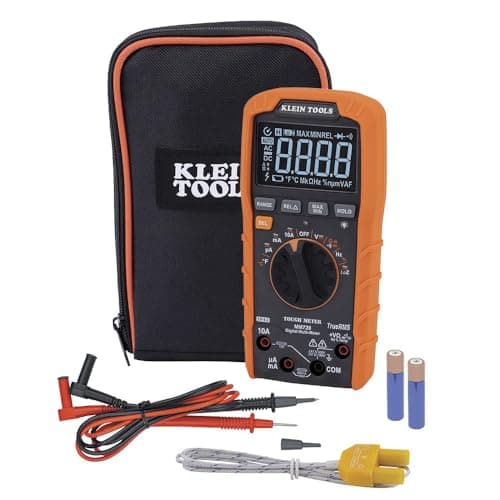
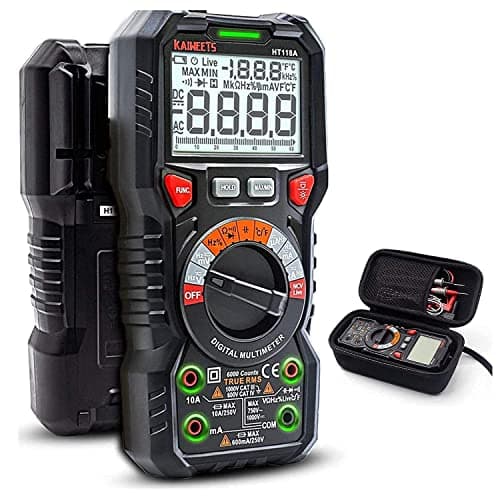
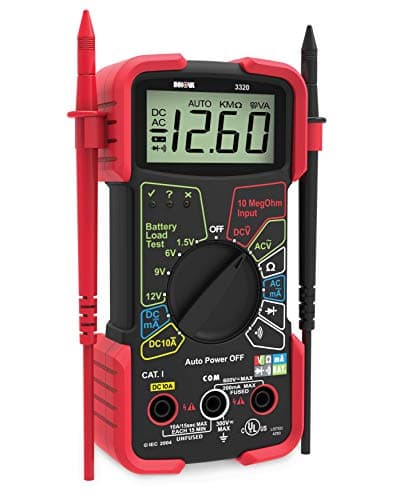
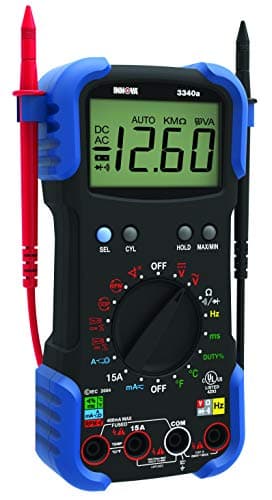
Verdict first: the Innova 3340 is the best Fluke alternative for car work - it matches the 88V's published 10 MΩ input impedance and adds RPM, dwell, pulse width and duty cycle functions the 88V does not bundle a clamp for, at a small fraction of the price. If what you valued was ruggedness, the Klein MM720 publishes CAT IV 600 V and a 6.6 ft drop rating. If it was true RMS, the KAIWEETS HT118A has it for very little. The budget pick is the Innova 3320: the cheapest meter here that still publishes 10 MΩ and is therefore safe on an ECU circuit.
Where the alternatives match it
On input impedance, exactly. Fluke publishes 10 MΩ on the 88V; Innova publishes 10 MΩ on both the 3340 and the 3320. That is the figure that decides whether a meter can be put across a sensor or control circuit without loading it, and it is the reason an old low-impedance meter is the wrong tool for a modern car. A $30 meter that publishes 10 MΩ is as safe on an ECU circuit as a $500 one that publishes the same figure.
On automotive functions, the Innova 3340 arguably goes further. Fluke publishes a wide temperature range and peak capture; Innova publishes RPM to 10,000 via an included inductive clamp, plus dwell, frequency, pulse width and duty cycle, and ships the temperature probe and clamp in the box. For ignition and injector work on a running engine, the clamp is the difference between a measurement and a guess.
Where they do not match it
Three places, and they are real. First, accuracy: ±(0.1% + 1) on DC volts is a tighter specification than any alternative here publishes, and if you are chasing millivolt voltage drops across a connector, that resolution is the job. Second, peak capture to 250 µs: catching a transient that lasts a quarter of a millisecond is a capability none of the meters below claims, and it is how an intermittent sensor glitch gets caught. Third, the limited lifetime warranty - nothing on this page offers an equivalent, and for a tool bought once in a working life that is not a trivial difference.
If any of those three is actually your use case, buy the Fluke. We earn a commission on it exactly as we do on the alternatives, and saying so is cheaper than pretending a $35 meter does something it does not.
The 88V against the alternatives, on published figures
| Meter | Input impedance | DC accuracy | Safety rating | Automotive functions |
|---|---|---|---|---|
| Fluke 88V | 10 MΩ | ±(0.1% + 1) | Not listed here | Peak capture to 250 µs, temp to 1090 °C |
| Innova 3340 | 10 MΩ | Not published | Not published | RPM, dwell, pulse width, duty cycle |
| Klein MM720 | Not published | Not published | CAT IV 600 V / CAT III 1000 V | None specific |
| KAIWEETS HT118A | Not published | Not published | CAT III 1000 V / CAT IV 600 V | Non-contact voltage test |
| Innova 3320 | 10 MΩ | Not published | UL listed | Battery load test |
Column one is the automotive safety column and three meters tie on it. Column two is the one the Fluke wins outright, and the only one where the alternatives have nothing to say - none of them publishes a DC accuracy figure on the pages we can read, and we have not supplied one on their behalf.
The order that actually saves money
A meter is the second diagnostic purchase. The scanner reads the code and tells you which circuit the car is complaining about; the meter tells you whether the component, its ground or its wiring is at fault. Buying a premium meter before a scanner means measuring excellent values on the wrong circuit. Best OBD2 scanners is the first purchase, best automotive multimeters under $100 is the price-capped version of this page, and beginner mechanic tool kit puts both in order.
What we would buy
The Innova 3340 for a home garage, because it matches the 88V on input impedance and beats it on bundled automotive functions for a small fraction of the money. The Klein MM720 if the meter will also see household wiring and gets treated roughly. The KAIWEETS HT118A if true RMS at the lowest price is the point. The Innova 3320 if you want the cheapest thing that is still safe on a control circuit. And the Fluke 88V itself if millivolt accuracy, 250 µs peak capture or a lifetime warranty is genuinely what you are buying - in which case none of the above is a substitute.