
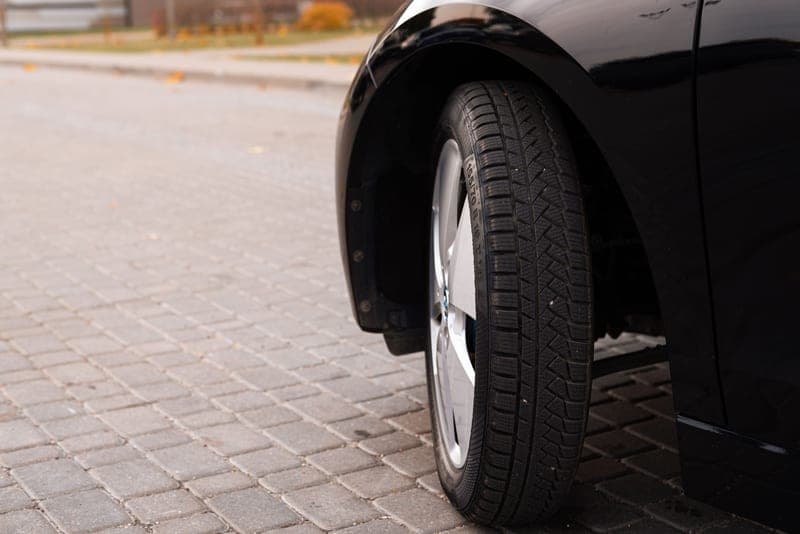
Short version: a wheel chock is a wedge you put against a tire so the car cannot roll. It is the cheapest item in a home garage, it takes two seconds to place, and it is the layer of protection most commonly left out — usually because the parking brake feels like enough. It is not, for a specific mechanical reason.
Why the parking brake is not a substitute
On most cars the parking brake acts on the rear wheels only. That leaves three situations where it does nothing useful:
- Rear wheels off the ground. If you have lifted the rear, the braked wheels are in the air and the brake is holding nothing.
- Rear brake work. You have to release it to service the very components it acts on.
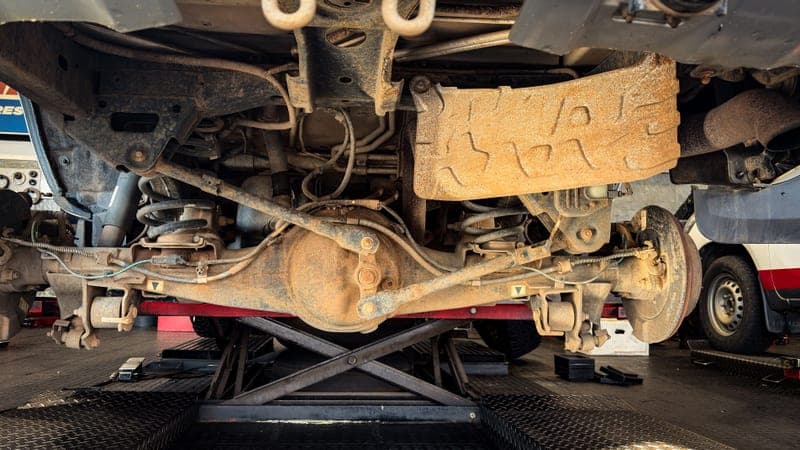
- A car on ramps. The front is up, the rears are on the ground, and a parking brake is being asked to hold a vehicle on an effective incline — which is not what it is rated for.
A chock is mechanical, works regardless of which wheels are in the air, and costs almost nothing.
Where the chock goes
| Situation | Chock where | How many |
|---|---|---|
| Lifting the front on a jack | Against a rear tire | One minimum, two preferred |
| Lifting the rear on a jack | Against a front tire | Two — front wheels can steer |
| Car on ramps (front up) | Behind a rear tire | Two, one each side |
| Any slope at all | Downhill side of both ground wheels | Two |
| Loose surface (gravel, dirt) | Both ends if possible | Two, plus reconsider the location |
The rule of thumb: chock the wheels that are staying on the ground, on the side the car would roll toward. On a nominally flat garage floor, there is almost always a slight fall — chock the downhill side.
What to buy
For car work, a molded plastic or rubber chock sized for passenger tires is all you need. Two features are worth having:
- A pull rope or handle. This is a genuine safety feature, not a convenience: retrieving a chock from behind a wheel otherwise means putting a hand under the car, which is exactly what you have been avoiding.
- UV-stable material. Chocks live in garages, get left outside, and cheap plastic goes brittle. Camco specifies UV inhibitors for this reason.
What you do not need is a truck or trailer chock. They are heavier, larger, and rated for loads a car does not produce — Camco explicitly states its car-sized chock is not for commercial trucks or trailers, and the reverse mismatch is just bulk you do not need.
Improvising, and its limits
A brick or a wood offcut against a tire is better than nothing and worse than a chock, for two reasons: the shape is wrong, so it does not wedge progressively, and it slides on a smooth floor rather than gripping. If you are using wood as a stopgap, use a substantial piece with a sawn angle on it, and accept that this is the item you should be replacing first given it costs so little.
What is never acceptable is using a chock as a substitute for a jack stand. They do different jobs: a chock stops rolling, a stand carries weight.
Two other genuinely useful uses
- Holding a wheel off the floor. Once a wheel is removed, it makes a tidy job of stopping it rolling across the garage — and a spare chock is better than the wheel resting against your ankle.
- Marking your position on ramps. A chock placed against the rear tire when the car is correctly positioned on ramps makes repeating the position trivial next time.