Short answer: a bicycle needs a wrench that starts at 2-5 Nm, and an automotive torque wrench does not. A typical carbon stem bolt is 5 Nm, which is 3.7 ft-lb — below the 10 ft-lb floor of the smallest click wrench in a normal tool kit, and far below the 40 ft-lb floor of a lug-nut wrench. Using one anyway is not measuring; it is guessing with a heavier tool.
Why this matters more on a bike than a car
Cars are made of steel and the fasteners are large. Bicycles are increasingly made of carbon fiber, and a carbon seatpost or handlebar clamped past its spec does not bend — it crushes and then fails later, often without warning. The manufacturer's number printed next to the bolt is a maximum for a reason, and hitting it accurately is the entire job.
Published ranges, side by side
| Tool | Range | Increment | Accuracy |
|---|---|---|---|
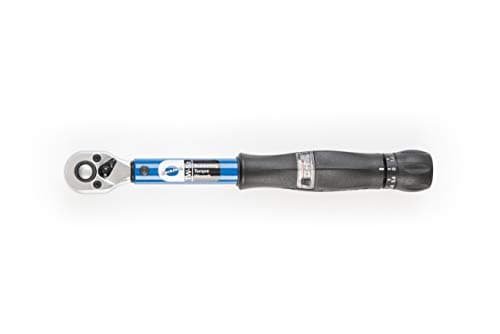
| Park Tool TW-5.2 | 2 – 14 Nm | 0.2 Nm | +/- 4% |
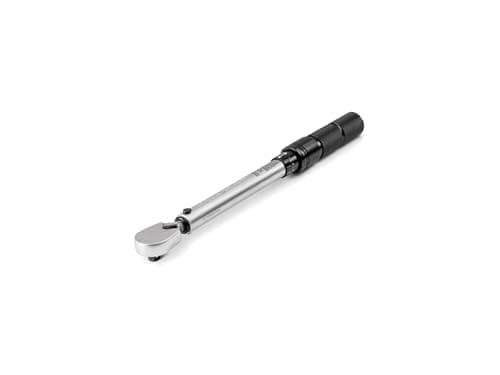
| TEKTON TRQ50402 | 20 – 200 in-lb (2.3 – 22.6 Nm) | 1 in-lb | +/- 3%, ISO 6789-1 / ASME B107.300 |
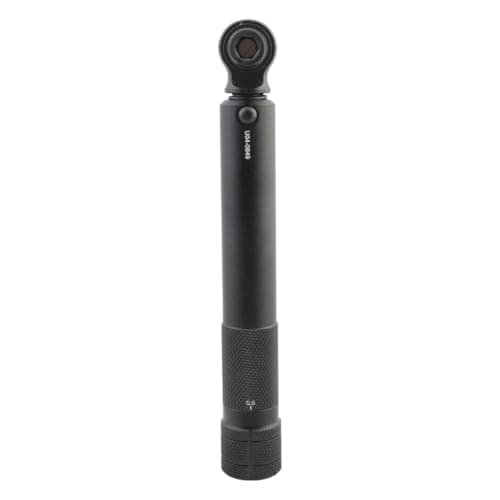
| Topeak Torq Stick | 2 – 10 Nm | Adjustable | +/- 4% |
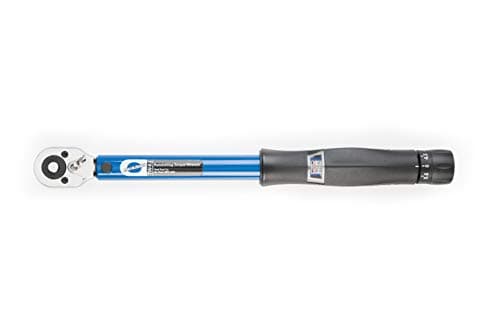
| Park Tool TW-6.2 | 10 – 60 Nm | 0.25 Nm | +/- 4% |
Which one you actually need
If you buy one tool
Buy something that covers 2-14 Nm. That single band handles almost everything you will touch on a modern bike, and the fasteners it misses are the ones you touch least often.
If you buy two
Add a 10-60 Nm wrench for bottom brackets, cassettes and cranks. Note the overlap at 10-14 Nm is deliberate and useful — you want the fastener somewhere in the middle of a wrench's range, not at the very end of it, because accuracy claims are weakest at the extremes.
If you only touch carbon clamps
A preset driver is the least error-prone option available, because there is no scale to misread and no collar to leave wound up.
Nm, in-lb and the conversion that trips people up
Bicycles are specified in newton-meters almost universally. Automotive wrenches sold in the US are usually marked in foot-pounds or inch-pounds. One Nm is about 8.85 in-lb, and 1 ft-lb is about 1.36 Nm. The failure mode is reading a 5 Nm spec on a foot-pound scale and applying 5 ft-lb, which is 6.8 Nm — around 36% over. If your wrench is not marked in Nm, write the converted number down before you pick the tool up.
Can you use your car wrench on a bike?
For a small number of high-torque fasteners, yes — a 3/8 in wrench starting at 10 ft-lb (13.6 Nm) will do a cassette lockring. For everything below that, no, and it is not a matter of care. The wrench physically cannot be set to the number. The main torque wrench roundup shows where the automotive ranges start.