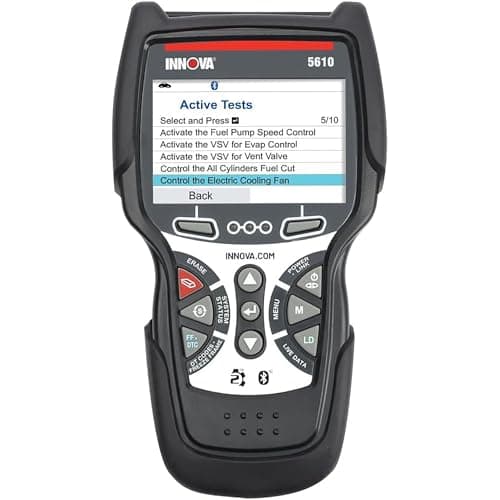
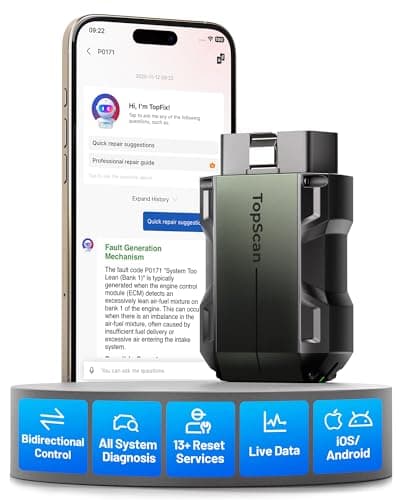
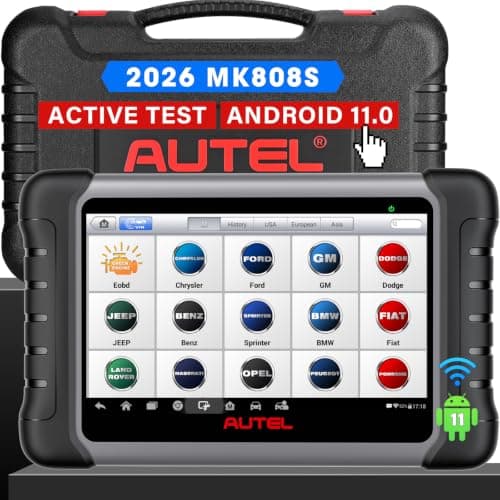
Top pick: the Autel MaxiCOM MK808S, because it is a self-contained tablet that performs bidirectional active tests across all available systems and publishes its service-function list. Bidirectional — also called active test or actuation — means the tool can send a command to a component and make it do something: cycle an ABS solenoid, run a cooling fan, retract an electric parking brake. A code reader can only ask the car what it has already recorded.
The three tools side by side
| Scanner | Format | Bidirectional | Updates |
|---|---|---|---|
| Autel MaxiCOM MK808S | 7 in Android tablet | Yes - active tests, all available systems | Not published here |
| Innova 5610 CarScan Pro | Handheld | Yes - engine, transmission, ABS, SRS | Free, no subscription |
| TOPDON TopScan Pro | Bluetooth dongle + phone | Yes - bi-directional control | Not published here |
All three publish bidirectional capability, which is the entry requirement for this page. Where they differ is format and longevity. The tablet is the tool you reach for when the job is long; the handheld is the one that still works in five years without a subscription; the dongle is the one that lives in the glovebox.
What bidirectional actually buys you
The short version
- Testing a component without removing it. Command the fan, the fuel pump or the EGR valve and watch whether it responds - that is a five-minute answer to a question that otherwise takes an hour.
- Retracting an electric parking brake before a rear brake job. On many modern cars this is not optional; the caliper will not open without it.
- Service resets after the work: oil service, steering angle, battery registration. These are commands, not readings.
- Separating 'the part is dead' from 'the part is not being told to move'. Without actuation you are guessing which side of the wire the fault is on.
That second point is the one that pushes beginners into this category. If your car has an electric parking brake and you want to do your own rear brakes, a reading scanner is not enough. The brake job wrench page covers the other half of that job.
Bidirectional is not the same as enhanced reading
These two get conflated constantly. Enhanced reading means a scanner can see manufacturer-specific systems beyond the legislated engine data — ABS codes, SRS codes, transmission data. Bidirectional means it can command those systems. A tool can do the first without the second, and plenty do.
If what you actually need is to read an ABS or airbag code rather than actuate anything, the ABS and SRS roundup is the cheaper answer, and bidirectional vs basic sets out the capability ladder in full.
Actuation deserves more respect than reading
The practical rule: read first, understand the fault, then actuate to confirm. Using actuation as an exploratory tool on a car you do not know is how people end up with a second problem. How to use an OBD2 scanner covers the reading half properly.
Who should not buy one
If your reason for owning a scanner is a check-engine light once a year, this is the wrong category and the money is better spent elsewhere. A code reader costs a fraction as much, does the job, and has nothing to go wrong. The beginner roundup and the budget roundup are both more honest starting points.
Buy bidirectional if you intend to do brake work on a car with an electric parking brake, if you want to diagnose rather than replace, or if you are the person your family brings cars to. Those are the three cases where actuation pays for itself.
What we would buy
The Autel MK808S if you want one tool that does everything and you would rather hold a tablet than a phone. The Innova 5610 if free updates and US and Canada coverage matter more than the screen — the long-term cost of ownership is the lowest here. The TOPDON TopScan if you want active tests in a dongle you can keep in the car, and you accept that the app is the product.