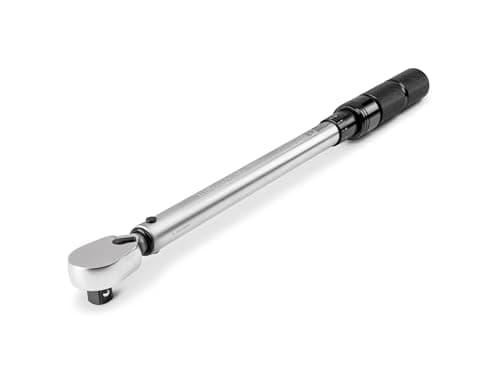
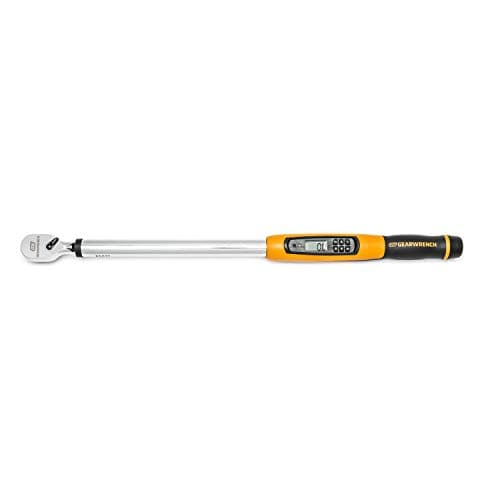
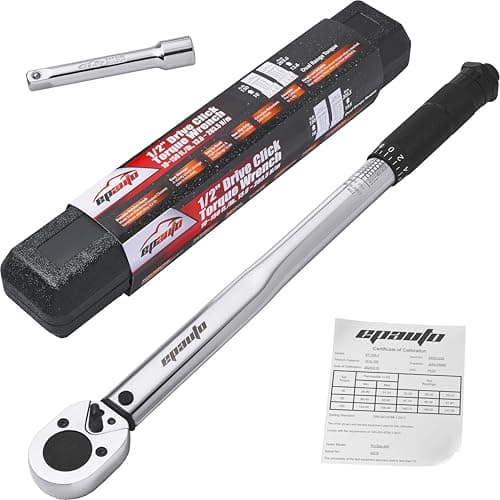
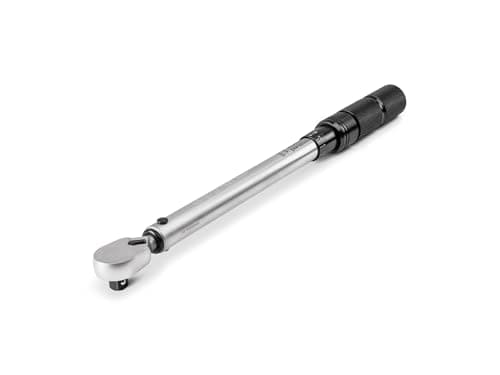
Short answer: a brake job needs two torque figures that are far apart. Caliper bracket bolts commonly sit in the 15-45 ft-lb band and lug nuts in the 80-100 ft-lb region on most passenger cars, so the honest recommendation is a 3/8 in wrench for the caliper hardware and a 1/2 in wrench for the wheels. If you want one tool, the GEARWRENCH 85077 covers 25-250 ft-lb and is the only wrench here that publishes an accuracy figure; the EPAuto covers 10-150 ft-lb for far less money and publishes a manual claim rather than a certificate.
Why one wrench usually is not enough
The classic beginner purchase is a 1/2 in drive click wrench with a 40-200 ft-lb range, because that is what the lug-nut advice points at. Then the first brake job arrives, the service manual says the caliper bracket bolts are 30 ft-lb, and the wrench will not go that low. Winding a 40 ft-lb wrench down below its scale does not produce a 30 ft-lb reading — it produces nothing usable at all.
| Fastener | Typical range | Which wrench reaches it |
|---|---|---|
| Caliper guide pin / slide bolts | Commonly 20-35 ft-lb | 3/8 in, GEARWRENCH, EPAuto |
| Caliper bracket to knuckle | Commonly 60-100 ft-lb | Any of the four |
| Brake hose banjo bolt | Commonly 15-25 ft-lb | 3/8 in or EPAuto |
| Wheel lug nuts | Commonly 80-100 ft-lb | 1/2 in, GEARWRENCH, EPAuto |
The ranges in the middle column are the bands these fasteners commonly fall in across passenger cars — they are orientation, not a specification. The point of the table is the right-hand column: the spread from a banjo bolt to a lug nut is wide enough that a single 40-200 ft-lb wrench misses most of it.
What the four wrenches publish
| Wrench | Drive | Range | Published accuracy |
|---|---|---|---|
| TEKTON TRQ51402 | 3/8 in | 10 - 100 ft-lb | Not published |
| TEKTON TRQ52402 | 1/2 in | 40 - 200 ft-lb | Not published |
| GEARWRENCH 85077 | 1/2 in | 25 - 250 ft-lb | +/-2% CW, +/-3% CCW |
| EPAuto 1/2 in click | 1/2 in | 10 - 150 ft-lb | Pre-calibrated to 4% |
"Not published" is a fact about the manufacturer's page, not a claim that the wrench is inaccurate. It does mean that if published accuracy is the thing you are buying, there is exactly one wrench here that sells it — and the GEARWRENCH warrants its calibration for 90 days, which is worth reading before you assume the spec is permanent. See how to check torque wrench calibration.
The order the job happens in
1.Crack the lug nuts on the ground
Use a breaker bar, never the torque wrench. Loosening a seized fastener with a click wrench is the fastest way to put it out of calibration. See torque wrench vs breaker bar.
2.Lift and support the car
Jack at a rated point and lower onto stands before the wheel comes off. A brake job is wheel-off work, so ramps cannot do it.
3.Torque the caliper hardware to specification
Look the figure up for your car, set the 3/8 in wrench, and stop at the click. Caliper slide bolts in particular are small fasteners into aluminum on many cars, and over-tightening strips them.
4.Refit the wheel and snug the nuts in a crisscross pattern
By hand first, in a star pattern, with the wheel still off the ground. This seats the wheel flat against the hub before any torque is applied.
5.Lower the car and torque the lug nuts
Full torque only with the weight on the wheels, crisscross, in the right sequence.
6.Re-torque after 50-100 miles
Standard guidance from wheel manufacturers, and it costs two minutes. Wind the wrench back down to its lowest setting before it goes in the case.
What we would buy
If you are buying one wrench and brakes are the reason, buy the EPAuto and accept its limits, or the GEARWRENCH if the budget stretches and you want a published spec with an alert before target. If you are buying for the long run, buy the 1/2 in TEKTON first for wheels and add the 3/8 in when the first brake job comes up — that pair covers everything a home garage asks for, with each wrench working in the middle of its scale rather than at the edge. The main roundup has the full field, and what size torque wrench do I need works through drive sizes properly.