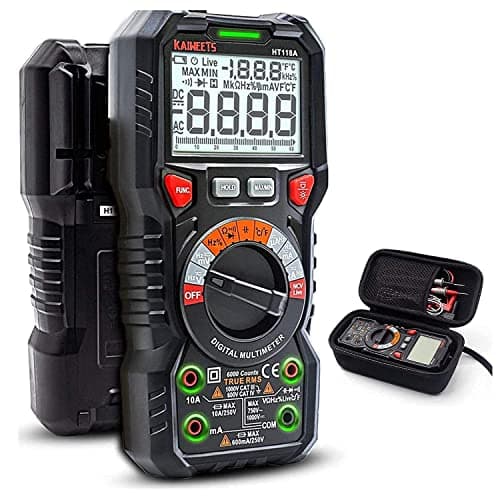
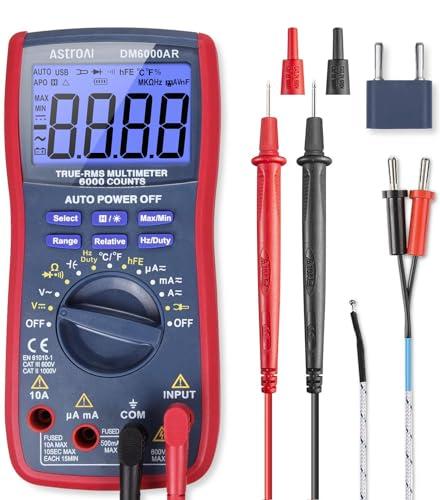
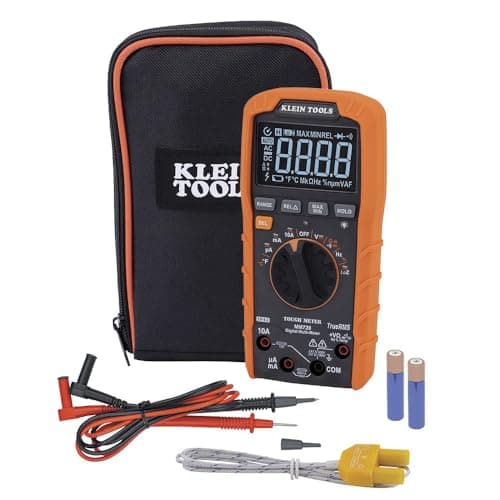
Short answer: the Klein Tools MM720 is the best true-RMS multimeter we cover, because it is the only one pairing a true-RMS claim with a full CAT IV 600 V / CAT III 1000 V rating and a 6.6 ft drop rating on the maker's own page. The KAIWEETS HT118A gets you a published CAT rating and true RMS for well under half the money, which makes it the value answer. The budget pick is the AstroAI AST-6000-D: the cheapest true-RMS meter here, with two named fuse ratings and no published safety rating at all. Before you buy any of them, read the next paragraph - because on a car, true RMS is probably not the spec you should be shopping for.
What we judged these on
1. Whether the true-RMS claim is actually published
All three, which is why they are the three on this page. Klein publishes "true RMS" alongside auto-ranging on the MM720. Kaiweets publishes 6000 counts and true RMS on the HT118A. AstroAI's listing states true RMS for measuring both AC current and voltage. Every other meter in our registry is either silent on the question or publishes nothing to support it, and we do not read the spec into an entry that fails to state it - which is exactly why this page has three picks rather than five.
2. The CAT rating, because that is what true RMS implies you will do
If you are buying true RMS you are probably planning to use the meter somewhere other than a car battery, and that is where a CAT rating stops being theoretical. Klein publishes CAT IV 600 V / CAT III 1000 V on its own page. Kaiweets publishes CAT III 1000 V / CAT IV 600 V. AstroAI publishes no CAT rating at all - it names its fuses instead, which is a different and lesser kind of protection claim. That ordering is most of this page's ranking, because it is the axis on which the three genuinely differ. Best multimeter brands for car work shows how rarely one brand publishes both the impedance figure and the CAT rating.
3. Counts, and what resolution buys you
Klein, Kaiweets and AstroAI all publish 6000 counts, so this axis is a tie - which is itself informative, because 6000 counts has clearly become the floor at this end of the market rather than a selling point. What it means in practice is a reading to four significant figures on most ranges, which is more resolution than any 12 V diagnosis needs. Do not pay for counts on a car meter; pay for the safety rating and, if you can get it, the impedance figure.
4. What the maker says about fuses
The least glamorous axis and the one that saves the meter. Current mode puts the meter in series with the circuit, and touching the probes across a battery in that mode is a dead short through the internal fuse - so a maker willing to name the fuse is telling you what to buy when you inevitably do it. AstroAI names both: F400mA/600 V and F10A/600 V ceramic fuses. Klein and Kaiweets publish anti-burn and overload wording without naming the parts. It is the one column the cheapest meter here wins outright.
The three on published specification
| Meter | CAT rating | Counts | Input impedance |
|---|---|---|---|
| Klein Tools MM720 | CAT IV 600 V / CAT III 1000 V | 6000 | Not published |
| KAIWEETS HT118A | CAT III 1000 V / CAT IV 600 V | 6000 | Not published |
| AstroAI AST-6000-D | Not published | 6000 | Not published |
The last column is the point of this page. Three meters, three true-RMS claims, and not one input-impedance figure between them - so if your work is sensor and control-circuit diagnosis rather than household AC, you are shopping on the wrong page and should read the next section.
When true RMS is the wrong thing to buy
If the meter is for the car and only the car, the spec to chase is the 10 MΩ input, and the two meters we cover that publish it are the Innova 3340 and the Fluke 88V. Innova also bundles the automotive functions a 12 V system actually generates work for - RPM via an included inductive clamp, dwell, frequency, temperature, pulse width and duty cycle - none of which appears on any meter on this page. The honest division is simple. Buy true RMS when one meter has to cover the car and the house, or when you will measure AC that is not a clean sine wave. Buy the 10 MΩ automotive meter when the work is a charging system, a parasitic draw, a voltage drop or a sensor signal. Best automotive multimeters under $100 is where those two requirements meet on a budget, and Fluke multimeter alternatives covers what the premium meter's figures actually buy.
What we would buy
The Klein Tools MM720 if one meter has to be safe on house wiring as well as a car, and you want the rating on the maker's own page rather than a marketplace listing. The KAIWEETS HT118A if you want the same two claims - true RMS and a full CAT rating - for well under half the money, and can live without an impedance figure. The AstroAI AST-6000-D if the budget is the budget and the work is strictly 12 V: it is the cheapest honest route to true RMS, and it is the only meter here that tells you which fuses to buy. And if the meter is for the car and nothing else, skip all three and read the automotive roundup - the spec you want is the one none of these publishes.
A meter and a code reader answer different halves of the same question, and at this price you can own both. Best OBD2 scanners under $50 covers the reader side of that pairing, where the thing to check is not capability but whether clearing a code is included.