Skip to content
JACK & TORQUE

Buying guide

What Size Torque Wrench Do I Need?

Drive size is not about strength. It is about which band of torque the wrench can measure accurately.

By Ryder M. · Published October 4, 2026 · Last reviewed October 4, 2026

We earn a commission when you buy through the Amazon links on this page, at no extra cost to you. It never changes which tool we put first, and we publish no price we have not verified. How this site is funded.

What Size Torque Wrench Do I Need? — ranked picks with scores and a price check for each
#PickDriveScorePrice
1
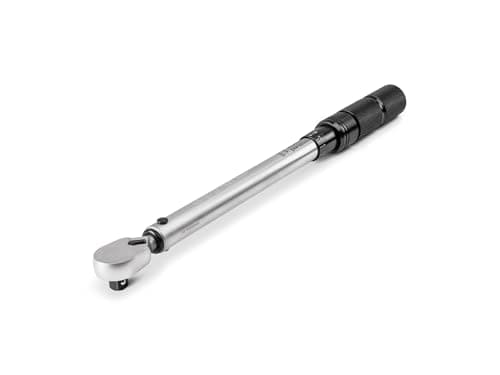
TEKTON 1/2 in Drive Micrometer Torque Wrench (TRQ52402), Amazon product photo
TEKTON 1/2 in Drive Micrometer Torque Wrench (TRQ52402)The 1/2 in wrench to buy first
1/2 in8.9
2
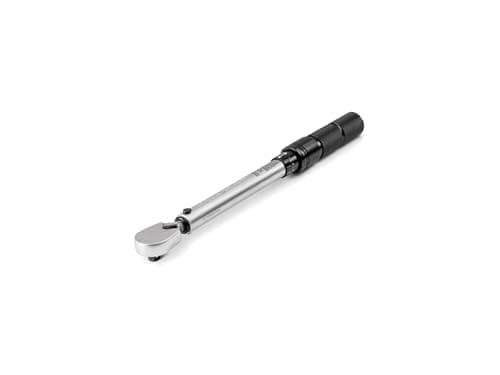
TEKTON 3/8 in Drive Micrometer Torque Wrench (TRQ51402), Amazon product photo
TEKTON 3/8 in Drive Micrometer Torque Wrench (TRQ51402)The 3/8 in wrench to buy second
3/8 in8.5
3
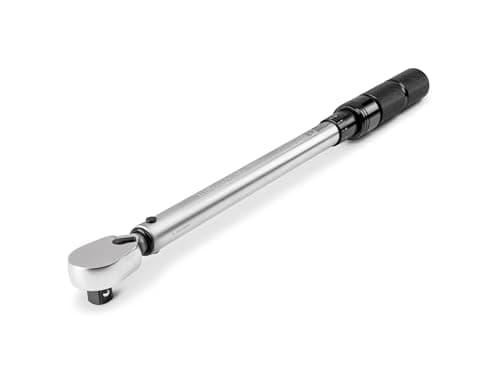
TEKTON 1/4 in Drive Micrometer Torque Wrench (TRQ50402), Amazon product photo
TEKTON 1/4 in Drive Micrometer Torque Wrench (TRQ50402)The 1/4 in wrench, if you need inch-pounds
1/4 in8.8
4
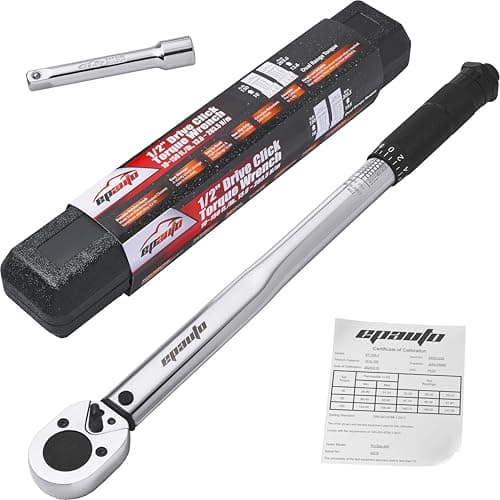
EPAuto 1/2 in Drive Click Torque Wrench (10-150 ft-lb), Amazon product photo
EPAuto 1/2 in Drive Click Torque Wrench (10-150 ft-lb)One wrench instead of two
1/2 in8.4

Product photographs come from each product's own Amazon listing via the Associates program. They are the seller's images, not photographs of anything we own — we have no test rig and claim none.

TEKTON 1/2 in Drive Micrometer Torque Wrench (TRQ52402), Amazon product photo

Short answer: for car work, a 1/2 in drive wrench covering roughly 40-200 ft-lb for wheels, and a 3/8 in drive covering roughly 10-100 ft-lb for everything smaller. Buy the 1/2 in first if lug nuts are why you are here. Drive size matters because it determines the range a wrench is built to measure — it is not a strength rating, and the bigger wrench is not the more capable one.

Drive size against the job

Drive sizes, the ranges they typically cover, and the fasteners they suit
DriveTypical rangeWhat it is for
1/4 in20 - 200 in-lbSensors, covers, trim, bicycle and small engine work
3/8 in10 - 100 ft-lbCaliper hardware, drain plugs, intake and accessory bolts
1/2 in40 - 250 ft-lbWheel lug nuts, suspension, crank and axle fasteners
3/4 inAbove 250 ft-lbHeavy truck and equipment work - not a home-garage size
Drive sizes, the ranges they typically cover, and the fasteners they suit

The ranges in the middle column are what the drive sizes commonly cover, not a rule. What is a rule is the relationship: a bigger drive means a longer handle, a stronger mechanism and a scale that starts higher. That last part is the one people miss. A 1/2 in wrench does not "also do" small fasteners at the bottom of its scale — it usually cannot reach them at all.

The rule that actually decides it

The short version

  • Your target figure should sit in the middle of the wrench's range, not at either end. Click wrenches are least accurate at the extremes of their scale.
  • If your target is 80 ft-lb, a 40-200 ft-lb wrench is a better tool than a 10-150 ft-lb one, even though both cover it.
  • A wrench whose scale starts above your target cannot measure it. There is no workaround.
  • Inch-pounds and foot-pounds are not interchangeable at a glance: 200 in-lb is 16.7 ft-lb.

This is why the usual answer to "what size do I need" is two wrenches rather than one very wide one. Two wrenches each working mid-scale beat one wrench working at both edges, and the 3/8 in model is rarely expensive.

If this is about lug nuts

Most passenger cars specify something in the 80-100 ft-lb region at the wheel, with trucks and larger wheel studs going higher. A 1/2 in drive wrench with a 40-200 ft-lb range brackets that comfortably. Check your own figure before you set anything — the lug nut torque chart explains how specifications relate to stud size and where to find yours, and the lug-nut roundup is the buying page for exactly this job.

Does the handle length matter?

It matters for access, not for accuracy. A longer wrench lets you reach the target torque with less hand force, which is why 1/2 in wrenches are long. But a calibrated click wrench clicks at the set figure regardless of where on the handle you push — within reason, and provided you pull smoothly with one hand on the grip rather than jerking it or using a cheater bar. Adding an extension to the handle changes the applied torque and invalidates the setting.

A note on reading the click: Park Tool points out that once the head of the wrench deflects, the set torque value has been achieved, and that turning past the point of deflection over-tightens the fastener. At low settings the sound can be faint, so watch and feel for the deflection rather than waiting for a noise.

Size is not the only choice

Once you know the drive size and range, the remaining decision is mechanism: click, split-beam, beam or electronic. That choice is about how the wrench tells you it has arrived and what it needs from you afterwards — a click wrench must be wound down to its lowest setting after use, and a split-beam does not. Click vs digital and beam vs click cover both comparisons.

What we would buy

A 1/2 in drive 40-200 ft-lb wrench, today, if wheels are the reason you are reading this. A 3/8 in drive 10-100 ft-lb wrench next, before the first brake job. A 1/4 in in-lb wrench only if you work on bicycles, small engines or anything with a torque figure printed in inch-pounds. Nobody in a home garage needs a 3/4 in drive.

Three pages take that sizing decision further. Best torque wrench sets covers buying those drive sizes as a sequence rather than a bundle, best inch-pound torque wrenches ranks the 1/4 in options and explains why a big wrench cannot simply be set lower, and Nm to ft-lb matters if your service data is metric, which most modern data is.

The picks in full

Every pick, in detail

TEKTON 1/2 in Drive Micrometer Torque Wrench (TRQ52402), Amazon product photo

1. The 1/2 in wrench to buy first

TEKTON 1/2 in Drive Micrometer Torque Wrench (TRQ52402)

TEKTON · score 8.9/10

40-200 ft-lb on a 90-tooth head covers every lug-nut spec a normal car will ask for, and it clicks loudly enough that a beginner can hear it.

40-200 ft-lb. If you are buying one torque wrench for a car, this is the size and this is the range: lug nuts on nearly every passenger car and light truck fall inside it, usually around the middle, which is where a click wrench is at its best. The 90-tooth head needs a small swing in a wheel arch. It cannot measure anything below 40 ft-lb.

Published specifications

Drive
1/2 in TEKTON
Range
40 – 200 ft-lb TEKTON
Head
90-tooth, dual direction TEKTON
Included
Storage case TEKTON

What works

  • 40-200 ft-lb brackets the 80-100 ft-lb most cars want at the wheel
  • 90-tooth ratchet needs only a small swing in a wheel well
  • Loud, unambiguous click — the thing beginners most need

What you give up

  • TEKTON does not publish an accuracy percentage for this model
  • Cannot do low-torque work — the range starts at 40 ft-lb
  • Must be wound back to its lowest setting after every use

Our scoring

  • Fit & reach9.0
  • Safety margin8.4
  • Beginner ease9.2
  • Build quality8.4
  • Value9.2
$125.00 · View on Amazon

#ad Price as of October 16, 2026. How this is funded

Specifications published by TEKTON — we earn nothing from that link.

TEKTON 3/8 in Drive Micrometer Torque Wrench (TRQ51402), Amazon product photo

2. The 3/8 in wrench to buy second

TEKTON 3/8 in Drive Micrometer Torque Wrench (TRQ51402)

TEKTON · score 8.5/10

10-100 ft-lb on a 3/8 in drive — the second wrench you buy, for caliper bolts and drain plugs a 1/2 in wrench cannot measure.

10-100 ft-lb on a 3/8 in drive. This is the size that covers caliper hardware, drain plugs, intake bolts and most of the fasteners that are not wheels. The smaller head fits where a 1/2 in wrench does not. For most home mechanics the 3/8 in wrench ends up being used more often than the 1/2 in one.

Published specifications

Drive
3/8 in TEKTON
Range
10 – 100 ft-lb TEKTON
Head
Dual direction TEKTON

What works

  • Covers the 15-45 ft-lb band where most brake hardware lives
  • Smaller head fits between a caliper and a wheel hub
  • Reaches 100 ft-lb, so it can do lug nuts on a small car in a pinch

What you give up

  • No published accuracy figure
  • Not enough range for truck lug nuts
  • A second purchase, not a first one

Our scoring

  • Fit & reach8.4
  • Safety margin8.2
  • Beginner ease8.8
  • Build quality8.4
  • Value8.8
$110.00 · View on Amazon

#ad Price as of October 16, 2026. How this is funded

Specifications published by TEKTON — we earn nothing from that link.

TEKTON 1/4 in Drive Micrometer Torque Wrench (TRQ50402), Amazon product photo

3. The 1/4 in wrench, if you need inch-pounds

TEKTON 1/4 in Drive Micrometer Torque Wrench (TRQ50402)

TEKTON · score 8.8/10

20-200 in-lb in 1 in-lb steps, certified to +/- 3% against ISO 6789-1:2017 and ASME B107.300-2021 — a published, standards-referenced accuracy claim at the low-torque end, which is rare.

20-200 in-lb in 1 in-lb steps, certified to plus or minus 3% against ISO 6789-1:2017 and ASME B107.300-2021 — a named-standard accuracy claim, which is rare at any price. 200 in-lb is only 16.7 ft-lb, so this is not a car-wheel tool; it is for the small fasteners a ft-lb wrench cannot resolve at all.

Published specifications

Drive
1/4 in TEKTON
Range
20 – 200 in-lb TEKTON
Accuracy
+/- 3% CW/CCW, ISO 6789-1:2017 and ASME B107.300-2021 TEKTON
Increments
1 in-lb TEKTON
Head
90-tooth, 4-degree swing arc TEKTON
Length
10.1 in TEKTON
Weight
0.73 lb TEKTON
Supplied with
Case, certificate of calibration, 1/4 in hex bit holder, drive adapter TEKTON

What works

  • Names the standards its accuracy is certified against, which most brands do not
  • 20 in-lb floor reaches the small fasteners a ft-lb wrench cannot measure at all
  • 4-degree swing arc is usable in a crowded engine bay or between spokes

What you give up

  • 200 in-lb is only 16.7 ft-lb — nowhere near a lug nut
  • 1/4 in drive needs its own sockets if you only own 3/8 in and 1/2 in
  • Must be wound back to its lowest setting after every use

Our scoring

  • Fit & reach8.6
  • Safety margin9.2
  • Beginner ease8.8
  • Build quality8.8
  • Value9.0
$85.00 · View on Amazon

#ad Price as of October 16, 2026. How this is funded

Specifications published by TEKTON — we earn nothing from that link.

EPAuto 1/2 in Drive Click Torque Wrench (10-150 ft-lb), Amazon product photo

4. One wrench instead of two

EPAuto 1/2 in Drive Click Torque Wrench (10-150 ft-lb)

EPAuto · score 8.4/10

Pre-calibrated to 4% with 1 ft-lb increments and a 10 ft-lb floor — the cheapest wrench here that can still do a brake caliper and a lug nut.

10-150 ft-lb on a 1/2 in drive in 1 ft-lb increments, pre-calibrated to 4% according to the manual. The widest single range here and the cheapest way to avoid buying two wrenches. The trade is real: a wrench is least accurate at the ends of its scale, and this one is being asked to work at both.

Published specifications

Range
10 – 150 ft-lb (13.6 – 203.5 Nm) EPAuto instruction manual
Accuracy
Pre-calibrated to 4% EPAuto instruction manual
Increments
1 ft-lb EPAuto instruction manual
Material
Chrome vanadium steel EPAuto instruction manual

What works

  • 10 ft-lb floor means one wrench covers brakes and wheels
  • 1 ft-lb increments are finer than several wrenches costing more
  • Extension bar included

What you give up

  • 4% accuracy claim comes with no third-party certificate
  • Must be wound back to its lowest setting after every use
  • Case latches are the first thing to wear out

Our scoring

  • Fit & reach8.8
  • Safety margin7.8
  • Beginner ease8.8
  • Build quality7.4
  • Value9.6
$36.87 · View on Amazon

#ad Price as of October 16, 2026. How this is funded

Specifications published by EPAuto — we earn nothing from that link.

Method

How these picks were chosen

We did not test these tools. We do not run a laboratory, we have not loaded a jack to failure or checked a wrench on a calibration bench, and we will not tell you otherwise. What we did instead is read the published manufacturer specifications, check the figures that matter against the safety standard that applies to portable automotive lifting equipment, and work out which tool suits which job. Every number on this page links to where it came from, so you can check us.

The five things we score are the five that decide a first purchase: will it fit under and lift your car, how much safety margin the rating and the locking mechanism leave you, how hard it is to get right alone in a driveway, what the materials and published standards say about how long it lasts, and what the money buys against the rest of the field.

Read the full method — including how we pick a top pick, and how prices get on the page.

Questions

Frequently asked questions

+Is a 1/2 inch torque wrench big enough for lug nuts?

Yes — 1/2 in drive is the standard size for wheel work, and a 40-200 ft-lb range brackets nearly every passenger car and light truck specification with the target near mid-scale.

+Can I use a 3/8 inch torque wrench for lug nuts?

On a small car whose specification is within the wrench's range, in a pinch, yes — a 10-100 ft-lb wrench reaches a 90 ft-lb spec. But you are working near the top of the scale, where accuracy is worst, and the socket and drive are smaller than the job wants. Use a 1/2 in drive for wheels.

+What is the difference between inch-pounds and foot-pounds?

Twelve inch-pounds make one foot-pound. A 1/4 in wrench reading 200 in-lb at the top of its scale is reading 16.7 ft-lb — nowhere near a wheel. Mixing the two up is how small fasteners get destroyed, so check which unit a specification is in before you set anything.

+Do I need two torque wrenches?

Eventually, most people do: a 1/2 in for wheels and a 3/8 in for everything else. One wide-range wrench such as a 10-150 ft-lb model will cover both, at the cost of working at the ends of its scale on both jobs. Start with one, add the second when a job demands it.

Sources

Where these figures come from

Read next

Related reading