

Skip to content
JACK & TORQUE

Use-case roundup

Best Car Ramps for Low Cars

Approach angle is the whole story. Everything else on the box is secondary if the bumper hits first.

By Ryder M. · Published September 26, 2026 · Last reviewed September 26, 2026

We earn a commission when you buy through the Amazon links on this page, at no extra cost to you. It never changes which tool we put first, and we publish no price we have not verified. How this site is funded.

Best Car Ramps for Low Cars — ranked picks with scores and a price check for each
#PickCapacityScorePrice
1
Low-angle view of a low-slung sports car sitting close to the ground
Race Ramps RR-56-2 (56 in, Two-Piece)Best for a genuinely low car
1,500 lb per ramp (6,000 lb vehicle)8.8
2
Low sports cars parked in a modern automotive workshop
Black Widow Low-Profile Plastic Service Ramps (6009-V2)Shallowest angle on a budget
4,400 lb8.0
3
Close view of a car undercarriage at a service station
Black Widow Plastic Low-Profile Car Ramps (TS265)Best for getting a jack under a low car
10,000 lb per pair8.2
4
A blue hydraulic floor jack standing beside an open toolbox on a garage floor
Arcan 3-Ton Aluminum Floor Jack (A20018)The jack that pairs with them
3 ton9.0

Photographs on this page are licensed stock images that show the category, not the exact model, and not anything we own. We have no test rig and claim none.

Low-angle view of a low-slung sports car sitting close to the ground

A low car cannot use most ramps, and the reason has nothing to do with capacity. It is geometry: the ramp's incline rises faster than the car's front overhang can clear, so the bumper or the front lip contacts the ramp before the tire reaches it. At that point you are either pushing the ramp forward or damaging the bodywork.

The angles, compared

Approach angles available, from shallowest to steepest
RampApproach angleLiftRamp length
Race Ramps 56 in + XTenders6.6 degrees8 in56 in plus extension
Black Widow 6009-V29.05 degrees2-1/2 in27-1/2 in
Race Ramps RR-56-210.8 degrees8 in56 in
RhinoRamps MAX17 degreesNot publishedAbout 36 in
Black Widow TS26517 degreesUp to 3 in17.5 in
Approach angles available, from shallowest to steepest

The pattern is straightforward: shallow angles need length, and length costs money and garage space. A 6.6-degree approach on a 56 in ramp plus extenders is a serious piece of equipment; a 17-degree wedge fits in a cupboard.

How to check your car before you buy

  1. 1.Measure the lowest point at the front

    Usually the front lip or the leading edge of a splitter. Measure from the ground straight up to it, with the car on level ground and the suspension settled.

  2. 2.Measure how far forward that point is from the tire

    Horizontal distance from the front face of the tire to the lowest point. That is your front overhang, and it is what has to clear the incline.

  3. 3.Compare against the ramp's rise over that distance

    A ramp rises roughly its angle's tangent per inch of length. At 17 degrees, the ramp surface is about 0.3 in higher for every inch forward; at 9 degrees, about 0.16 in. Multiply by your overhang and compare to your clearance. If the numbers are close, you need the shallower ramp.

  4. 4.Do a dry test with cardboard

    Cut a piece of cardboard to the ramp's profile, stand it against the tire, and look at where the bumper falls. Crude, effective, free.

Workarounds, ranked

  1. Buy the shallower ramp. Boring and correct. The angle is the problem; a longer ramp is the solution.
  2. Use extenders. Race Ramps sells XTenders specifically to drop the 56 in ramps' approach to 6.6 degrees. A manufacturer-supported solution to exactly this problem.
  3. Wedges plus a jack. Skip the service ramp entirely: raise the car 3 in on short wedges and use an ordinary floor jack. See low-profile floor jacks.
  4. Boards in front of the ramp. A plank laid so the tire climbs onto it first reduces the effective angle. It works, and it adds a second thing that can shift — so it is a last resort, not a plan.

Do not forget lift height

A low car starts closer to the ground, so it needs more lift to reach a usable working height, not less. This is why the shallow-angle budget wedges at 2-1/2 in are a clearance aid rather than a service solution for a low car: you have solved the approach and not the access.

The picks in full

Every pick, in detail

Low-angle view of a low-slung sports car sitting close to the ground

1. Best for a genuinely low car

Race Ramps RR-56-2 (56 in, Two-Piece)

Race Ramps · score 8.8/10

A 10.8-degree approach angle and 8 in of lift on solid high-density foam — the ramp for a car that scrapes on everything else.

A 10.8-degree approach angle over 56 in of ramp, with 8 in of lift — the combination that lets a low car get properly off the ground rather than just slightly off it. Solid high-density foam with an anti-slip coating. Race Ramps also sells XTenders that reduce the approach to 6.6 degrees for the lowest cars. Limits: 1,500 lb per ramp, and 56 in of garage depth.

Published specifications

Capacity
1,500 lb per ramp (6,000 lb vehicle) Race Ramps
Approach angle
10.8 degrees Race Ramps
Lift height
8 in Race Ramps
Length
56 in Race Ramps
Material
Solid high-density foam, anti-slip coating Race Ramps

What works

  • Shallowest approach angle here — clears low front lips
  • Two-piece design lets you remove the ramp section for side access
  • 8 in of lift is more than any plastic ramp in this set

What you give up

  • 1,500 lb per ramp limits it to lighter vehicles — check your axle weight
  • 56 in of ramp needs real garage depth
  • By far the most expensive ramps here

Our scoring

  • Fit & reach9.6
  • Safety margin8.6
  • Beginner ease9.0
  • Build quality9.2
  • Value6.8
Check price on Amazon

#ad No price shown — we have no live feed. How this is funded

Specifications published by Race Ramps — we earn nothing from that link.

Low sports cars parked in a modern automotive workshop

2. Shallowest angle on a budget

Black Widow Low-Profile Plastic Service Ramps (6009-V2)

Black Widow · score 8.0/10

A 9.05-degree loading angle at 4-1/2 lb per ramp — the gentlest approach angle you can buy cheaply, at the cost of only 2-1/2 in of lift.

9.05 degrees — shallower on paper than the Race Ramps — at a fraction of the price, from a 27-1/2 in ramp weighing 4-1/2 lb. The catch is 2-1/2 in of lift and 4,400 lb capacity, so it gets a low car up a little, not a lot.

Published specifications

Capacity
4,400 lb Retail listing
Lift height
2-1/2 in Retail listing
Loading angle
9.05 degrees Retail listing
Dimensions
27-1/2 in x 7-3/4 in x 2-1/2 in Retail listing
Weight
4-1/2 lb per ramp Retail listing

What works

  • 9.05-degree angle is gentler than most ramps costing many times more
  • Honeycomb channels stop water pooling in storage
  • Light enough to carry in one hand

What you give up

  • 4,400 lb capacity is the lowest here — check your vehicle's weight first
  • 2-1/2 in of lift is a clearance aid, not a working height
  • Long and thin, so it needs a flat run-up

Our scoring

  • Fit & reach7.8
  • Safety margin7.4
  • Beginner ease9.0
  • Build quality7.6
  • Value9.0
Check price on Amazon

#ad No price shown — we have no live feed. How this is funded

Specifications published by Black Widow — we earn nothing from that link.

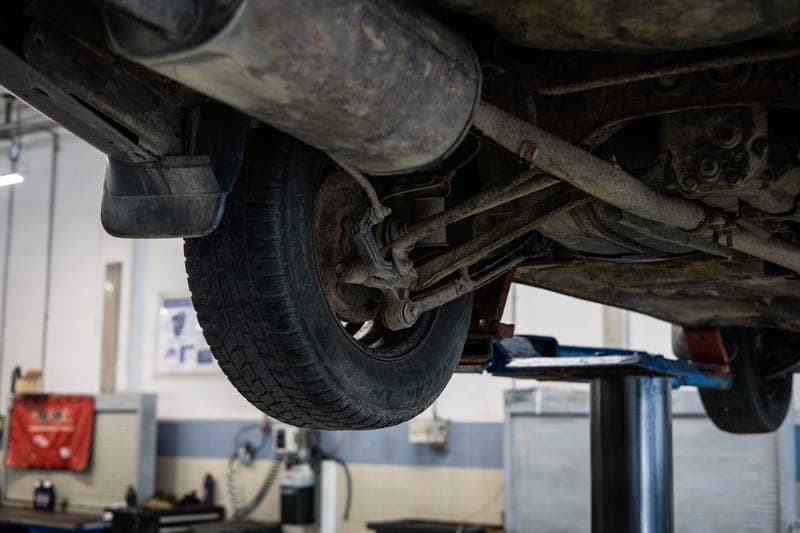
Close view of a car undercarriage at a service station

3. Best for getting a jack under a low car

Black Widow Plastic Low-Profile Car Ramps (TS265)

Black Widow · score 8.2/10

3 in of lift from a 17.5 in ramp — not a service ramp, a way to get a low car high enough that a floor jack finally fits underneath.

3 in of lift on a 17-degree angle, 10,000 lb per pair. Steeper, so check your bumper — but if it clears, 3 in is usually enough to slide a normal floor jack under the sill, which is the cheapest solution to the low-car problem.

Published specifications

Capacity
10,000 lb per pair Retail listing
Lift height
Up to 3 in Retail listing
Loading angle
17 degrees Retail listing
Dimensions
17.5 in x 9.75 in x 3 in Retail listing
Weight
5 lb per ramp Retail listing

What works

  • Solves the low-car problem for jacks that need 3.5 in of clearance
  • 5 lb each — they live in a trunk, not a garage
  • Cheapest useful lifting aid on the site

What you give up

  • 3 in of lift is not enough to work under the car
  • 17-degree angle is steep for a very low bumper
  • Small footprint needs flat, clean ground

Our scoring

  • Fit & reach7.6
  • Safety margin8.0
  • Beginner ease9.2
  • Build quality7.8
  • Value9.4
Check price on Amazon

#ad No price shown — we have no live feed. How this is funded

Specifications published by Black Widow — we earn nothing from that link.

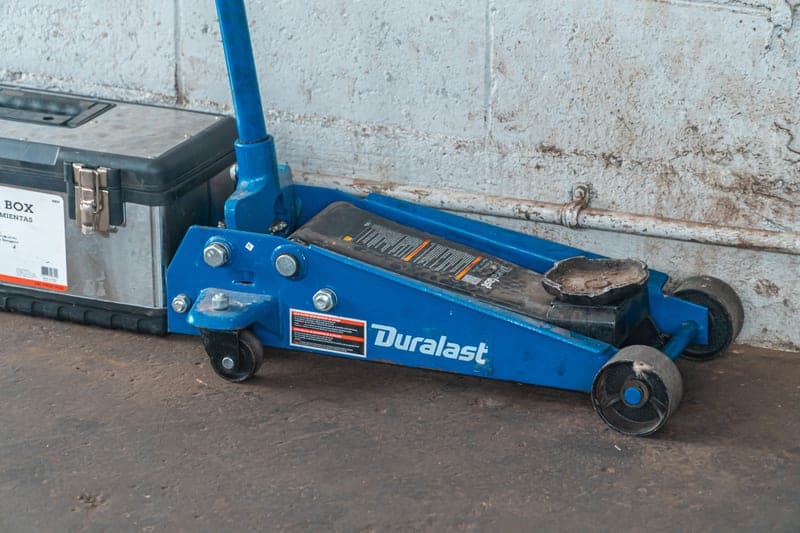
A blue hydraulic floor jack standing beside an open toolbox on a garage floor

4. The jack that pairs with them

Arcan 3-Ton Aluminum Floor Jack (A20018)

Arcan · score 9.0/10

A 3-ton aluminum service jack that slides under a stock sedan at 3.78 in and still reaches 18.9 in — the widest useful range a beginner can buy at one weight they can actually move.

3.78 in minimum height is the lowest published figure on this site, so if wedges are not an option this is the jack most likely to fit a low car unaided. 18.9 in of lift at 52.91 lb.

Published specifications

Min saddle height
3.78 in Arcan Professional Tools
Max lift height
18.9 in Arcan Professional Tools
Material
Aluminum Arcan Professional Tools

What works

  • Fits under most unmodified sedans without ramps or boards
  • 18.9 in of lift clears a wheel on a crossover, not just a car
  • Aluminum keeps it at a weight one person can lift into a trunk

What you give up

  • Costs noticeably more than a steel jack of the same capacity
  • Arcan does not publish an ASME PASE compliance statement for this model
  • 52.91 lb is light for the class, not light in absolute terms

Our scoring

  • Fit & reach9.4
  • Safety margin8.8
  • Beginner ease9.0
  • Build quality8.8
  • Value8.0
Check price on Amazon

#ad No price shown — we have no live feed. How this is funded

Specifications published by Arcan — we earn nothing from that link.

Method

How these picks were chosen

We did not test these tools. We do not run a laboratory, we have not loaded a jack to failure or checked a wrench on a calibration bench, and we will not tell you otherwise. What we did instead is read the published manufacturer specifications, check the figures that matter against the safety standard that applies to portable automotive lifting equipment, and work out which tool suits which job. Every number on this page links to where it came from, so you can check us.

The five things we score are the five that decide a first purchase: will it fit under and lift your car, how much safety margin the rating and the locking mechanism leave you, how hard it is to get right alone in a driveway, what the materials and published standards say about how long it lasts, and what the money buys against the rest of the field.

Read the full method — including how we pick a top pick, and why we publish no prices.

Questions

Frequently asked questions

+What ramp angle do I need for a low car?

Under about 11 degrees for most mildly low cars, and 6-9 degrees for genuinely lowered ones. Measure your front lip height and overhang, then compare against the ramp's rise over that distance.

+Can I put boards in front of ramps to lower the angle?

It works geometrically and it adds another object that can shift under a climbing tire. Treat it as a last resort, use a single solid plank rather than a stack, and stop immediately if anything moves.

+Are low-profile ramps weaker?

Not necessarily. Race Ramps' shallow ramps are rated 1,500 lb per ramp, which is a real constraint driven by the foam construction, while the budget wedges range from 4,400 to 10,000 lb. Read each rating on its own; the angle does not predict the capacity.

+Is a low-profile jack better than low-profile ramps?

They solve different problems. A low jack lets you lift one corner and take a wheel off; ramps get the whole front up with no load transfer. If you can only buy one, buy the jack plus stands — it does more.

Sources

Where these figures come from

Read next

Related reading