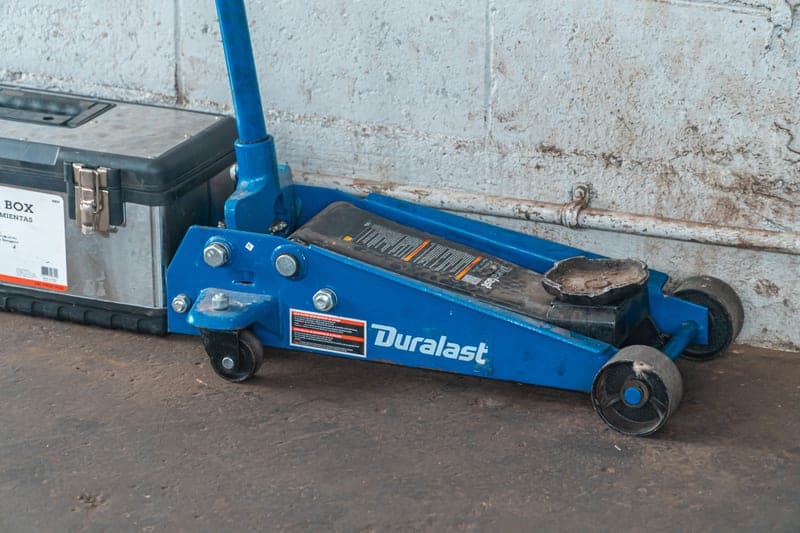


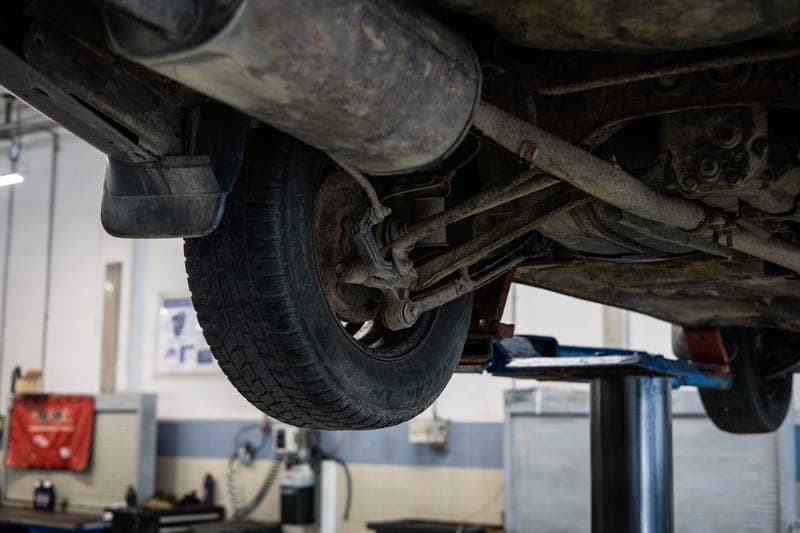

"Low profile" is a marketing phrase with no fixed definition, which means the only thing worth reading on the box is the minimum height figure. Under 4 in is genuinely useful. Around 5 in is a normal jack with ambitious branding.
Measure your car, then read one number
1.Park on level ground and let the suspension settle
Not on a slope, not half on a curb. The clearance you measure on a slope is not the clearance you will have.
2.Find the manufacturer's lift point
Your owner's manual shows it. On most unibody cars it is a reinforced section of the sill, often marked with a notch or an arrow in the plastic trim. Car jack points walks through finding it.
3.Measure floor to lift point, then subtract a margin
The jack has to roll in under there, not be dropped in from above. Give yourself half an inch. The result is the highest minimum height you can buy.
Why a low jack is harder to build
A floor jack lifts by swinging an arm through an arc. The lower the starting point, the shallower that arc begins and the longer the chassis has to be to get useful height out of it. That is why low-profile jacks are long — the Sunex is a 26-1/2 in chassis — and why the genuinely low ones are usually aluminum: a steel chassis of that length would be unpleasantly heavy.
The practical consequence is floor space. A long jack needs a clear run to roll in and a clear arc to swing the handle. In a tight garage that is a real constraint, and it is worth measuring alongside the car.
The two-tool workaround
If nothing in your budget fits under your car, the cheapest fix is not a better jack. It is a pair of short ramps or wedges that lift the front wheels 2-3 in, after which a completely ordinary jack slides under the sill. You spend less, you end up with two tools instead of one, and you gain a fast way to do oil changes without lifting anything at all.
The catch is that you are driving onto ramps first, which needs flat clean ground and a shallow enough approach angle for your bumper. Best ramps for low cars covers the angles.
Do not forget the stands
A low car plus a low jack still needs a stand that fits under it at its lowest setting. Many 3-ton stands start around 11 in; ESCO's performance stand starts at 13.2 in, which is tall for a low car even though the stand itself is excellent. Check the stand's minimum height against the height your jack can actually reach, not against the car's resting clearance.
Best jack stands lists the minimum heights side by side.