
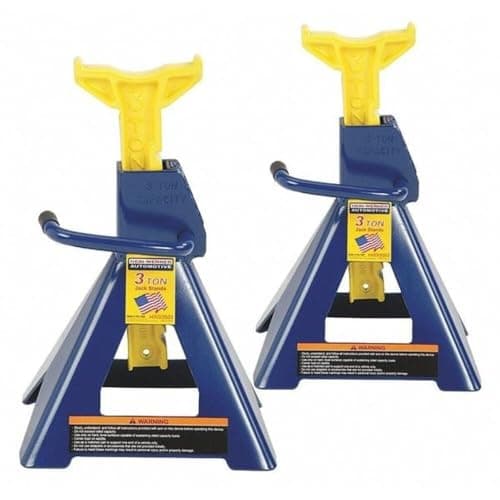

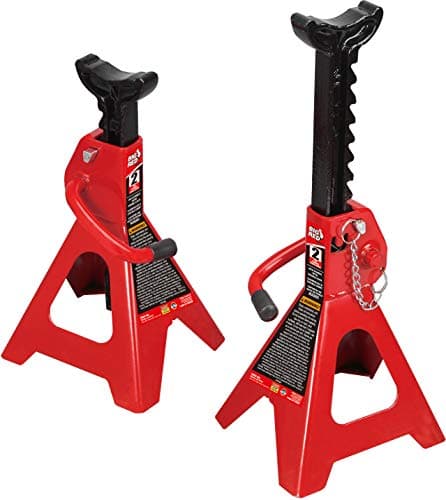
Short answer: on a low car, read the stand's minimum height and ignore almost everything else until that number works. A 3-ton stand that starts at 13 in is not usable under a car whose sill sits at 11 in after the jack has lifted it, no matter how well made it is.
Published minimum heights, lowest first
| Stand | Minimum | Maximum | Locks |
|---|---|---|---|
| BIG RED T42002A (2 ton) | 10.8 in | 16.5 in | Ratchet bar plus pin |
| BIG RED T43002A (3 ton) | 11-1/4 in | 16-3/4 in | Ratchet bar + safety pin |
| Hein-Werner HW93503 (3 ton) | 11-1/2 in | 17 in | Ratchet bar, 11/16 in steps |
| ESCO 10498 (3 ton per stand) | 13.2 in | 21.5 in | Pin and post, 10 positions |
The ESCO is on the table as the counter-example. It is the best-built stand we cover and its 13.2 in lowest setting makes it the wrong stand for this page.
The sequence that actually works on a low car
1.Gain clearance for the jack first
Drive the front wheels onto a pair of low ramps. Two and a half inches is usually enough to let a floor jack that would not otherwise fit slide under the sill. This is the step most guides skip, and it is the one that makes the rest possible.
2.Lift from the manufacturer's point
On a low car that is normally the reinforced pinch weld section. Use a slotted pad so the cradle does not fold the seam — remembering it costs you about an inch of height.
3.Set both stands to the same notch
Not approximately the same. On a low car you frequently have one usable notch, which is exactly why fine increments are worth paying for.
4.Lower on, then push-test
Lower slowly until the car is on the stands and the jack is just in contact as a backup. Push hard at a corner. Any rocking means reset, not proceed.
The jack has the same problem
A stand that fits is no use if the jack does not. Minimum heights of 3-1/2 in and below are what you are looking for, and the low-profile jack page compares the published figures. Buying a low jack and a low stand together is the only way to be sure the pair works on your car.