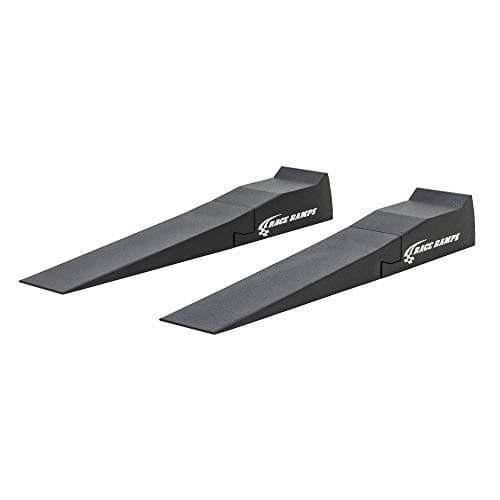
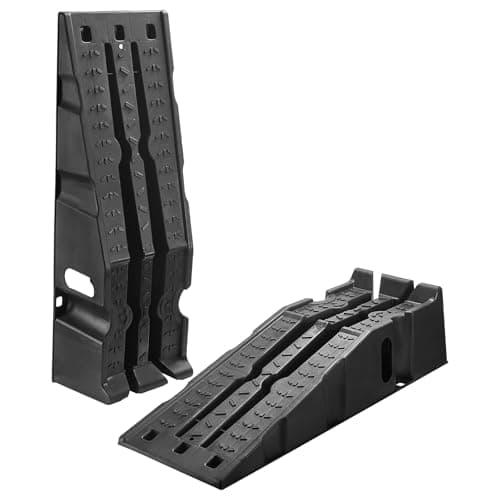
Short answer: the VEVOR pair is the safest ramp for most cars, because 16,000 lb GVW per pair gives capacity headroom nothing else here matches and the deep-grooved tire channel attacks the most common failure mode directly. For a low car, the safest ramp is the one with the shallowest approach — the Race Ramps RR-72-2 at 6.8 degrees, or the Black Widow 6009-V2 at 9.05 degrees if the budget is fixed. Ramps are covered by the same US safety standard family as jacks and stands.
The three specs that decide ramp safety
"Safest" is not a marketing adjective on a ramp — it decomposes into three published figures, and every one of them is on the box.
The short version
- Capacity headroom. Compare the rating to your vehicle's gross weight from the door-jamb sticker, and note whether the rating is per pair or per ramp. These are not interchangeable.
- Base grip. A ramp that slides forward as the tire meets it is the single most common incident in this category. A published base-grip or tire-channel spec is the only one that addresses it.
- Approach angle. Low angles let the car climb at idle. Steep angles make the bumper touch first, and the instinctive response — more throttle — is what launches a ramp across a garage.
The four ramps on the safety specs
| Ramp | Capacity | Approach angle | Lift | Base |
|---|---|---|---|---|
| VEVOR car ramps | 16,000 lb GVW per pair | 17 degrees | Drive-on | Grooved honeycomb |
| Race Ramps RR-72-2 | 1,500 lb per ramp | 6.8 degrees | 8 in | Traction coating |
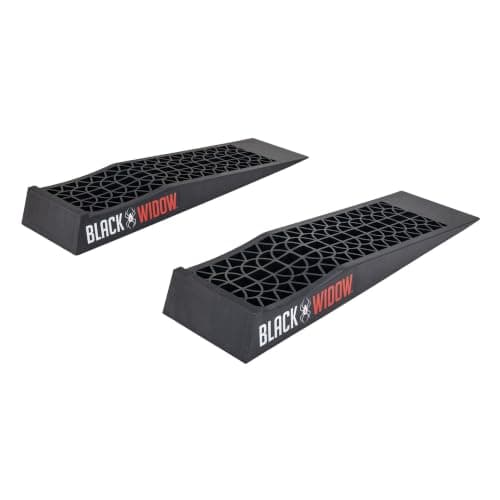
| Black Widow 6009-V2 | 5,000 lb per axle | 9.05 degrees | 2-1/2 in | Plastic, honeycomb |
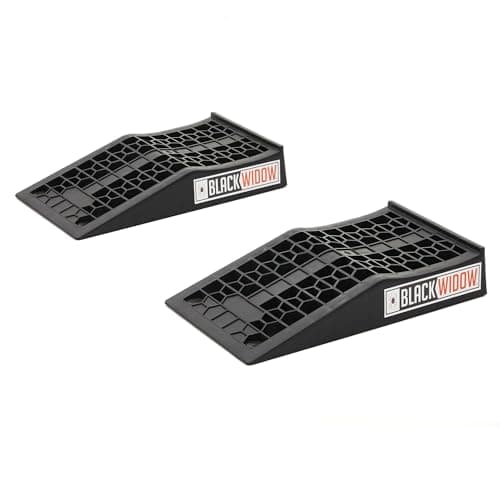
| Black Widow low-profile | 5,000 lb per axle | Not published | 3 in | Plastic |
Read the capacity column carefully, because the four ramps publish it four different ways. "16,000 lb GVW per pair" is a whole-vehicle gross weight limit. "1,500 lb per ramp" is a per-wheel limit, which on a front-engine car is the tighter constraint than it sounds. "5,000 lb" with no qualifier is the figure to check against the retailer listing before you buy. Comparing the headline numbers without reading the basis is how people conclude a foam ramp is weaker than a plastic one when the two are measuring different things.
Why approach angle is a safety spec, not a convenience spec
A ramp incident almost never starts with the ramp breaking. It starts in the first three seconds, while the car is being driven on. If the bumper or the front lip touches the ramp before the tire has started climbing, the driver feels resistance and applies more throttle, and the ramp — which is only held in place by friction — moves. On a 17-degree ramp that happens to plenty of ordinary sedans. On a 9 to 11-degree ramp it happens to very few cars.
This is why the shallow-angle ramps appear on a page about safety rather than a page about low cars. If your car is low enough that the approach is tight, the shallow ramp is not a comfort upgrade — it is the safety upgrade. The angle and clearance page works through how to measure your own car's approach before buying.
Plastic, resin and foam
Material is the specification people ask about first and it matters least. Impact-resistant plastic ramps are rated at figures like 16,000 lb GVW for a pair; solid high-density foam ramps are rated at 1,500 lb each and are used under cars worth more than most garages. Within their published ratings none of these materials is the weak point. Where plastic and foam are less forgiving than steel is that they do not bend visibly before they fail and they do not like point loads on uneven ground — which is another way of saying: flat, clean concrete.
Safer than jack stands?
Different, and for the one job they both do — getting the front of a car up for an oil change — ramps have a genuine structural argument: the car stays on its own wheels and never passes through a stage where its weight is on hydraulics. The counter-argument is that ramps cannot take a wheel off, so for brakes and tires the comparison does not arise. The full version is car ramps vs jack stands, and the failure modes in detail are in are car ramps safe.
What we would buy
For an ordinary sedan, crossover or half-ton pickup on a clean garage floor: the VEVOR pair, with two chocks behind the rear wheels. For anything with a low front bumper: the Race Ramps RR-72-2 if the budget allows and the axle weight is within 1,500 lb per ramp, the Black Widow 6009-V2 if it does not. For a car that is too low for a floor jack to fit under at all, the 3 in Black Widow is a clearance tool rather than a service ramp, and it is still a far safer answer than wood.