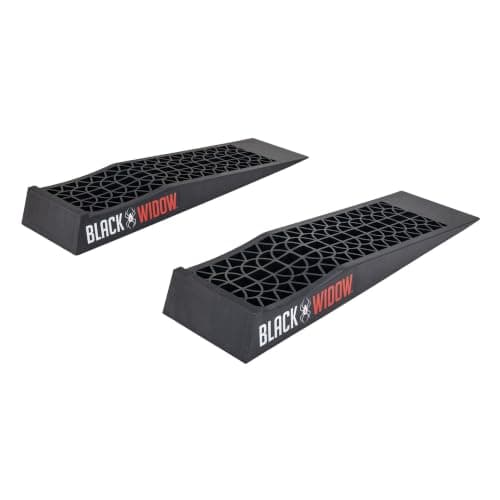
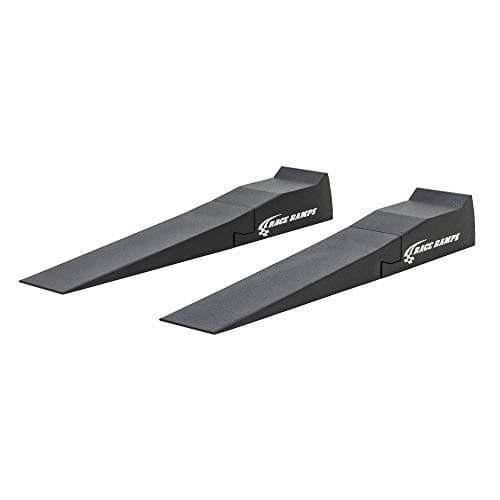
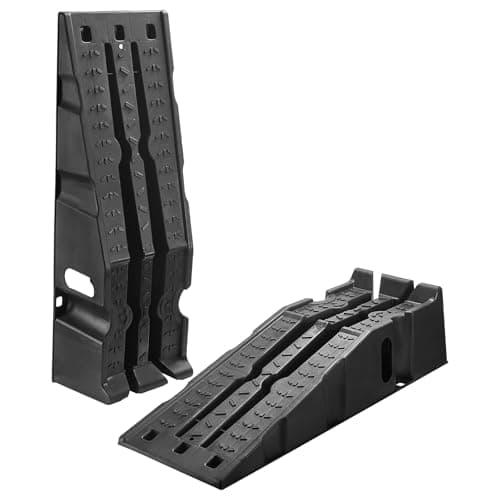
Direct answer: yes, if you change your own oil and your car can clear the approach angle. A pair of ramps turns a 45-minute setup into a one-minute one, and for a job that repeats two or three times a year that pays back quickly. No, if you are buying them instead of a floor jack and stands — ramps support the car on its own wheels, so a wheel can never come off, which rules out brakes, tires and rotations permanently.
Who they are worth it for
The short version
- You change your own oil and want the setup to stop being the hard part.
- You already own a jack and stands, and ramps would be the second tool.
- Your car clears the approach angle, or you are buying a shallow-angle ramp because it does not.
- You have flat, clean concrete to work on — a garage floor or a level driveway.
And who they are not worth it for: anyone whose first job is brakes, anyone working on gravel or a sloped drive, and anyone hoping to avoid buying a jack. Ramps do not replace a jack; the full argument is in floor jack vs ramps.
The actual arithmetic
A pair of plastic ramps costs less than a single shop oil change on most vehicles, and considerably less than one brake job. The question is not really whether ramps are expensive — they are the cheapest way to get a car off the ground that exists. The question is whether you will use them, and that comes down to two things: whether they fit your car, and whether the job you want to do is one ramps can do at all.
| Job | Ramps? | Why |
|---|---|---|
| Oil and filter change | Yes - best tool | Front end up, wheels stay on, nothing to balance |
| Underbody inspection, front half | Yes | Enough clearance to see and reach |
| Exhaust work at the front | Yes | Within the ramp's lift height |
| Brake pads or rotors | No | The wheel has to come off and the ramp is holding it |
| Tire rotation or a flat | No | Same reason |
| Suspension or wheel bearing | No | Wheel-off job |
| Transmission or rear differential | Usually no | Ramps lift the front axle only |
Four of those seven rows are no, and all four are no for the same reason. That is the real answer to "are they worth it": ramps are an excellent tool with one structural limitation, and whether the limitation matters depends entirely on what you plan to do.
Will they fit your car?
The deciding spec is approach angle against your front overhang. A 17-degree ramp — which is most plastic ramps — suits an ordinary sedan, crossover or pickup. Anything with a low front lip may touch before the tire climbs, and that is where ramps go from convenient to dangerous, because the instinct is to add throttle and the ramp is only held by friction. Shallow-angle ramps at 9 to 11 degrees exist precisely for this, and car ramps for low cars goes through the options.
The second check is capacity, and it is easy to get wrong because manufacturers publish it on different bases. "16,000 lb GVW per pair" is a whole-vehicle figure; "1,500 lb per ramp" is a per-wheel figure. Compare against the gross vehicle weight rating on the driver's door jamb sticker, not against what you think the car weighs.
Ramps or stands, if you can only buy one
Stands, every time — but only because stands come with a jack, and a jack and stands can do everything ramps can plus everything they cannot. If you have already made that purchase and you are asking whether ramps are worth adding, the answer tips strongly toward yes, because the oil change is the job that repeats and ramps are dramatically faster at it. The structural comparison is in car ramps vs jack stands, and if the concern is safety specifically, safest car ramps ranks the field on the three specs that matter.
The verdict
Buy them if you do your own oil and your car clears the angle. Buy the shallow-angle pair if it does not. Do not buy them as a substitute for a jack and stands, and do not buy them at all if your only flat ground is gravel. For most people reading this, a pair of plastic ramps is the second-best value purchase in the whole category, behind the stands that make a jack usable.