
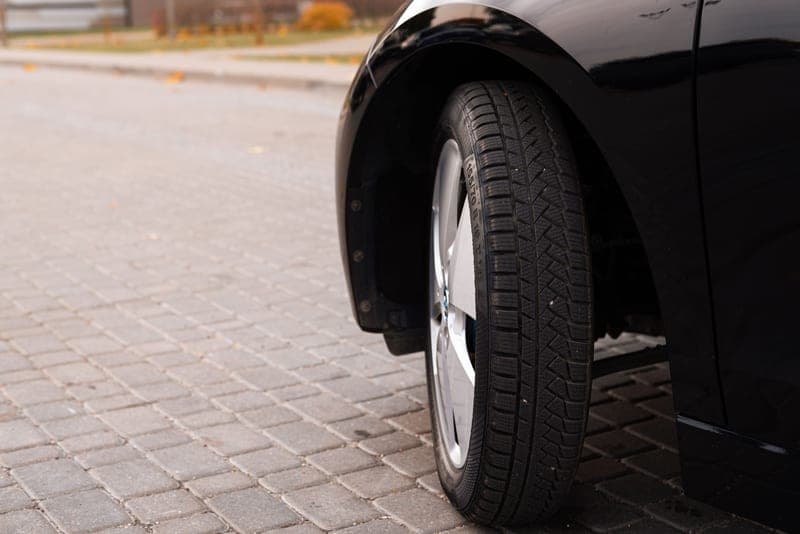


Direct answer: yes. A car ramp used within its published capacity, on flat clean solid ground, with the car secured and a rear wheel chocked, is a safe way to raise the front of a vehicle. Ramps are covered by the same US safety standard as jacks and stands. What makes them unsafe is a short list of specific, avoidable conditions — and almost all incidents happen in the first few seconds, while driving on.
The three ways ramps actually fail
| Failure | When it happens | How to prevent it |
|---|---|---|
| The ramp slides forward | As the tire first contacts it, especially on a dusty or damp floor | Sweep the floor; buy a non-skid base; approach at walking pace |
| The car rolls back off | After it is up, if nothing chocks the rear wheels | Chock a rear wheel, parking brake on, in park or in gear |
| The ramp is overloaded or point-loaded | Vehicle above rating, or ramp on uneven ground | Check the rating against the door-jamb sticker; flat ground only |
Notice that two of the three are about the floor and the approach rather than the ramp. The ramp itself failing structurally is the least likely of these by a wide margin.
Do car ramps break?
Reinforced resin ramps are rated at figures like 16,000 lb GVW for a pair, and foam ramps at 1,500 lb each. Within those numbers the material is not the weak point. Where plastic and foam are less forgiving than steel is point loading — a ramp bridging a crack, sitting on a stone, or contacted by a narrow tire at an angle concentrates load in a way the rating does not anticipate.
So the practical answer is: they fail when used outside the assumptions behind the rating, which is flat continuous ground and a tire rolling squarely up the middle.
The mistake that causes most incidents
Adding throttle when the car does not climb. The bumper touches, or the tire spins slightly, and the instinct is to give it more. That is precisely the input that shoots the ramp out from under the tire.
If the car does not climb smoothly at walking pace, the setup is wrong. Stop, get out, look. Either the angle is too steep for the car — see best ramps for low cars — or the floor is not providing grip.
The safety checklist
1.Check the rating against your vehicle
Door-jamb sticker versus the most restrictive published ramp figure.
2.Sweep the approach and the ramp base area
Grit under a ramp base is the main reason ramps slide. This is free.
3.Set the ramps square to the tires, touching them
Butt the ramp against the tire so there is no run-up gap for it to be kicked into.
4.Drive up at walking pace with a spotter if possible
Steady, straight, no throttle correction. Stop when the tire is on the flat.
5.Secure the car and chock a rear wheel
Engine off, park or in gear, parking brake on, chock behind a rear tire.
6.Push the car before you go under
Firm shove at a corner. Nothing should move — not the car, not the ramps.
Compared with jack stands
Ramps involve fewer steps and no load transfer, which means less scope for user error. Stands cover far more jobs. Neither is meaningfully more likely to fail structurally than the other, and both are far safer than the thing that actually causes serious injuries: working under a car supported only by a jack. Car ramps vs jack stands has the full comparison.