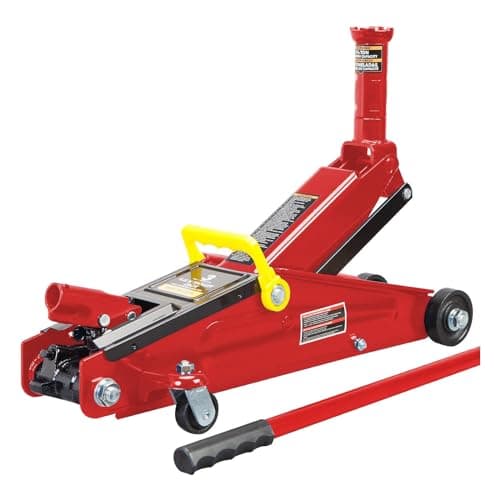
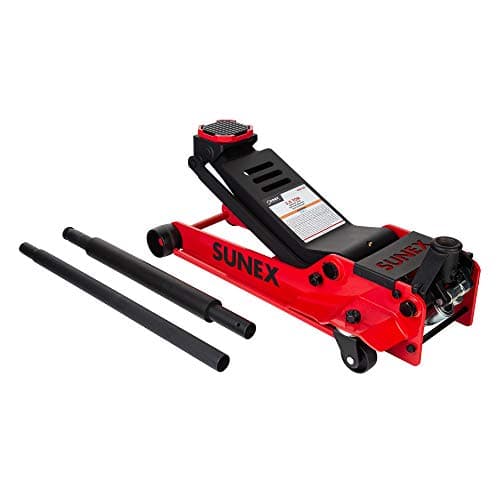
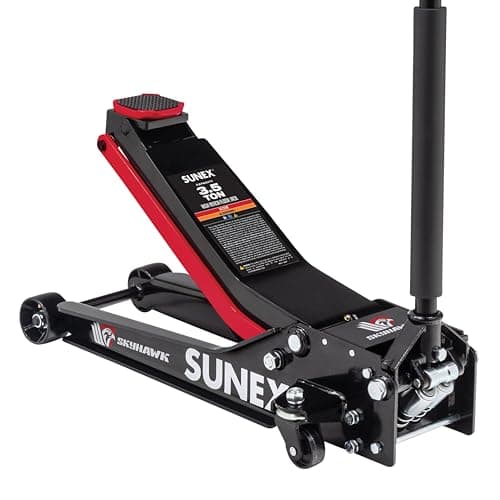
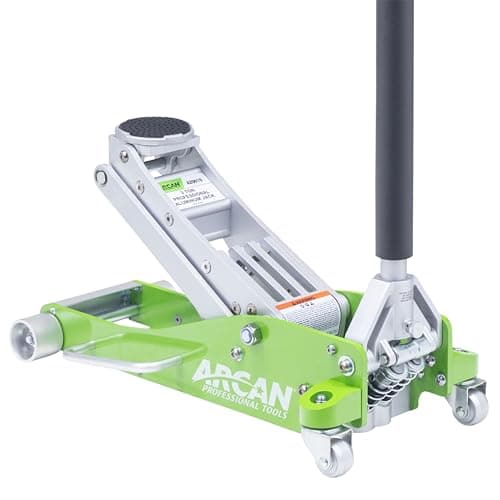
"SUV" covers two mechanically different vehicles, and they want different jacks. A unibody crossover — a RAV4, a CR-V, an Equinox — lifts the way a car does, from reinforced sill points that sit low. A body-on-frame SUV — a 4Runner, a Tahoe, a Wrangler — lifts from a frame rail or an axle, sits much higher, and needs a jack that reaches.
The measurement that separates them is floor-to-lift-point. Take it before you shop; it decides everything else on this page.
Work out which kind of SUV you have
| Unibody crossover | Body-on-frame SUV | |
|---|---|---|
| Lift points | Reinforced sill, as on a car | Frame rail or axle tube |
| Typical clearance at the lift point | Low — a car jack fits | High — a car jack wastes its range |
| Minimum jack height that matters | Yes, critically | Barely |
| Maximum lift that matters | 15 in is usually enough | 20 in and up |
| Jack chassis length | Standard is fine | Longer reaches the rail |
If you are not sure which you own, the owner's manual jacking diagram tells you: a sill-point diagram with a notch or arrow on the rocker means unibody. Car jack points walks through finding them.
Check the stand, not just the jack
The pairing people get wrong is jack maximum against stand minimum. A 3-ton car stand starts around 11 in and tops out near 17 in, which is often below where a body-on-frame SUV needs support. Buying a jack that reaches 21 in and then a stand that stops at 17 in leaves you with a lifted vehicle and nothing to put under it. Stand height ranges sets out the numbers.
Capacity, briefly
A 3-ton jack lifting one corner of a 5,000 lb SUV is carrying roughly 1,250 lb — about a fifth of its rating. Capacity is not what fails. We still suggest 3 ton, because at any given brand the 3-ton model is the longer, taller, stiffer tool. The capacity guide does the arithmetic properly.