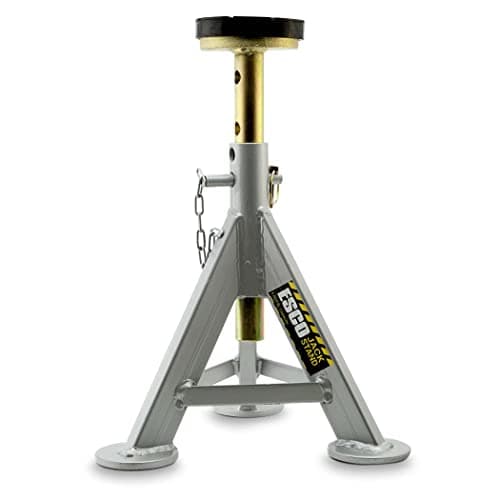
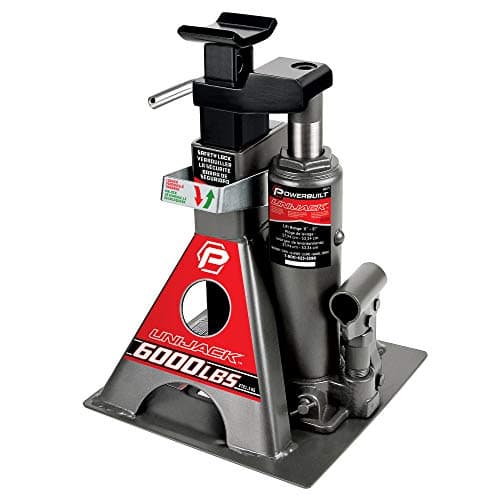
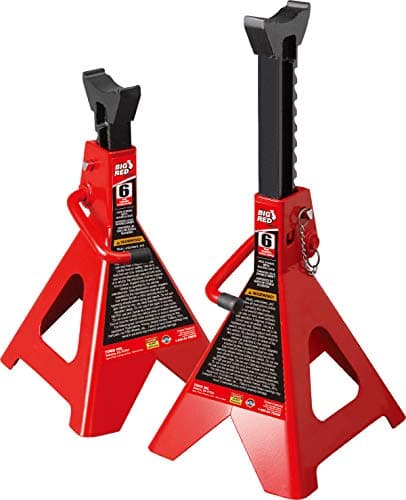
Short answer: buy for height range first. A truck does not weigh enough at one corner to trouble a 3-ton stand — the problem is that most 3-ton stands top out around 17 in, and a pickup frame rail sits higher than that once the jack has lifted the tire clear.
Published height ranges, compared
| Stand | Height range | Rating | Rated per |
|---|---|---|---|
| BIG RED T46002A | 15-3/8 – 23-13/16 in | 6 ton (12,000 lb) | Pair |
| ESCO 10498 | 13.2 – 21.5 in | 3 ton | Stand |
| Powerbuilt 620471 Unijack | 11 – 21 in | 3 ton | Unit (one corner) |
| BIG RED T43002A (car stand) | 11-1/4 – 16-3/4 in | 3 ton | Pair |
The last row is on the table deliberately: it is the stand most people already own, and Torin's own listing says that size is not intended for SUVs or trucks.
The rating trap: per pair or per stand
"3 ton" is not one number. Torin rates the T43002A at 3 ton per pair — 3,000 lb a corner. ESCO rates the 10498 at 3 ton per stand — 6,000 lb a corner. On a car the difference rarely bites. On a 6,000 lb truck where one corner can be 1,800 lb or more, it is the difference between comfortable margin and none. Jack stand weight ratings takes the labeling apart properly.
Where a truck stand goes
On a body-on-frame truck the support point is the frame rail or, for rear work, the axle tube — not a rocker panel, not a bumper, not a running board bracket. A flat saddle sits against a frame rail better than a curved cradle does, which is the practical case for the ESCO. Where to put jack stands goes area by area.
Match the jack to the stand
A stand that starts at 15-3/8 in needs a jack that can lift past it. That rules out a lot of car jacks and is the reason the lifted-truck jack page ranks on maximum lift. Buy the pair together or you will find out in the driveway.