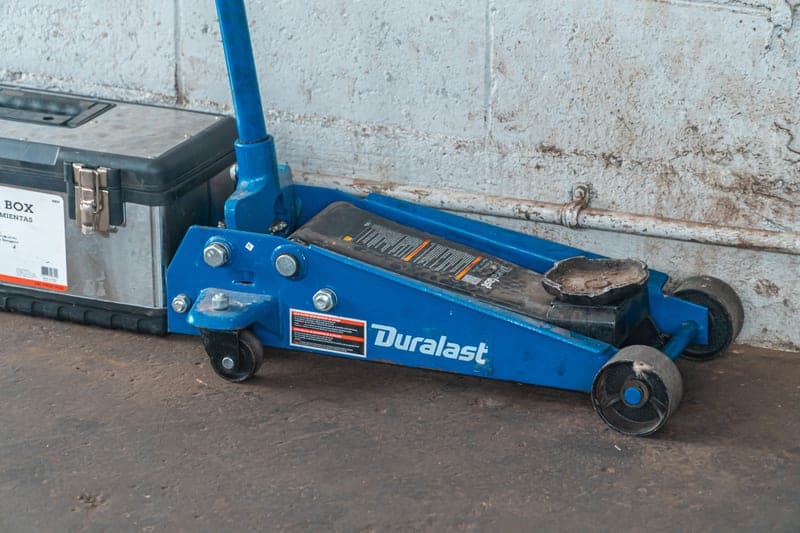


Short answer: a floor jack lifts one corner or one end of a car, so it carries roughly a quarter to a little over a third of the vehicle's weight. On a 3,500 lb sedan that is under 1,000 lb — well inside a 2-ton (4,000 lb) rating. We still recommend 3 ton for a first purchase, but for reasons that have nothing to do with the arithmetic.
The arithmetic, properly
Weight distribution is not even. A front-engined car carries roughly 55-60% of its weight on the front axle, so lifting one front corner is lifting more than a flat quarter. Work it conservatively:
| Vehicle weight | Front axle share (60%) | One front corner | As a % of a 2-ton rating |
|---|---|---|---|
| 3,000 lb | 1,800 lb | 900 lb | 23% |
| 3,500 lb | 2,100 lb | 1,050 lb | 26% |
| 4,500 lb | 2,700 lb | 1,350 lb | 34% |
| 6,000 lb | 3,600 lb | 1,800 lb | 45% |
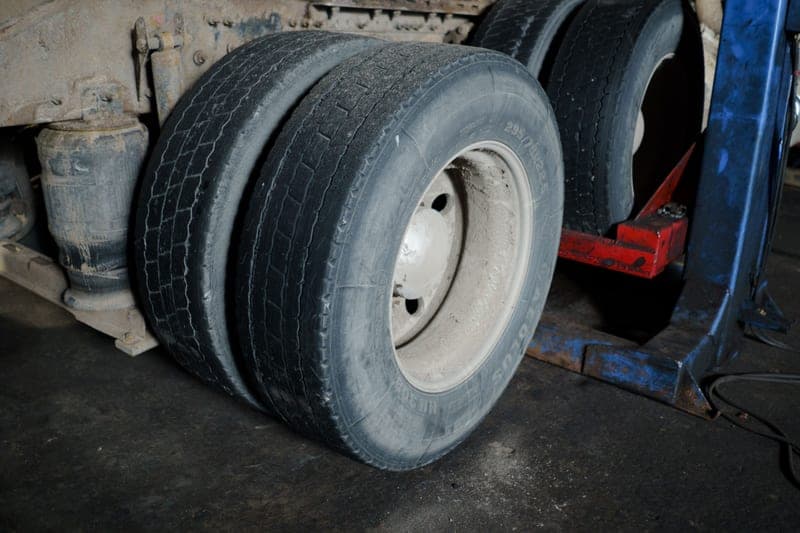
Even a 6,000 lb truck corner sits under half a 2-ton jack's rating. Lifting a whole end of the car rather than a corner — which a central lift point does — roughly doubles those numbers, and a 6,000 lb truck front end at 3,600 lb is then 90% of a 2-ton rating, which is too close. That is the case where capacity genuinely decides.
So why recommend 3 ton
Three honest reasons, none of them "because 2 ton is not enough":
- The 3-ton version is usually the better tool. Within a manufacturer's range, the higher-rated jack typically also lifts higher, has a bigger saddle and a stiffer chassis. You are buying the package, not the number.
- Headroom covers the case you did not plan for. A friend's heavier car, a central lift point instead of a corner, a future vehicle. Capacity is the cheapest kind of margin.
- Less flex under load. A jack working well inside its rating deflects less, which keeps the saddle square to the lift point. That matters more than the rating itself.
Where capacity ratings actually bite: stands
Jack ratings are forgiving. Stand ratings are where people get into trouble, because some stands are rated per pair and some per stand, and the difference is a factor of two. A "3 ton" pair rated per pair gives 1.5 tons per stand. Under one corner of a car that is still fine; under a heavy truck it is not.
Read the figure stamped on the stand, not the retail listing. Jack stand weight ratings covers this properly, because it is the single most misread number in the whole category.
How to find your car's actual weight
Open the driver's door and read the sticker on the door jamb. It lists the gross vehicle weight rating (GVWR) and often the individual axle ratings (GAWR). Those are maximums including load, so they are conservative — which is exactly what you want when sizing a jack. Use the front GAWR as your worst case for a front lift.