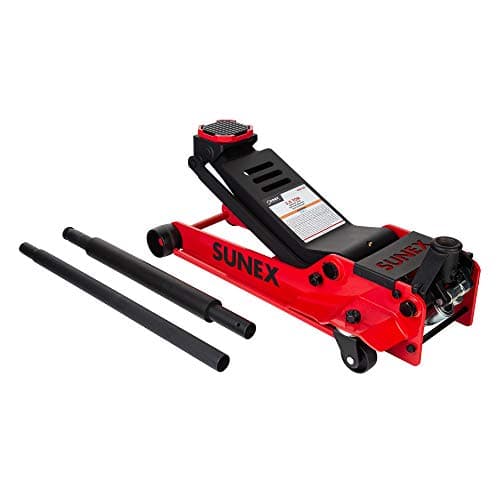
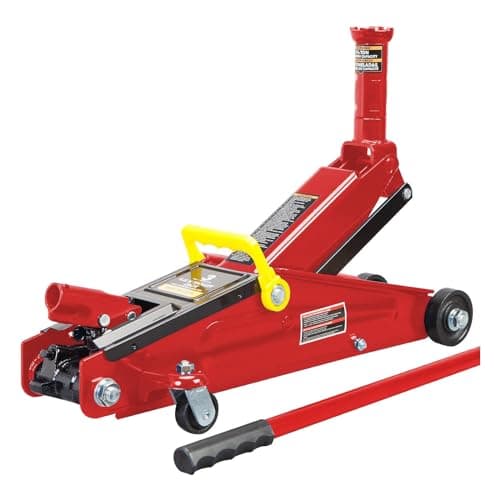
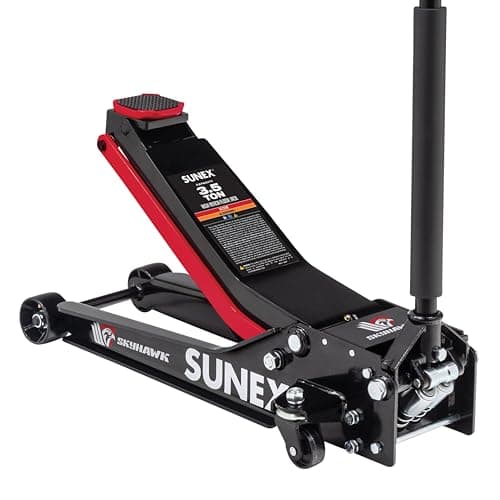
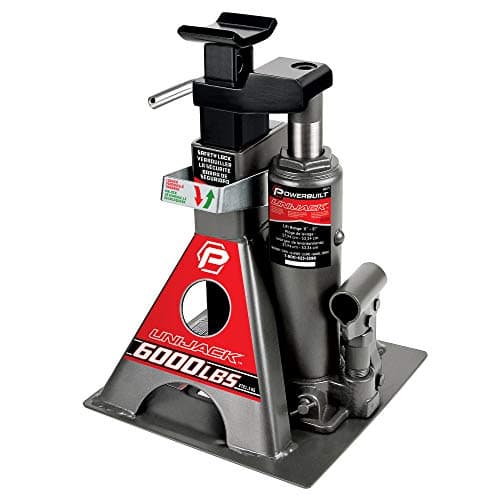
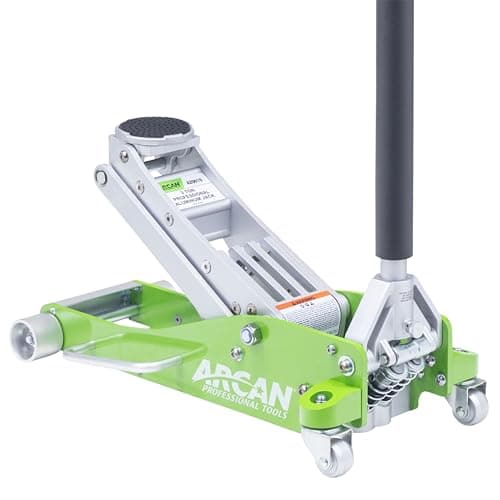
Every jack on this page carries the same rating, which is exactly why the rating is useless for choosing between them. A 3-ton jack lifting one corner of a sedan is carrying maybe 900 lb — around 15% of its capacity. Nothing here is close to being worked hard.
So the useful question is not "is 3 ton enough" but "what does 3 ton come bundled with". Usually: a longer chassis, more lift, a stiffer frame and a bigger saddle than the 2-ton version of the same model. That bundle is the real reason to buy 3 ton, and it is what the picks above are actually ranked on.
The specs that separate five identically rated jacks
| Jack | Lift range | Material | Pump |
|---|---|---|---|
| Arcan A20019 | 3.75 – 18 in | Aluminum | Not published |
| Sunex 66035SJ | 3.85 – 21.2 in | Steel | Dual piston |
| BIG RED T83006 | 5-7/8 – 20-7/8 in | Steel | Single piston |
| Sunex 66035HR | 3.58 – 24.4 in | Steel | Dual piston |
| Powerbuilt 620471 | 11 – 21 in | Steel bottle jack | Not published |
3 ton versus 2 ton, honestly
A 2-ton jack is not dangerous on a car. It is arithmetically sufficient for every passenger vehicle most people own. What it usually is, is smaller: shorter chassis, less lift, lighter gauge steel. The capacity guide works through the actual corner weights, and the US-made Hein-Werner jack on the US-assembled page is the counter-example — a 2-ton jack that out-reaches several 3-ton ones.
Match the stands to the rating properly
A 3-ton jack pairs with 3-ton stands, but read the small print: Torin rates its popular T43002A pair at 3 ton per pair, while ESCO rates the 10498 at 3 ton per stand. Those are very different numbers wearing the same label. Jack stand weight ratings takes it apart.