Short answer: a 3-ton floor jack with a saddle that starts under about 4 in and lifts to at least 18 in covers almost every car, crossover and half-ton pickup a home mechanic owns. Tonnage is rarely the constraint — a jack lifts one corner, so even a 2-ton jack is carrying far less than the car weighs. What actually goes wrong is height: a jack that will not fit under the car, or one that runs out of travel before the jack stand can go underneath.
The three numbers that make up "size"
The short version
- Capacity (tonnage) — the rated load. A jack takes roughly a quarter to a third of the car's weight, so this is the number with the most built-in margin.
- Minimum saddle height — how low the saddle sits before you pump. If it is taller than the gap under your car's lift point, the jack is useless on that car.
- Maximum lift height — how high the saddle goes. This has to beat your jack stands' minimum height by a clear margin, not match it.
Almost every "I bought the wrong jack" story is one of the last two. Tonnage is printed in huge type on the box; the height range is in the specification table, and it is the part that decides whether the tool does the job.
Tonnage: why 3 ton is the default answer
A floor jack lifts one corner, or at most one end, of a car. The load on the saddle is a fraction of the vehicle's weight, not all of it, and the fraction is usually somewhere around a quarter at a single corner. That means a 2-ton jack is not working anywhere near its limit under a normal passenger car.
We still recommend 3 ton, for two reasons that have nothing to do with the arithmetic. First, capacity headroom buys you a slower, more controlled lift — a jack working at a third of its rating moves predictably and its seals last. Second, 3-ton jacks are usually the better-built models in a brand's line, with longer handles and bigger saddles. The full worked arithmetic, including how to find your own car's figure, is in the floor jack capacity guide. If you drive a lifted truck or a three-quarter-ton pickup, start at the lifted-truck roundup instead — the height requirement changes before the tonnage does.
Where to find your own number
Open the driver's door and read the sticker on the door jamb. It carries the vehicle's gross weight rating, which is the loaded figure — heavier than the car as it sits empty, so using it is the conservative choice. Divide by four for a rough single-corner load and by two if you plan to lift a whole axle at once with a cross-member or a lifting rail. Compare that to the jack's rating, in the same units, and you will almost always find you have more than double the capacity you need.
Minimum saddle height: will it fit under?
This is the number that rules jacks out. Measure the vertical gap between the ground and the manufacturer's lift point on your car — not the lowest part of the bumper, the actual lift point. Then compare it to the jack's minimum saddle height, and leave about half an inch so you are not scraping the saddle along the sill to get it into position.
| Jack | Capacity | Minimum saddle height |
|---|---|---|
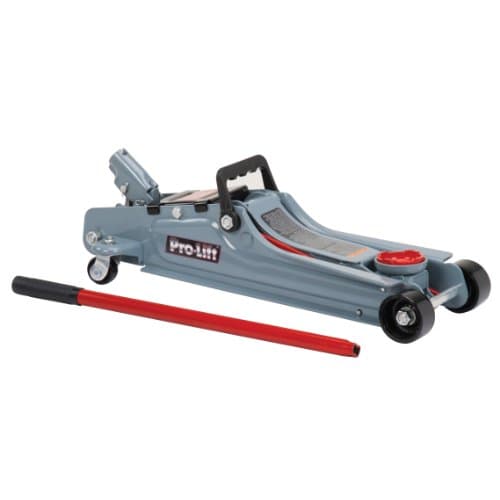
| Pro-Lift F-767 | 2 ton | 3-1/2 in |
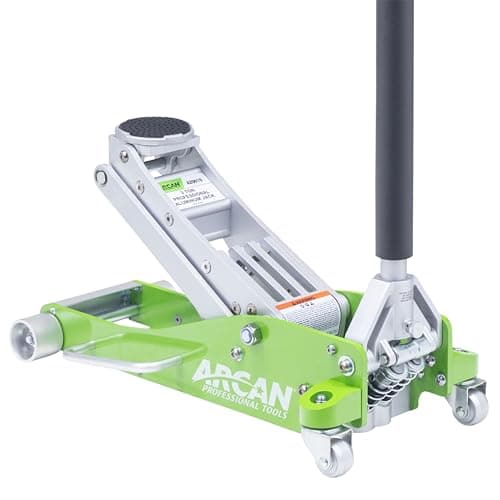
| Arcan A20019 | 3 ton | 3.75 in |
| Sunex 66035SJ | 3.5 ton | 3.85 in |
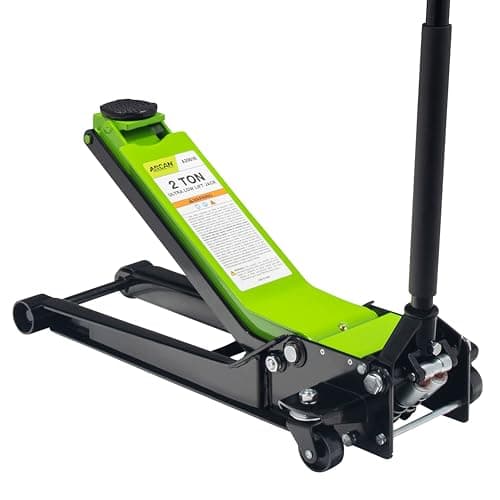
| Arcan A20016 | 2 ton | 2.75 in |
| Sunex 66035HR | 3.5 ton | 3.58 in |
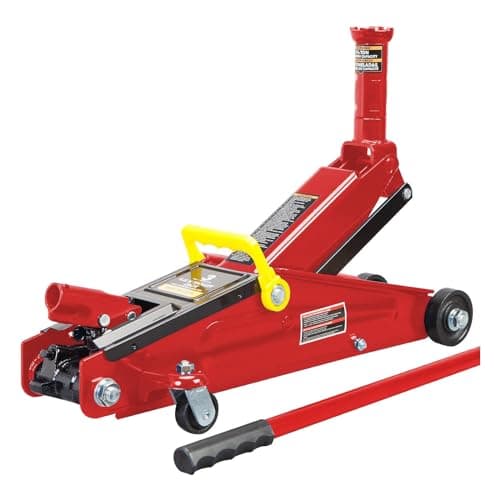
| Torin BIG RED T83006 | 3 ton | 5-7/8 in |
If your car is lowered, or has side skirts, or is simply a modern sports saloon with a 4 in gap, you are shopping in the top two rows of that table and nowhere else. That is the whole subject of low-profile floor jacks.
Maximum lift: the number people forget
The jack has to lift the car past the height of your jack stands, so you can set the stands under the car and then lower onto them. A BIG RED 3-ton stand, to take a common example, adjusts between 11-1/4 in and 16-3/4 in at the saddle. To use that stand at its tallest setting you need a jack that reaches comfortably past 16-3/4 in — and the lift point you are jacking from is not always the same height as the point the stand supports.
A jack topping out at 14 in can only work with stands near their lowest setting. A jack reaching 18 in or 20-7/8 in gives you the whole range of the stand plus margin. Buy the margin. Running out of jack travel while a wheel is off is the situation that makes people improvise, and improvising under a car is the thing this site exists to talk you out of.
Reach and footprint, if you lift from the middle
Length matters on two jobs: reaching a central lift point under a long car, and reaching a differential or cross-member from the side. A long service base like the Sunex 66035SJ's, or the 32 in chassis of the Arcan A20016, buys that reach. A short jack will simply not get to the middle of a full-size sedan from beside it. If your car has a single front lifting point rather than two sill points, check the jack's overall length before you check anything else.
What size to buy
For a normal car, crossover or half-ton pickup: 3 ton, minimum saddle under 4 in, maximum lift 18 in or more. For a low or lowered car: 2 or 3 ton with a saddle at 3-1/2 in or lower, and accept the shorter lift. For a truck or a tall SUV: 3 ton with the longest body and the highest maximum lift you can find, because the frame rail you are lifting is already 8 or 10 in off the ground. Then buy stands whose height range sits inside what that jack can reach — the two tools are bought together or not at all.