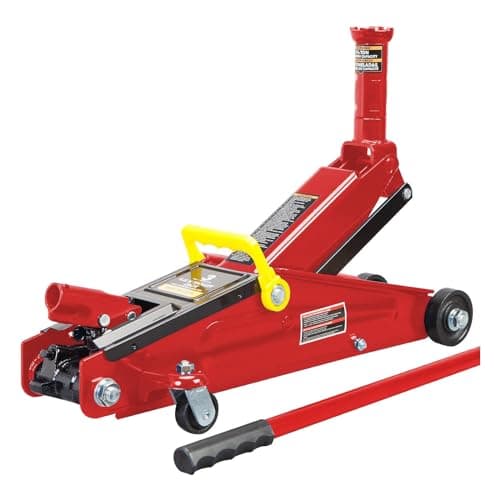
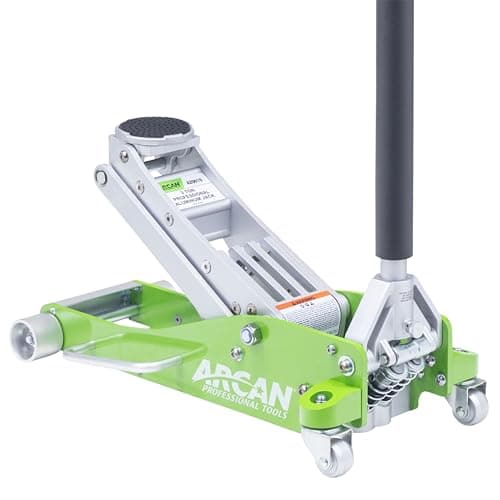
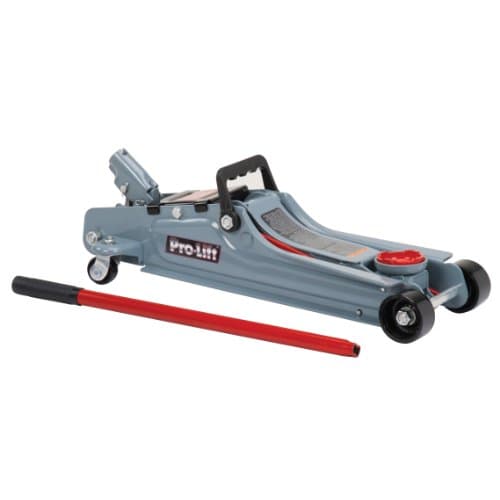
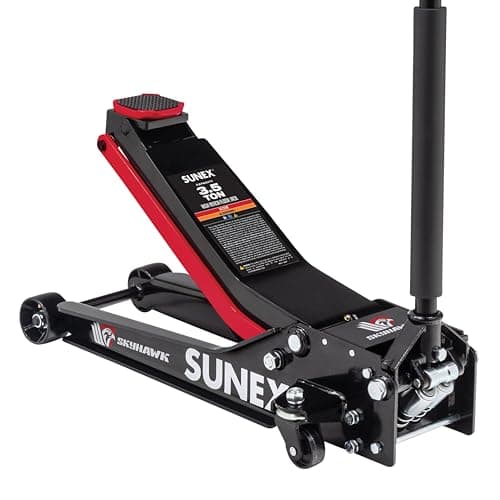
Short answer: a home-garage floor jack lifts to somewhere between 14 in and 24.4 in at the saddle, measured from the floor. Low-profile jacks sit at the bottom of that band because a low start usually costs you travel at the top; full-size steel service jacks sit at the top. What makes a figure good or bad is not the number itself but whether it clears the jack stands you intend to put under the car.
Published lift ranges
| Jack | Capacity | Minimum | Maximum | Stroke |
|---|---|---|---|---|
| Sunex 66035HR | 3.5 ton | 3.58 in | 24.4 in | 20.8 in |
| Torin BIG RED T83006 | 3 ton | 5-7/8 in | 20-7/8 in | 15 in |
| Arcan A20016 | 2 ton | 2.75 in | 24 in | 21-1/4 in |
| Sunex 66035SJ | 3.5 ton | 3.85 in | 21.2 in | 17.35 in |
| Arcan A20019 | 3 ton | 3.75 in | 18 in | 14.25 in |
| Pro-Lift F-767 | 2 ton | 3-1/2 in | 14 in | 10-1/2 in |
The stroke column is the subtraction, not a published figure — it is there because it is the honest way to compare jacks. A jack with a 10-1/2 in stroke and one with an 18-1/2 in stroke are different tools even when both say "floor jack" on the box.
How high is high enough?
Work backwards from the stands, not from the car. A jack stand has its own published height range — a BIG RED 3-ton stand adjusts from 11-1/4 in to 16-3/4 in at the saddle, and a 6-ton stand starts at 15-3/8 in and goes to 23-13/16 in. The jack has to raise the car high enough that the stand slides underneath at the setting you want, with room to spare for the stand's saddle to pass under the support point.
The short version
- Decide which stand setting you need first — usually the lowest one that gives you working room, because lower is more stable.
- Add two or three inches of margin on top of that setting. The jack's lift point and the stand's support point are rarely the same height on the car.
- Check the jack's maximum against that total. If it is close, the jack is too short for the job.
- Remember the tire: if you are taking a wheel off, the car has to come up far enough for the tire to clear the ground after the stand takes the weight.
That last point catches people on brake jobs. The car settles slightly as the load transfers from the jack to the stand, and a wheel that was barely off the floor can end up touching it again. Lift one stand setting higher than feels necessary.
Why low jacks lift less
A floor jack is a lever. The lifting arm pivots at the back of the frame and the saddle rides at the front, so total travel is set by how far the arm can swing — and a jack built to start very low has a shallower frame and a flatter arm, which limits the swing at the top. That is the mechanical reason the Pro-Lift F-767 starts at 3-1/2 in and stops at 14 in while the Hein-Werner Sunex 66035HR starts at 3.58 in and reaches 24.4 in.
Some jacks escape the trade-off by being longer and better made, which is what the Arcan A20019's 3.75 in to 18 in span represents. Others escape it with a two-stage ram. What no jack does is start very low and finish very high for very little money — that combination is the thing you pay for. The aluminum versus steel comparison covers the other half of this decision.
What not to do when it will not reach
The legitimate ways to gain height are: drive the other end of the car onto ramps so the whole vehicle sits higher, lift from a higher structural point if the manufacturer lists one, or buy a jack with more stroke. Car ramps are the cheapest of the three, and floor jack versus ramps explains when each is the right tool.
Measuring what you actually got
1.Pump the jack to full extension with no load
Run the handle until the arm stops rising. An unloaded jack reaches its mechanical limit, which is the figure manufacturers publish.
2.Measure from the floor to the top of the saddle
Use a tape against the saddle face, not the arm. The saddle is what touches the car.
3.Release the valve fully and measure again
That is your true minimum. A jack that has been stored wound up, or has air in the cylinder, will not drop to its published figure until it is bled.
4.Compare both to your jack stands
Set a stand to the height you intend to use and hold it beside the extended jack. If the jack is not clearly taller, you have found your problem before the car is in the air.
A jack that no longer reaches its published maximum usually has air in the hydraulic circuit rather than a fault. Most manufacturers document a bleeding procedure in the manual; it takes a minute and restores the stroke.
The figure to shop for
Aim for at least 18 in of maximum lift on a normal car and 20 in or more if you own a crossover, SUV or pickup. Treat 14 in as a low-car-only specification and check it against your stands before buying. And buy the jack and the stands as a pair, because the only measurement that matters is the gap between what the jack can reach and what the stands need — the jack and stand combo page exists for exactly that reason.