

Before you start
You need two stands of the same model, a floor jack that can lift higher than the stands' lowest setting, at least one wheel chock, and your owner's manual for the lift and support points. Level, solid ground is not optional.
The sequence
1.Inspect both stands
Ratchet teeth not rounded or deformed, pin straight and moving freely, column not bent, base welds free of cracks, base sitting flat. A stand that fails any of these is scrap — not a repair project.
2.Set both stands to the same height, before you lift
Count teeth or holes so both are identical. Doing this on the bench rather than under the car means you are not adjusting a stand while a car is being held above it. Pick a setting your jack can comfortably lift past.
3.Secure the car and chock a wheel
Engine off, automatic in park or manual in gear, parking brake on — except when working on rear brakes, where the parking brake acts on the components you are servicing. Chock a wheel at the opposite end of the car.
4.Lift past the stand height
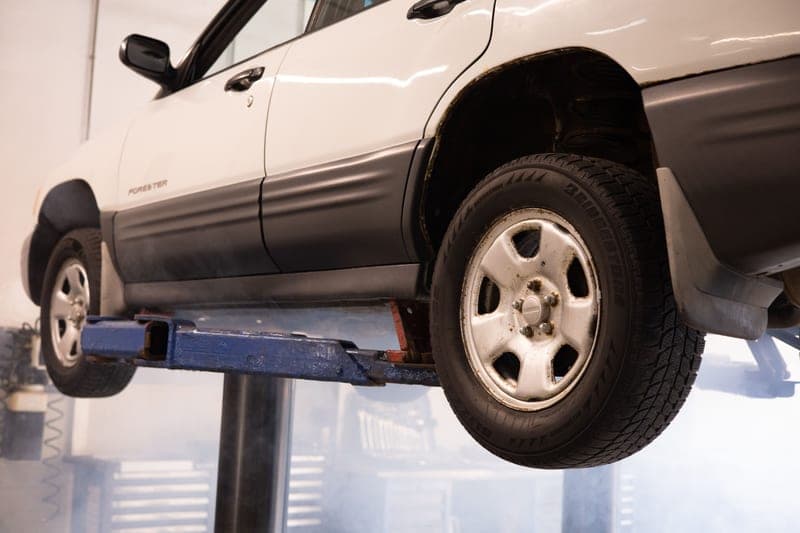
On the manufacturer's lift point, per car jack points. Go high enough that a stand slides underneath with room, not just barely.
5.Place the stands on structural points
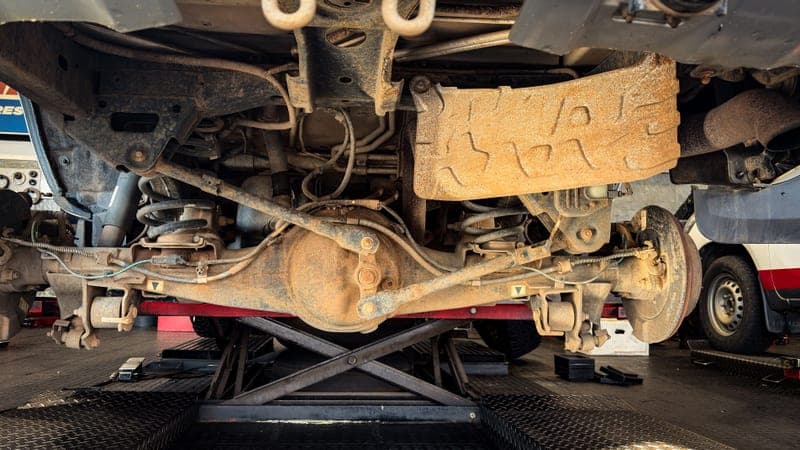
A subframe, a frame rail, a reinforced sill point or a solid rear axle. Not a floor pan, not a suspension arm that moves with the load, not a plastic under-tray, not the exhaust. Make sure the saddle is centered and square. Where to put jack stands goes through it area by area.
6.Lower onto the stands slowly
Open the jack's release valve gradually. Watch each saddle engage the car: if a stand tips, slides or contacts on one edge, stop, lift again and reposition. Only when both saddles are bearing squarely do you let the jack take the weight off.
7.Leave the jack in place
Unloaded but snug against the lift point. It costs nothing and it is another obstruction if a stand moves.
8.Test the car
Push firmly at a raised corner, front-to-back and side-to-side. It should feel dead solid. Rocking, creaking or settling means something is wrong — raise it and reset. Only after this test does anything of yours go under the car.
If you need all four wheels up
Four matched stands, and lift one end fully onto stands before starting on the other. Never lift the second end with the first end already on stands unless the stands are placed so the car cannot rotate — the geometry gets genuinely tricky and the risk is the car walking off a stand as the attitude changes. If you are new to this, do jobs one end at a time.
Lowering, in reverse
Jack up just far enough to unload both stands. Remove them completely — not partly, not to one side. Then open the release valve slowly and let the car settle onto its tires. A floor jack release is often more sensitive than people expect, and dropping the last two inches is hard on the car and on the jack.
If a wheel came off, lug nuts get torqued with the car on the ground, not in the air. See how to torque lug nuts.
Mistakes worth naming
The short version
- Adjusting a stand's height while the car is resting on it
- Using two different stand models as a pair
- Placing a stand under a suspension arm, which moves as the car settles
- Skipping the push test because the car looks fine
- Removing the jack entirely instead of leaving it as a backup
- Working on rear brakes with the parking brake applied