Skip to content
JACK & TORQUE

Reference

Where to Put Jack Stands

Support points are not always the same as lift points. Here is what carries a car safely, and what only looks like it does.

By Ryder M. · Published September 26, 2026 · Last reviewed September 26, 2026

We earn a commission when you buy through the Amazon links on this page, at no extra cost to you. It never changes which tool we put first, and we publish no price we have not verified. How this site is funded.

Where to Put Jack Stands — ranked picks with scores and a price check for each
#PickCapacityScorePrice
1
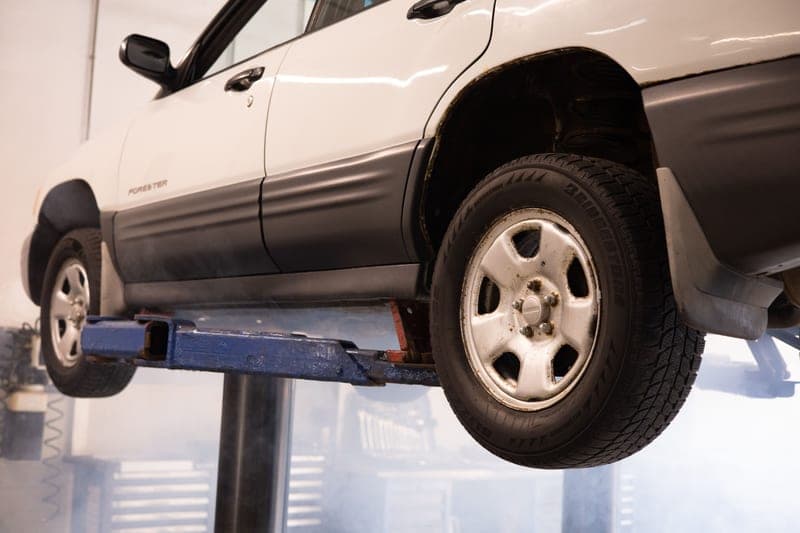
A white car suspended above the floor in an automotive repair shop
ESCO 10498 3-Ton Performance Jack StandBest saddle for a flat support point
3 ton per stand8.8
2
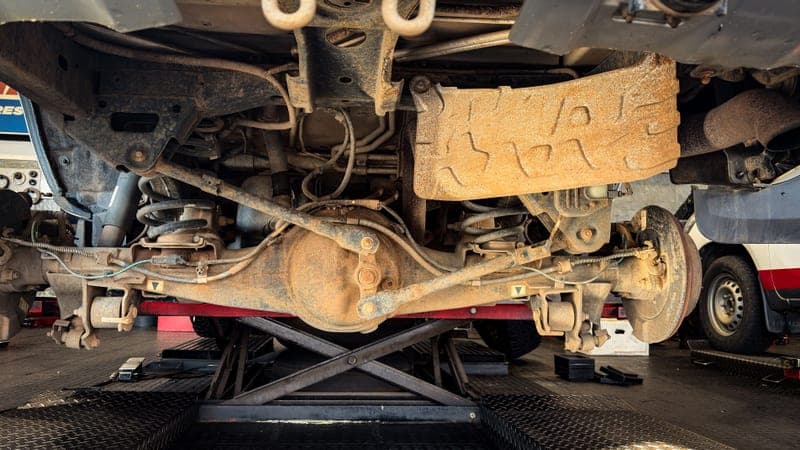
Close view of a car suspension assembly during a repair in a garage
BIG RED T43002A 3-Ton Double-Locking Jack StandsBest all-round pair
3 ton (6,000 lb) per pair9.1
3
A car raised on a shop lift with its undercarriage visible
Hein-Werner HW93503 3-Ton Jack StandsBest base for soft ground
3 ton8.7

Photographs on this page are licensed stock images that show the category, not the exact model, and not anything we own. We have no test rig and claim none.

A car raised on a shop lift with its undercarriage visible

The direct answer, as a list. Jack stands belong under:

  1. Reinforced sill / pinch weld points, using a stand with a flat or slotted saddle that does not fold the seam.
  2. The front or rear subframe, where it is a substantial welded or bolted structural member.
  3. Frame rails, on body-on-frame trucks and SUVs.
  4. A solid rear axle, at a designated point on the axle tube (not the differential cover).
  5. Designated factory support points, where the manual names points specifically for supporting rather than lifting.

Your owner's manual is the authority. Some manufacturers designate separate lift and support points, and where they do, the manual wins over any general rule.

Why support points differ from lift points

A jack contacts the car briefly, at one point, under a controlled load you are applying. A stand holds the car for as long as you are underneath, and it has to resist not just weight but any sideways nudge, any suspension movement as parts come off, and the change in balance when a wheel is removed.

That is why the two lists are not identical. A point perfectly adequate for a thirty-second lift may be a poor place to leave a car parked on a steel column for an hour while you lean on it.

Support points, area by area

Where a jack stand does and does not belong
LocationUse as a support point?Notes
Reinforced sill / pinch weld pointYesUse a flat or slotted saddle, not a curved cradle
Front subframe / crossmemberYes, where designatedSubstantial structure; check the manual
Rear subframeYes, where designatedOften the best rear support on a unibody car
Frame rail (body-on-frame)YesThe easiest and strongest option on a truck
Solid rear axle tubeYesAt a designated point, not on the differential cover
Lower control armNoMoves under load; changes geometry as parts come off
Floor panNoUnreinforced sheet metal
Plastic under-trayNoNot structural
Exhaust, fuel or brake linesNoServices, and damaging them is dangerous
Oil or transmission panNoThin, fluid-filled, often aluminum
Where a jack stand does and does not belong

How to verify a stand is bearing correctly

  1. 1.Look at the contact before you release the jack

    The saddle should sit flat and centered on the support point, with the stand vertical. Contact on one edge only means it will slip or dig in.

  2. 2.Lower slowly and watch

    Release the jack gradually. If the stand tips, rotates or slides as the load comes on, lift it back off and reposition rather than hoping it settles.

  3. 3.Check both stands are at the same height

    A car sitting on stands at different heights is twisted, and one stand is carrying more than its share. Set them before lifting — see how to use jack stands safely.

  4. 4.Push the car firmly before going under

    Front-to-back and side-to-side at a raised corner. It should feel dead. Any movement, creak or settle means reset.

  5. 5.Leave the jack in place, unloaded

    Snug against the lift point as a backup. It costs nothing.

Supporting all four corners

Four matched stands, and lift one end fully onto stands before starting the other. The risk to watch is that the car's attitude changes as you raise the second end, which can walk the first pair of stands if their saddles are not bearing squarely. For a first-timer, doing jobs one end at a time avoids the whole problem.

Spreading load on soft ground

A broad, solid board under the stand's whole base is legitimate and standard practice on asphalt — it spreads the footprint so the base cannot sink. What is not acceptable is wood between the stand and the car, or wood stacked to gain height. See jack stands vs wood blocks for why the distinction matters.

The picks in full

Every pick, in detail

A white car suspended above the floor in an automotive repair shop

1. Best saddle for a flat support point

ESCO 10498 3-Ton Performance Jack Stand

ESCO · score 8.8/10

A removable flat rubber saddle instead of the usual curved axle cradle, rated 3 ton per stand and tested to ASME standards by an A2LA-certified lab.

A removable flat-top rubber saddle spreads load across a sill or subframe instead of digging in at two edges the way a curved axle cradle does. 3 ton per stand, 13.2 in to 21.5 in, 10 positions, ASME tested by an A2LA-certified facility per ESCO.

Published specifications

Capacity
3 ton per stand ESCO
Height range
13.2 in – 21.5 in ESCO
Positions
10 adjustable positions ESCO
Saddle
Removable flat-top rubber cushion ESCO
Weight
11.4 lb ESCO
Testing
Tested to ASME standards by an A2LA-certified facility ESCO

What works

  • Flat rubber saddle sits against a sill or subframe without digging in
  • Rated per stand rather than per pair — easier to reason about
  • Third-party ASME testing named on the manufacturer listing

What you give up

  • 13.2 in minimum is the tallest low setting of the car stands here
  • Pin-and-post adjustment is slower than a ratchet
  • The most expensive stand in this set

Our scoring

  • Fit & reach8.4
  • Safety margin9.4
  • Beginner ease8.2
  • Build quality9.2
  • Value7.8
Check price on Amazon

#ad No price shown — we have no live feed. How this is funded

Specifications published by ESCO — we earn nothing from that link.

Close view of a car suspension assembly during a repair in a garage

2. Best all-round pair

BIG RED T43002A 3-Ton Double-Locking Jack Stands

Torin (BIG RED) · score 9.1/10

A ratchet bar plus a separate safety pin — two independent locks instead of one — at the height range a car actually needs, and Torin states they meet ASME safety standards.

Double locking, 11-1/4 in to 16-3/4 in, ASME compliance stated by Torin. The low minimum height makes it easier to place under a car's support points than a taller stand.

Published specifications

Capacity
3 ton (6,000 lb) per pair Torin
Min height
11-1/4 in Torin
Max height
16-3/4 in Torin
Base footprint
7-11/16 in x 6-7/8 in Torin
Standards
Meets ASME safety standards Torin

What works

  • Two independent locking mechanisms, not one
  • 11-1/4 in to 16-3/4 in matches what a 3-ton floor jack can reach
  • The cheapest way to buy a genuinely double-locked stand

What you give up

  • Rated per pair, not per stand — read the rating before loading two corners
  • 11-1/4 in minimum is taller than some low cars want
  • Torin's own listing says this size is not intended for SUVs or trucks

Our scoring

  • Fit & reach8.6
  • Safety margin9.2
  • Beginner ease9.0
  • Build quality8.2
  • Value9.4
Check price on Amazon

#ad No price shown — we have no live feed. How this is funded

Specifications published by Torin (BIG RED) — we earn nothing from that link.

A car raised on a shop lift with its undercarriage visible

3. Best base for soft ground

Hein-Werner HW93503 3-Ton Jack Stands

Hein-Werner · score 8.7/10

11/16 in height increments and a formed base that resists sinking, made in the USA — the stand to buy if you want engineering rather than the lowest price.

A formed 7-5/8 x 8-3/4 in base is shaped to spread load, which matters as much as the saddle when the stand is on asphalt. 11-1/2 in to 17 in in 11/16 in increments, made in the USA.

Published specifications

Capacity
3 ton Hein-Werner
Min height
11-1/2 in Hein-Werner
Max height
17 in Hein-Werner
Height increments
11/16 in Hein-Werner
Base size
7-5/8 in x 8-3/4 in Hein-Werner
Weight
19 lb gross Hein-Werner

What works

  • Fine 11/16 in increments let you match two stands to the same height
  • Formed base is shaped to spread load on asphalt
  • Made in the USA with a dual-purpose carry and release handle

What you give up

  • Hein-Werner does not publish an ASME PASE compliance statement for this model
  • Ratchet bar only — no separate secondary pin
  • Costs more than a double-locking budget pair

Our scoring

  • Fit & reach8.6
  • Safety margin8.6
  • Beginner ease8.8
  • Build quality9.4
  • Value8.0
Check price on Amazon

#ad No price shown — we have no live feed. How this is funded

Specifications published by Hein-Werner — we earn nothing from that link.

Method

How these picks were chosen

We did not test these tools. We do not run a laboratory, we have not loaded a jack to failure or checked a wrench on a calibration bench, and we will not tell you otherwise. What we did instead is read the published manufacturer specifications, check the figures that matter against the safety standard that applies to portable automotive lifting equipment, and work out which tool suits which job. Every number on this page links to where it came from, so you can check us.

The five things we score are the five that decide a first purchase: will it fit under and lift your car, how much safety margin the rating and the locking mechanism leave you, how hard it is to get right alone in a driveway, what the materials and published standards say about how long it lasts, and what the money buys against the rest of the field.

Read the full method — including how we pick a top pick, and why we publish no prices.

Questions

Frequently asked questions

+Where do jack stands go on a unibody car?

Under reinforced sill points with a flat or slotted saddle, or under the front or rear subframe where the manufacturer designates it. Never under the floor pan, a control arm or a plastic tray.

+Can I put jack stands under the control arms?

No. Control arms move under load, so the geometry changes as you lift and as you remove parts, and the arm can slide off the saddle.

+Should jack stands go under the same points as the jack?

Sometimes, and not always. A jack contacts briefly under a load you control; a stand holds the car while you work under it. Some manufacturers designate different points for each, and the manual decides.

+Can I put jack stands on the rear axle?

On a vehicle with a solid rear axle, yes, at a designated point on the axle tube — not on the differential cover, which is a thin pressed component.

+How do I know the stands are holding properly?

Saddle flat and centered, stand vertical, both stands at the same height, and a firm push at a raised corner producing no movement at all. Anything less and you reset.

Sources

Where these figures come from

Read next

Related reading