Skip to content
JACK & TORQUE

Comparison

Pin vs Ratchet Jack Stands

Both mechanisms work. What separates them is how they fail — and whether there is a second one behind the first.

By Ryder M. · Published September 26, 2026 · Last reviewed September 26, 2026

We earn a commission when you buy through the Amazon links on this page, at no extra cost to you. It never changes which tool we put first, and we publish no price we have not verified. How this site is funded.

Pin vs Ratchet Jack Stands — ranked picks with scores and a price check for each
#PickCapacityScorePrice
1
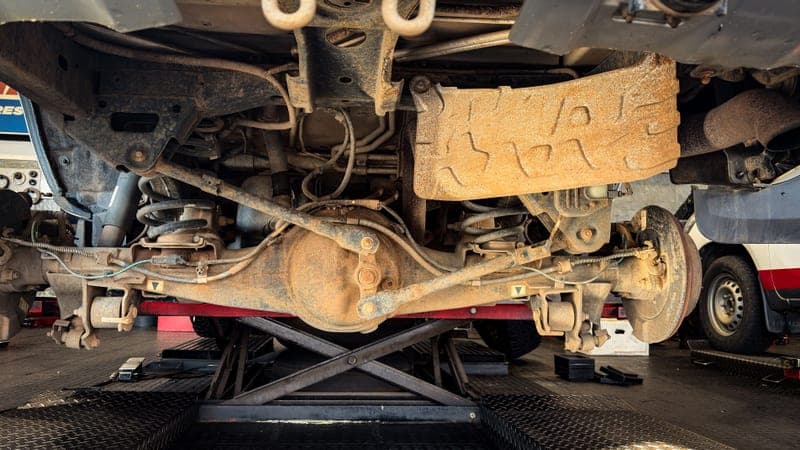
Close view of a car suspension assembly during a repair in a garage
BIG RED T43002A 3-Ton Double-Locking Jack StandsThe double-locking answer
3 ton (6,000 lb) per pair9.1
2
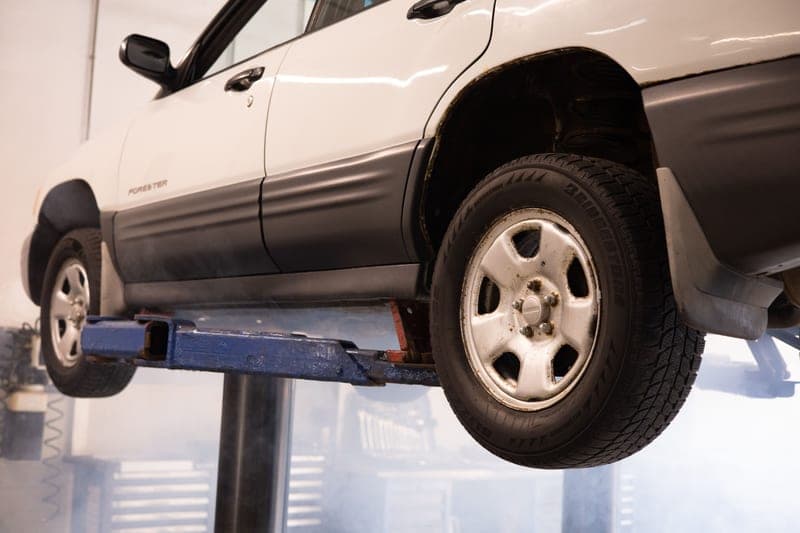
A white car suspended above the floor in an automotive repair shop
ESCO 10498 3-Ton Performance Jack StandThe pin-and-post case
3 ton per stand8.8
3
A car raised on a shop lift with its undercarriage visible
Hein-Werner HW93503 3-Ton Jack StandsThe ratchet case, done well
3 ton8.7

Photographs on this page are licensed stock images that show the category, not the exact model, and not anything we own. We have no test rig and claim none.

A car raised on a shop lift with its undercarriage visible

Short answer: buy double locking. A ratchet bar is faster to set and a pin is a more positive engagement, but the real difference is redundancy — a double-locking stand has two independent mechanisms, so no single one is the only thing between the car and the ground. The cost of that second mechanism is trivial.

How the mechanisms compare

Ratchet bar, pin and post, and double locking compared
Ratchet barPin and postDouble locking
Speed to setFastSlowFast
Height optionsEvery toothDrilled holes onlyEvery tooth
Matching two standsDepends on tooth pitchTrivial — count the holesDepends on tooth pitch
Engagement typePawl against sawtoothSteel pin through the columnBoth
RedundancyNoneNoneTwo independent locks
Main failure concernPawl not fully seated, worn teethPin not pushed home, bent pinBoth, but one backs up the other
Ratchet bar, pin and post, and double locking compared

The ratchet bar, honestly

A sawtooth column drops through a housing and a spring-loaded pawl sits against a tooth. Lift the handle to release, let it drop to engage. It is fast, it is adjustable at every tooth, and it has been the standard mechanism for decades because it works.

Its two genuine weaknesses: a pawl can be left resting on the very tip of a tooth rather than seated at its base, and the teeth themselves can deform over years of load if the stand has been abused. Both are visible if you look — which is the argument for inspecting stands before every use rather than for avoiding ratchets.

Tooth pitch decides how well two stands match

A coarse ratchet means the nearest available setting on each side may differ by most of a tooth, which leaves the car very slightly twisted. Hein-Werner's 11/16 in increments are fine enough that this effectively disappears. This is the detail worth paying for in a ratchet stand.

The pin and post, honestly

A steel pin passes right through a drilled column. There is no pawl, no spring and no partial engagement — the pin is either through the hole or it is not, which is exactly the property you want in a lock. It is slower, and you can only set the heights the holes allow.

That fixed-position limitation has an underrated benefit: matching two stands is a matter of counting holes. On a pin stand you can be certain both sides are at identical height, which is harder to guarantee on a coarse ratchet.

Double locking, and why it wins

A double-locking stand is a ratchet stand with a separate safety pin that passes through the column independently of the pawl. You get the ratchet for speed and the pin for certainty, and either one alone will hold the load. Nothing else available at this price buys as much margin.

What to inspect, per mechanism

The short version

  • Ratchet: teeth for rounding or deformation, pawl spring for tension, pawl sitting fully at the base of a tooth
  • Pin: pin straight and unbent, holes not elongated, pin passing fully through both walls of the column
  • Both: base welds for cracks, column for bending, base sitting flat on a level floor

The picks in full

Every pick, in detail

Close view of a car suspension assembly during a repair in a garage

1. The double-locking answer

BIG RED T43002A 3-Ton Double-Locking Jack Stands

Torin (BIG RED) · score 9.1/10

A ratchet bar plus a separate safety pin — two independent locks instead of one — at the height range a car actually needs, and Torin states they meet ASME safety standards.

Ratchet bar for speed, independent safety pin for redundancy. Torin states ASME compliance. This is the mechanism argument settled by buying both: 11-1/4 in to 16-3/4 in, 3 ton per pair.

Published specifications

Capacity
3 ton (6,000 lb) per pair Torin
Min height
11-1/4 in Torin
Max height
16-3/4 in Torin
Base footprint
7-11/16 in x 6-7/8 in Torin
Standards
Meets ASME safety standards Torin

What works

  • Two independent locking mechanisms, not one
  • 11-1/4 in to 16-3/4 in matches what a 3-ton floor jack can reach
  • The cheapest way to buy a genuinely double-locked stand

What you give up

  • Rated per pair, not per stand — read the rating before loading two corners
  • 11-1/4 in minimum is taller than some low cars want
  • Torin's own listing says this size is not intended for SUVs or trucks

Our scoring

  • Fit & reach8.6
  • Safety margin9.2
  • Beginner ease9.0
  • Build quality8.2
  • Value9.4
Check price on Amazon

#ad No price shown — we have no live feed. How this is funded

Specifications published by Torin (BIG RED) — we earn nothing from that link.

A white car suspended above the floor in an automotive repair shop

2. The pin-and-post case

ESCO 10498 3-Ton Performance Jack Stand

ESCO · score 8.8/10

A removable flat rubber saddle instead of the usual curved axle cradle, rated 3 ton per stand and tested to ASME standards by an A2LA-certified lab.

Ten defined positions and a locking pin, rated 3 ton per stand, tested to ASME standards by an A2LA-certified facility. Slower to adjust and only settable at fixed holes — which is also why two stands are trivially easy to match exactly.

Published specifications

Capacity
3 ton per stand ESCO
Height range
13.2 in – 21.5 in ESCO
Positions
10 adjustable positions ESCO
Saddle
Removable flat-top rubber cushion ESCO
Weight
11.4 lb ESCO
Testing
Tested to ASME standards by an A2LA-certified facility ESCO

What works

  • Flat rubber saddle sits against a sill or subframe without digging in
  • Rated per stand rather than per pair — easier to reason about
  • Third-party ASME testing named on the manufacturer listing

What you give up

  • 13.2 in minimum is the tallest low setting of the car stands here
  • Pin-and-post adjustment is slower than a ratchet
  • The most expensive stand in this set

Our scoring

  • Fit & reach8.4
  • Safety margin9.4
  • Beginner ease8.2
  • Build quality9.2
  • Value7.8
Check price on Amazon

#ad No price shown — we have no live feed. How this is funded

Specifications published by ESCO — we earn nothing from that link.

A car raised on a shop lift with its undercarriage visible

3. The ratchet case, done well

Hein-Werner HW93503 3-Ton Jack Stands

Hein-Werner · score 8.7/10

11/16 in height increments and a formed base that resists sinking, made in the USA — the stand to buy if you want engineering rather than the lowest price.

A ratchet bar with 11/16 in increments — fine enough that the usual ratchet complaint about coarse steps does not apply. Formed base, 19 lb gross, made in the USA. No secondary pin, and no published ASME statement for this model.

Published specifications

Capacity
3 ton Hein-Werner
Min height
11-1/2 in Hein-Werner
Max height
17 in Hein-Werner
Height increments
11/16 in Hein-Werner
Base size
7-5/8 in x 8-3/4 in Hein-Werner
Weight
19 lb gross Hein-Werner

What works

  • Fine 11/16 in increments let you match two stands to the same height
  • Formed base is shaped to spread load on asphalt
  • Made in the USA with a dual-purpose carry and release handle

What you give up

  • Hein-Werner does not publish an ASME PASE compliance statement for this model
  • Ratchet bar only — no separate secondary pin
  • Costs more than a double-locking budget pair

Our scoring

  • Fit & reach8.6
  • Safety margin8.6
  • Beginner ease8.8
  • Build quality9.4
  • Value8.0
Check price on Amazon

#ad No price shown — we have no live feed. How this is funded

Specifications published by Hein-Werner — we earn nothing from that link.

Method

How these picks were chosen

We did not test these tools. We do not run a laboratory, we have not loaded a jack to failure or checked a wrench on a calibration bench, and we will not tell you otherwise. What we did instead is read the published manufacturer specifications, check the figures that matter against the safety standard that applies to portable automotive lifting equipment, and work out which tool suits which job. Every number on this page links to where it came from, so you can check us.

The five things we score are the five that decide a first purchase: will it fit under and lift your car, how much safety margin the rating and the locking mechanism leave you, how hard it is to get right alone in a driveway, what the materials and published standards say about how long it lasts, and what the money buys against the rest of the field.

Read the full method — including how we pick a top pick, and why we publish no prices.

Questions

Frequently asked questions

+Are pin-type jack stands safer than ratchet?

A pin is a more positive engagement — there is no partial-seating failure mode. Both are adequate used correctly. A double-locking stand that has both is better than either alone, which is what we recommend.

+What is a double locking jack stand?

A ratchet stand with an additional independent safety pin through the column. Two mechanisms, either of which can hold the load on its own.

+Can a ratchet jack stand slip?

The realistic concern is a pawl left resting on the tip of a tooth rather than seated at its base, or worn teeth on an abused stand. Both are visible on inspection, which is why inspecting before every use is part of the procedure.

+Which is easier to set at the same height on both sides?

Pin and post, because you count holes. On a ratchet, the finer the tooth pitch the better — 11/16 in increments are fine enough that it stops mattering.

Sources

Where these figures come from

Read next

Related reading