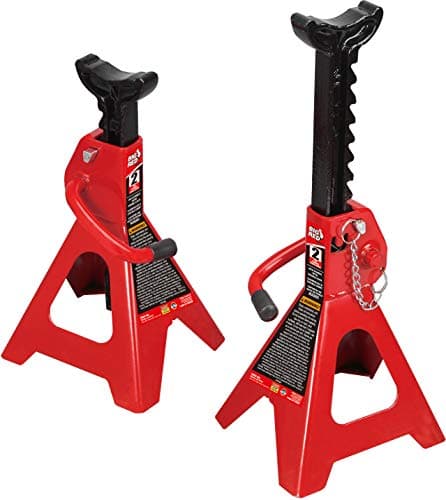
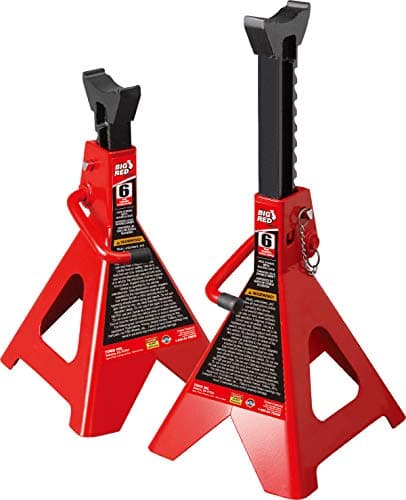
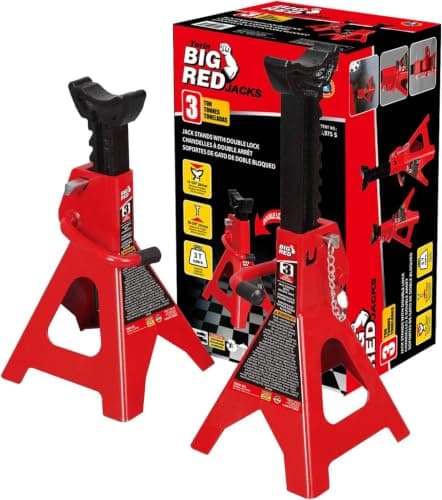
Short answer: the Torin BIG RED T43002A for most cars — a ratchet bar with a separate safety pin, 11-1/4 in to 16-3/4 in, and a stated ASME claim. If your car sits low, the T42002A does the same thing from 10.8 in and is the only stand on this page whose maker names a specific edition of the standard, ASME PASE-2019. If the vehicle is a pickup or a body-on-frame SUV, the 6-ton T46002A is the same mechanism at frame-rail height.
What we judged these on
1. How many mechanisms hold the load
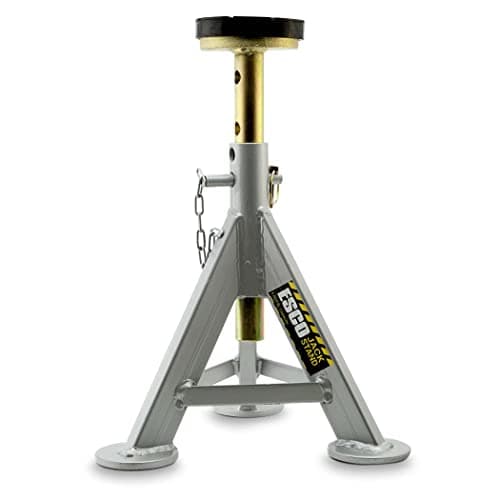
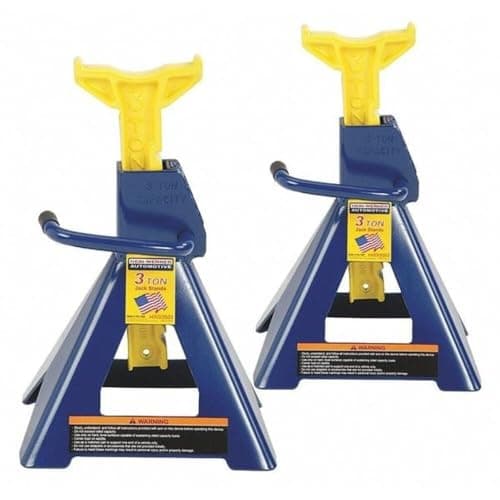
This is the whole premise of the page and it is a published fact, not a judgment. Torin publishes a ratchet plus safety pin on the T43002A and T46002A, and a 10-level ratchet support bar plus a double locking pin on the T42002A. Hein-Werner publishes a ratchet bar with 11/16 in increments and no secondary pin. ESCO publishes a pin with 10 positions and no ratchet. Three of the five are double-locking; two are excellent stands that are not, and we have said so beside each one rather than quietly leaving them off.
2. What the ASME claim actually says
Jack stands in the US are covered by ASME PASE, and the wording of a maker's claim matters more than its presence. "Complies with ASME PASE-2019" names an edition. "Tested to meet ASME standards" asserts testing without naming who did it. "Tested to ASME standards by an A2LA-certified facility" names the accreditation of the lab. No statement at all means exactly that. Those four claims appear on this page in that order of strength, and the strongest paper does not belong to the most expensive stand.
3. The height range, against your car and your jack
A stand that will not go low enough cannot be slid under the car; a stand that will not go high enough leaves you working in a gap you cannot fit into. And the jack has to out-lift the notch you want to use, because you raise the car past the stand height before you lower it on. Arcan publishes 18 in of maximum lift on the A20019, which clears the 16-3/4 in top setting of the 3-ton Torins comfortably. What size jack stands do I need works the arithmetic through properly.
4. Base footprint, because the floor is part of the system
Published base dimensions are the only honest guide to how a stand behaves on an imperfect surface. Torin publishes 7-11/16 x 6-7/8 in for the 3-ton; Hein-Werner publishes a formed 7-5/8 x 8-3/4 in base; the 6-ton Torin uses a wide pyramid base. Bigger spreads the load, which matters on asphalt in summer and on anything that is not a garage slab. Best jack stands for uneven ground is the page for that problem.
5. Per pair or per stand
The trap on every jack stand listing. Torin quotes 3 ton (6,000 lb) per pair — 3,000 lb a stand. ESCO quotes 3 ton per stand, which is twice the figure for the same words. Both are generous under one corner of a car, because a corner of a typical sedan carries somewhere around a thousand pounds. On a heavy vehicle the difference stops being academic. Jack stand weight ratings takes it apart.
The five stands on published mechanism
| Stand | Locking mechanism | Height range | Rating basis | Standards claim |
|---|---|---|---|---|
| Torin T43002A (3 ton) | Ratchet + safety pin | 11-1/4 – 16-3/4 in | Per pair | Meets ASME |
| Torin T42002A (2 ton) | Ratchet + double locking pin | 10.8 – 16.5 in | Per stand | ASME PASE-2019 |
| Torin T46002A (6 ton) | Ratchet + safety pin | 15-3/8 – 23-13/16 in | Per pair | Tested to meet ASME |
| ESCO 10498 (3 ton) | Pin, 10 positions | 13.2 – 21.5 in | Per stand | ASME testing, A2LA lab |
| Hein-Werner HW93503 (3 ton) | Ratchet only, 11/16 in steps | 11-1/2 – 17 in | Per pair | None published |
Read columns two and five together. The two-mechanism stands are all Torin; the best-documented testing claim belongs to a single-pin stand. There is no product here that wins both, which is why this page ends with a recommendation rather than a winner on points.
Is a second lock worth paying for?
Yes, and it usually costs nothing, which is the honest answer nobody makes money from. Double-locking stands sit in the same price bracket as single-mechanism stands of the same capacity, so the question is not really whether the redundancy is worth a premium — it is whether you would rather have it than not. Given that the thing being made redundant is the only component between a car and your chest, the answer is not close.
What a second lock does not do is make the stand stronger, make a poorly placed stand safe, or make up for a soft surface. The failures that hurt people are overwhelmingly placement and surface failures rather than mechanism failures: a stand under a plastic sill cover, a stand on gravel that tips, a car nudged sideways while a bolt is broken loose. A pin behind the ratchet protects you from one specific and relatively rare event. Treat it as cheap insurance you take because it is cheap, not as permission to be less careful about where the stand goes. Where to put jack stands is the part that matters more.
What we left out, and why
We have not load-tested any stand on this site and we are not going to imply we have. Every figure above is published by the manufacturer or an authoritative retailer and linked in the sources; the ranking is our editorial judgment applied to those figures, and how we review says exactly what that is worth. We also left out the trestle and screw-type supports sold for trailers and caravans: they are not automotive service stands, they are not covered by the same standard, and they do not belong under a car.
What we would buy
For a normal car, with a jack bought at the same time: the Torin T43002A, with the pin used every single time and not treated as optional. For a car that sits low, the T42002A, both for the 10.8 in minimum and because ASME PASE-2019 is the clearest standards claim anyone on this page makes. For a truck or a tall SUV, the T46002A, because nothing shorter reaches the frame. And if you would rather have one simple pin, independent testing and a flat saddle than two mechanisms, the ESCO 10498 is a defensible different answer rather than a worse one — we would just rather have the redundancy.