Short answer: on a rear-wheel-drive vehicle with a solid rear axle, often yes - the differential housing is a designated lift point on many trucks and older rear-drive cars, and lifting there raises both rear wheels at once. On a vehicle with independent rear suspension, usually no: what looks like a differential is a carrier bolted into a subframe, frequently aluminum, and it is not designed to carry the vehicle's weight through a jack saddle. And on every vehicle, one rule holds regardless: the differential may be a lifting point, but it is never a support point. Jack stands do not go there.
The short version
- Solid rear axle: commonly a designated lift point. Check your manual, then lift on the housing, not the cover.
- Independent rear suspension: normally not. The carrier is often aluminum and bolted to a subframe.
- Never on the cover plate. It is a thin stamped lid over a gasket, and it bends and leaks.
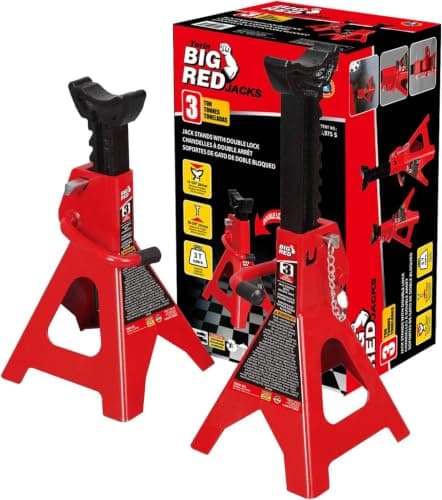
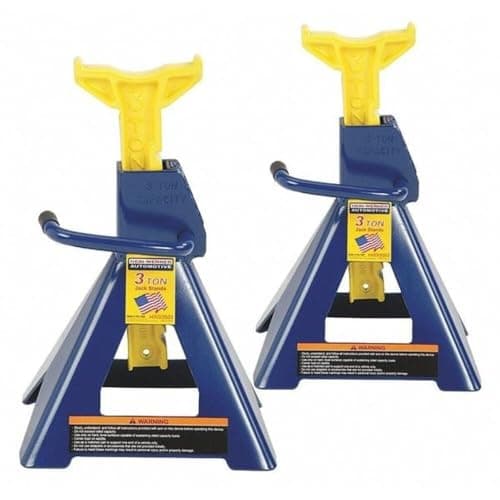
- Never support the car there. Stands go under the axle tubes or the manufacturer's named support points.
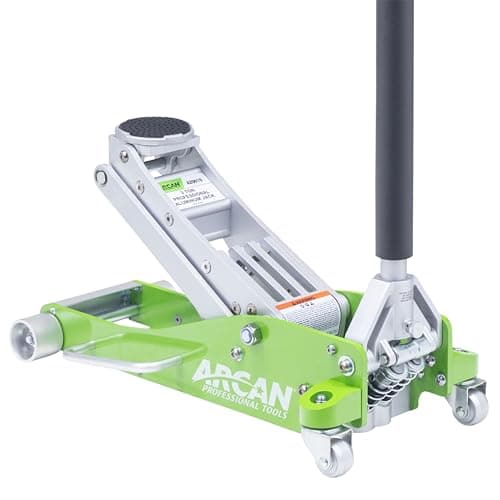
- Use a wide saddle and square the jack - a round housing will roll off a narrow one.
The solid axle case
A solid, or live, rear axle is a single steel beam running across the car with the differential in the middle of it and the wheels on its ends. It is a structural member that already carries the whole rear of the vehicle in normal use, and on a lot of pickups and older rear-drive cars the manufacturer names the differential housing as the point to lift the rear end from. Doing so raises both rear wheels together, which is exactly what you want for a differential service, a rear brake job on both sides or a tire rotation.
Three qualifications, all of which matter. First, it must be the housing - the cast or fabricated center section, or the axle tube immediately beside it - and never the cover plate. The cover is a thin stamped lid held on by a ring of bolts over a gasket, and a jack saddle under it bends it, breaks the seal and produces a leak you will be fixing instead of doing the job you started. Second, square the jack and use the widest saddle you have, because a round housing on a narrow saddle wants to roll. Third, your manual still decides: some manufacturers explicitly prohibit it even on a solid axle.
The independent rear suspension case
On a car with independent rear suspension there is no beam. The differential is a separate carrier, bolted into a rear subframe through rubber or hydraulic bushes, and each wheel moves on its own set of arms. Two problems follow. The carrier housing is frequently aluminum, cast for the loads it normally sees - driveline torque through its mounting points - rather than for a point load from underneath. And the mounts themselves are not designed to take the vehicle's weight in that direction; lifting on the carrier loads the bushes and the subframe brackets in a way nothing else ever does.
The consequences range from expensive to very expensive: a cracked carrier, a distorted mount, a leak at a seal that was not designed to be loaded. Which is why the answer on a modern car with independent rear suspension is almost always to use the lift points the manufacturer names - usually reinforced sill points or subframe mounts - and to leave the differential alone. Car jack points is the reference for finding them.
How to tell which you have, in one look
1.Get the car on level ground and look along the rear axle line
From behind the car, with a flashlight. You are looking for whether a single tube runs continuously from one wheel to the other.
2.Solid axle: one beam, wheel to wheel
A continuous housing with the differential bulge in the middle and a tube running out to each hub. Both wheels move together because they are physically joined.
3.Independent rear suspension: arms, not a beam
A compact differential carrier in the middle with two driveshafts running out to the hubs, and separate control arms for each wheel. Nothing continuous connects left to right.
4.Confirm it in the owner's manual
Whatever you see, the manual's named lift and support points are the authority. Looking at the car tells you which answer to expect; the manual tells you what is permitted.
Why the differential is never a support point
This is the part that matters most and the part people get wrong, including some who know the lifting answer. Lifting at the differential is a brief, controlled, supervised load with you standing beside the car. Supporting at the differential means leaving the vehicle's weight there for an hour while you work underneath, concentrated on a small contact patch, with nothing stopping the car rotating about that single central point if it is nudged.
A car resting on a single central stand is balancing, not supported. Push on a wheel and it will pivot. So the sequence on a solid axle is: lift at the differential, then place two stands - one under each axle tube, or at the support points your manual names - and lower the axle onto them. Now you have two widely spaced contact points and a car that cannot rotate. Where to put jack stands covers placement, and how many jack stands do I need covers how many the job takes.
What about a front differential, or a transfer case?
Same reasoning, usually a firmer no. On a four-wheel-drive vehicle the front differential is often integrated into or bolted onto the engine cradle, and a transfer case hangs off the transmission. Neither is designed to carry the vehicle through a point load from below, and a transfer case in particular is an aluminum case full of oil with a mounting arrangement that assumes it is hanging rather than supporting. Use the frame rails on a truck: where to jack up a truck covers those points.
If you do lift there, protect the contact
A bare steel jack saddle against a cast housing marks both and has very little friction. A rubber pad between the two - the kind of slotted or flat pad sold for pinch welds works here too - increases grip and spreads the contact patch. ESCO publishes a removable flat-top rubber cushion on its stands for a related reason. And keep the saddle away from the drain and fill plugs, the cover bolts and any breather fitting, all of which are on the housing and none of which are load paths.
The rule
If your manual names the differential housing as a rear lift point and your vehicle has a solid rear axle, lift there - on the housing or the tube beside it, never the cover, with a wide saddle and the jack square to the car. If you have independent rear suspension, or your manual does not name it, do not. And whatever the vehicle, the differential is where the lift happens and not where the car rests: two stands under the axle tubes or the named support points, every time.