Direct answer: on a body-on-frame truck, lift and support on the frame. At the front that means the boxed frame rail just behind the front wheel, at the point the owner's manual nominates. At the rear it means the rear axle housing, or the leaf spring perch where the axle meets the spring, again as the manual shows. Never the bumper, never a control arm, never the differential cover, and never the body sill — that last one is the point a car uses, and a truck body is not carrying that load.
Why a truck is different from a car
A unibody car has no separate frame. Its load paths run through the shell, which is why car lift points are reinforced sections of the sill and why pinch welds matter so much on a car and barely at all on a pickup. A body-on-frame truck is a ladder frame with a body bolted on top. The frame carries everything; the body is cargo.
That changes the whole job. The frame rail is a thick box section that will take a jack saddle anywhere along a long stretch of its length, which makes positioning easier than on a car — but it sits much higher off the ground, which makes the height of your equipment the limiting factor instead. Car jack points covers the unibody case; this page is the frame case.
The points, front and rear
| End | Lift with the jack | Support on stands | Never |
|---|---|---|---|
| Front | Frame rail behind the front wheel, or the front crossmember if the manual names it | Frame rail, both sides, saddle square across the box section | Bumper, lower control arm, steering components, sway bar |
| Rear | Rear axle housing near the center, or the spring perch | Frame rail behind the cab, or the axle if the manual allows it | Differential cover, leaf spring leaves, bumper, bed floor |
| One corner | Frame rail at that corner | Frame rail at that corner, plus a second stand at the other side | Any single-stand setup |
The manual is the authority for your specific truck, not this table. Manufacturers differ about whether the rear axle housing is an acceptable support point — some nominate it, some explicitly say the frame only — and that distinction is in the book, not in general advice.
The front
Work from under the front of the truck with a torch and find the frame rail: a straight boxed steel beam running fore and aft, inboard of the wheel. The lift point is usually a plain section of that rail a little behind the front wheel, clear of brake lines, fuel lines and the steering box. Put the jack saddle square across the rail's width so it cannot slide off an edge.
Some trucks nominate the front crossmember instead, which lifts both sides at once. If the manual names it, it is a legitimate and convenient point — but check what is mounted to it before you load it, because on some vehicles the crossmember also carries the steering rack or an engine mount.
The rear
On a solid rear axle — which most pickups have — the axle housing itself is the usual jacking point, taken near the center but off to one side of the differential rather than on it. The differential cover is sheet metal over a gasket: it holds oil, not a truck. Lifting there dents the cover and can start a leak that only shows up a week later.
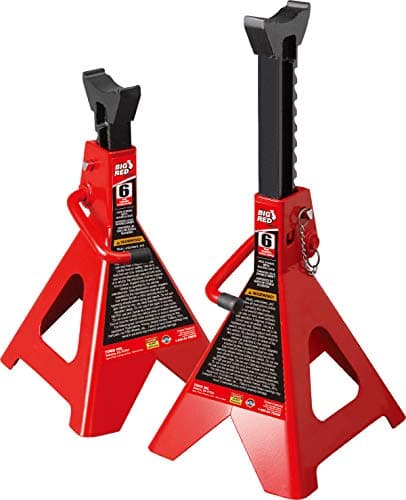
The spring perch, where the axle tube meets the leaf spring, is the other common nominated point and it is a solid one. Once the rear is up, the stands normally go under the frame rails behind the cab rather than under the axle, because supporting on the frame lets the suspension hang and gives you access to it. Where to put jack stands goes through the stand placement decision properly.
Height is the real constraint on a truck
The short version
- The frame rail starts high. A 3-ton stand topping out at 17 in may not reach it at a useful working height on a full-size pickup, let alone a lifted one.
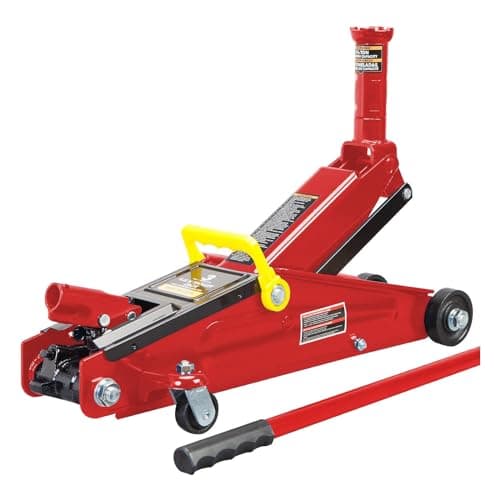
- The jack has to out-reach the stand setting. If you are placing a stand at 20 in, a jack with an 18 in maximum cannot do it.
- Longer jack, easier job. Reaching a frame rail from beside a wide truck wants a long body, not just a tall lift.
- A lifted truck changes everything again. Suspension lift raises the frame without raising the tires, so the gap between the ground and the rail grows.
Check your own numbers before you buy anything. How high does a floor jack lift lists the published maximum for every jack on this site, and best floor jack for lifted trucks is the roundup for the extreme case.
If your "truck" is not body-on-frame
Some modern pickups and most crossovers are unibody, with no separate ladder frame at all. On those, the lift points are reinforced body sections much like a car's, and the frame-rail advice on this page does not apply. The tell is in the manual diagram: if it shows a notch in a sill seam, you have a unibody. If it shows a straight steel beam, you have a frame.
For unibody SUVs and crossovers, best jack stands for an SUV splits the two cases, and the pinch-weld stand roundup covers protecting a seam.
The rule for a truck
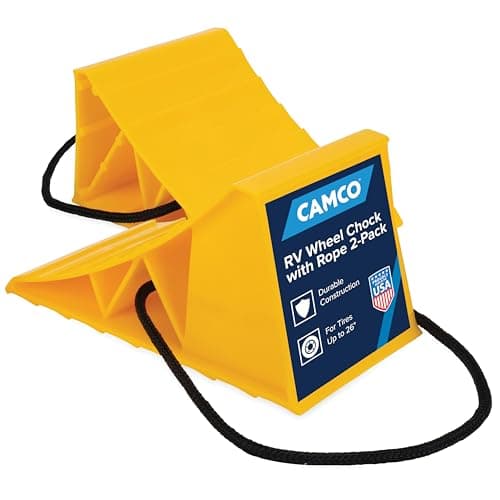
Frame at the front, axle or spring perch to lift at the rear, frame to support at both ends unless the manual says otherwise. Never a bumper, a control arm or a differential cover. Two stands minimum, at matched heights, set before the lift starts. Flat concrete, a chock at the far end, and the shove test before you go under. The full generic sequence is in how to jack up a car safely — everything there applies to a truck, with more weight and more height.