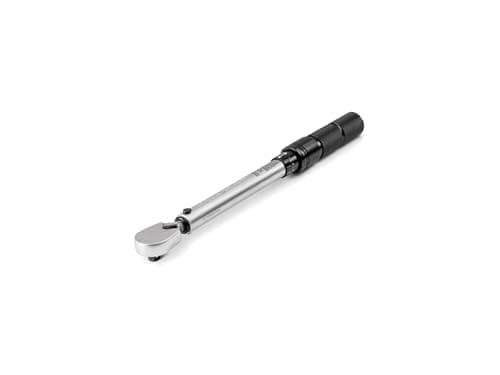
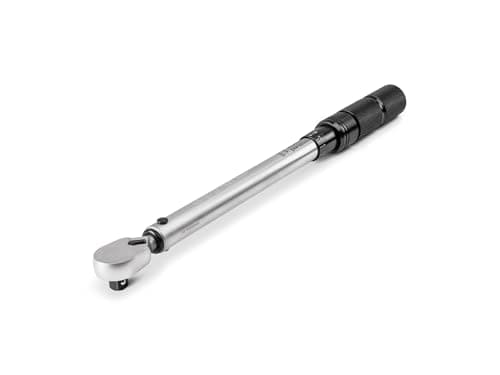
Top pick: the TEKTON TRQ51402, a 3/8 in drive wrench covering 10 to 100 ft-lb — because spark plug torque is low, and 3/8 in is the drive size plug sockets and extensions are built for. NGK publishes a table of plug torque by thread diameter and seat type, and the whole automotive range sits between roughly 7 and 32 lb-ft. A 40 to 200 ft-lb lug nut wrench cannot measure any of it.
What spark plugs are actually torqued to
NGK publishes figures by thread diameter, seat type and cylinder head material. These are the manufacturer's general figures, not a substitute for your engine's service information — but they show the band a wrench has to cover.
| Seat type | Thread | Cast iron head | Aluminum head |
|---|---|---|---|
| Flat seat (with gasket) | 18 mm | 25.3 - 32.5 | 25.3 - 32.5 |
| Flat seat (with gasket) | 14 mm | 18.0 - 25.3 | 18.0 - 21.6 |
| Flat seat (with gasket) | 12 mm | 10.8 - 18.0 | 10.8 - 14.5 |
| Flat seat (with gasket) | 10 mm | 7.2 - 10.8 | 7.2 - 8.7 |
| Flat seat (with gasket) | 8 mm | Not published | 5.8 - 7.2 |
| Conical seat (no gasket) | 18 mm | 14.5 - 21.6 | 14.5 - 21.6 |
| Conical seat (no gasket) | 14 mm | 10.8 - 18.0 | 7.2 - 14.5 |
| Conical seat (no gasket) | 12 mm | Not published | 7.36 - 14.75 |
Two things fall out of that table. NGK notes that under-torquing leaves the plug not fully seated so it cannot dissipate heat to the cylinder head, while over-torquing can stretch the metal shell, crack the threads and break the inner gas seals. And the whole automotive range tops out around 32 lb-ft — which is below the starting point of the 40 to 200 ft-lb wrench most people own for wheels.
Why drive size decides this
The short version
- A wrench cannot measure below the bottom of its scale. A 40 to 200 ft-lb wrench will not read 20 lb-ft at all - it is not a question of accuracy, it simply does not go there.
- A click wrench is least accurate at the extremes of its range, so a figure sitting at the very bottom of the scale is the second-worst case after one outside it.
- Spark plug sockets, swivels and extensions are overwhelmingly 3/8 in drive. Matching the wrench to the socket avoids a stack of adapters in a deep well.
- Below about 17 lb-ft you are in inch-pound territory, where a 1/4 in drive wrench reading in 1 in-lb steps resolves the figure properly.
The general rule behind all of this is in what size torque wrench do I need: get the target figure near the middle of the wrench's range rather than at either end.
Reading the units correctly
Twelve inch-pounds make one foot-pound, and plug specifications are published in all three of lb-ft, in-lb and Nm depending on who wrote them. Mixing them up on a spark plug is expensive: setting 20 Nm when the spec said 20 lb-ft means applying about a third less torque than intended, and setting 20 lb-ft when the spec said 20 Nm means applying about half again too much into an aluminum head.
| If the spec says | In lb-ft | In in-lb | In Nm |
|---|---|---|---|
| 10 lb-ft | 10 | 120 | 13.6 |
| 15 lb-ft | 15 | 180 | 20.3 |
| 18 lb-ft | 18 | 216 | 24.4 |
| 25 lb-ft | 25 | 300 | 33.9 |
Technique matters more here than on wheels
1.Clean the plug hole and the seat
Blow or brush out debris before the plug goes anywhere near the thread. Dirt in the thread absorbs torque the wrench thinks is going into the joint.
2.Start the plug by hand
Finger-tight, with a length of hose on the plug if the well is deep. If it does not turn freely by hand, stop and find out why rather than reaching for the wrench.
3.Set the wrench to the published figure for your plug and head
Thread diameter, seat type and head material all change the number. Set it, confirm the unit, and double-check the lock.
4.Pull smoothly to the first click and stop
One click. At these low settings the click is faint, so watch and feel for the head deflecting rather than listening for a noise.
5.Wind a click wrench back to its lowest setting
Before it goes back in the case, every time, unless it is a split-beam or electronic wrench that does not need it.
On the fourth step: Park Tool notes that once the head of the wrench deflects, the set torque value has been achieved, and turning past that point over-tightens the fastener. That matters at 18 lb-ft in an aluminum head far more than it does at 100 lb-ft on a steel wheel stud. Does a torque wrench click once or twice is the full answer to the question that creates.
What we would buy
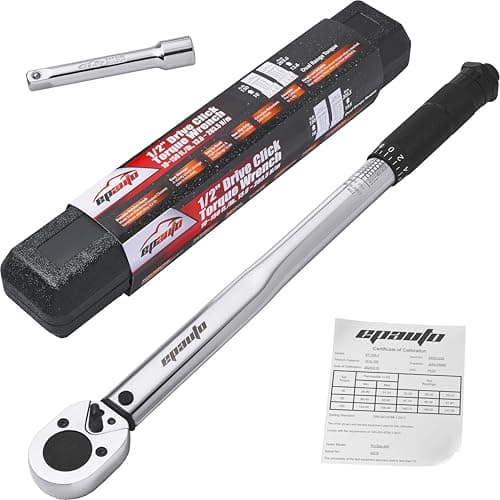
A 3/8 in drive 10 to 100 ft-lb wrench if your car runs 14 mm plugs, which most do — it covers the plug band and doubles as the brake and accessory wrench. Add a 1/4 in drive in-lb wrench if you also work on motorcycles, small engines or anything with 8 to 12 mm plugs, because those specifications are below what a ft-lb scale can resolve. Buy the 1/2 in 10 to 150 ft-lb wrench only if it is the one wrench you are going to own, and accept that you are working at the bottom of its scale.