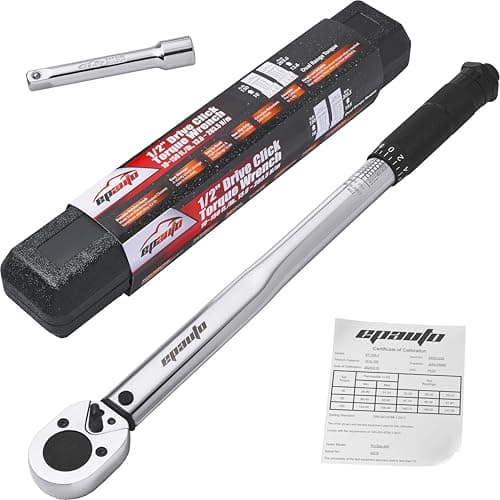
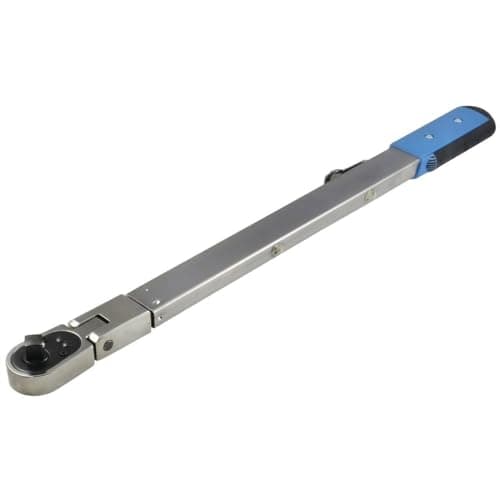
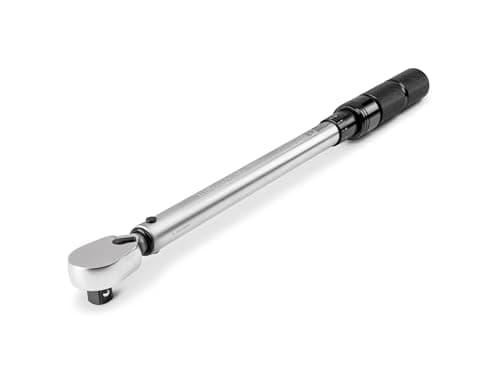
Short answer: a lug wrench is for getting wheel nuts off and running them back on; a torque wrench is for tightening them to the figure in your handbook. You need both, in that order, and neither does the other job. A lug wrench has no measuring mechanism at all, so it cannot tell you when to stop. A torque wrench has one, which is exactly why it must never be used to crack a seized nut.
What each tool actually is
The lug wrench
A simple lever with a socket on the end, supplied with your car, usually as an L-shape or a four-way cross. Its job is mechanical advantage: enough leverage to break a nut loose at the roadside with nothing else available. It has no scale, no spring and no mechanism. It cannot be calibrated because there is nothing to calibrate.
A four-way cross wrench is better than the folding L-bar in your trunk for driveway work, because you can spin nuts quickly with both hands. A breaker bar with a long handle is better again for genuinely seized nuts, and that is the comparison in torque wrench vs breaker bar.
The torque wrench
A measuring instrument with a ratchet on the end. You set a target, tighten until it signals, and stop. The signal is a click, a beep or a vibration depending on type, and the whole value of the tool is the moment it tells you to stop pulling. Everything about its design — the spring, the scale, the calibration certificate — serves that one function.
The comparison, line by line
| Lug wrench | Torque wrench | |
|---|---|---|
| Purpose | Apply force | Measure force |
| Loosening nuts | Yes — this is its job | No, never |
| Tightening to a spec | No — it has no scale | Yes — this is its job |
| Measuring mechanism | None | Spring and scale, or strain gauge |
| Needs calibration | No | Yes, periodically |
| Roadside use | Yes — it lives in the car | No, leave it in the garage |
| Cost | Usually supplied with the car | A real purchase |
| Can it be ruined by misuse | Practically no | Yes, in one wrong pull |
Read the last row. The asymmetry in this comparison is that misuse only hurts one of the two tools. Using a torque wrench to break a nut loose applies a force well beyond its calibrated range, which puts the measurement out and leaves you with a wrench that still clicks and now lies.
What to look for in the torque wrench half
You almost certainly already own a lug wrench; it came with the car. So the decision is which torque wrench to add, and three things decide it.
1. A range that brackets your wheel spec
Most passenger cars sit between 80 and 100 ft-lb, and light trucks run higher. A 40-200 ft-lb wrench puts a typical car spec near the middle of the scale, which is where a click wrench is at its best. Check your own figure first — the lug nut torque chart collects published specifications by thread size, and your owner's handbook overrides it.
2. A signal you cannot miss
You will be crouched beside a wheel, possibly on a driveway, and the click is the entire user interface. A loud mechanical click is the best thing a beginner can buy; the question of whether to stop at the first one is answered in does a torque wrench click once or twice.
3. Whether storage can ruin it
A micrometer click wrench must be wound back to its lowest setting after every use. A split-beam does not have to be. If you are honest with yourself about whether you will remember, that honesty is worth money.
Why the spec matters at all
Under-tightened wheel nuts work loose. Over-tightened ones stretch the stud past its elastic limit, distort the brake rotor, and turn the next removal into a snapped stud — which is why re-torque guidance exists at all. Wheel manufacturers publish it: Alcoa's own wheel guidance covers torque and re-torque, and Continental publishes a re-torquing procedure after wheel fitment. Neither is achievable with a lug wrench and a sense of how tight feels right.
The impact-wrench version of this mistake is worse again, and it is covered in torque wrench vs impact wrench. An impact gun is the fastest way to over-torque a wheel ever invented.
What we would own
The lug wrench that came with the car stays in the car, for the roadside. Add a four-way cross wrench or a breaker bar if you do your own tire rotations and the trunk tool is making you miserable. Then buy one torque wrench — the TEKTON TRQ52402 if you want the standard answer, the EPAuto if price is the obstacle, the Precision Instruments C3FR250F if you expect to be doing this for a decade. Use the first to take nuts off and the second to put them back, and never the other way around.