Skip to content
JACK & TORQUE

Safety guide

Can You Use Car Ramps on Gravel?

The ramp does not fail on gravel. The ground under it does, in the first second of the climb.

By Ryder M. · Published October 6, 2026 · Last reviewed October 6, 2026

We earn a commission when you buy through the Amazon links on this page, at no extra cost to you. It never changes which tool we put first, and we publish no price we have not verified. How this site is funded.

Can You Use Car Ramps on Gravel? — ranked picks with scores and a price check for each
#PickCapacityScorePrice
1
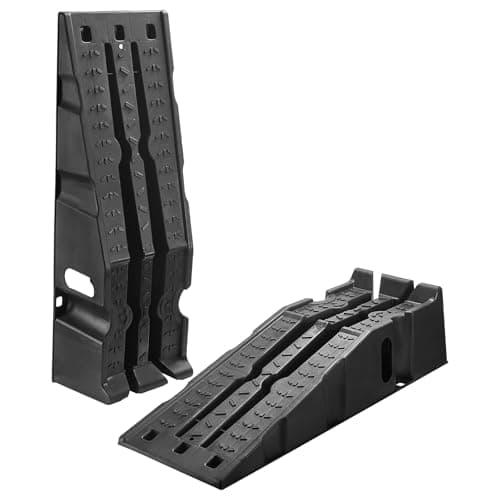
VEVOR Car Service Ramps (16,000 lb GVW, 6.7 in Lift), Amazon product photo
VEVOR Car Service Ramps (16,000 lb GVW, 6.7 in Lift)Best grip on a hard floor
16,000 lb GVW per pair8.9
2
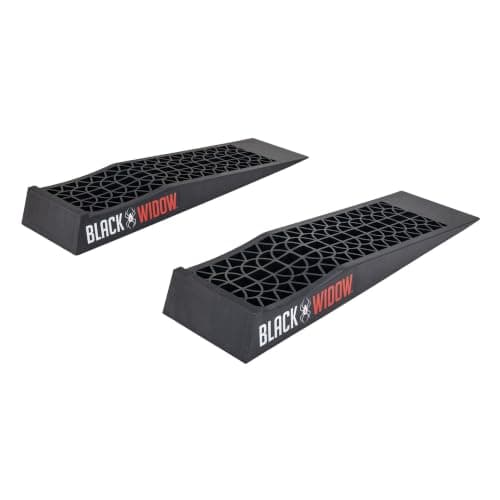
Black Widow Low-Profile Plastic Service Ramps (6009-V2), Amazon product photo
Black Widow Low-Profile Plastic Service Ramps (6009-V2)Lightest wedge, most at risk
5,000 lb per axle (10,000 lb GVW)8.0
3
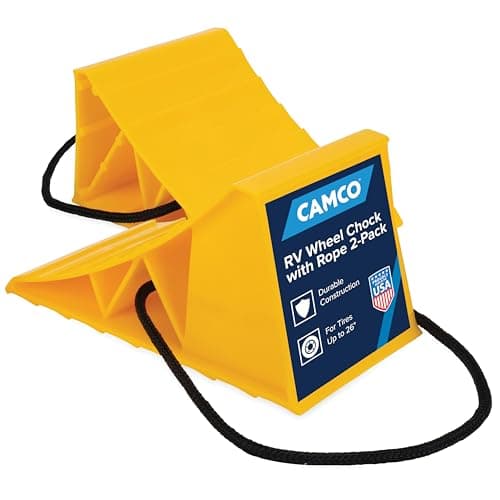
Camco 44471 Wheel Chock with Rope (2-Pack), Amazon product photo
Camco 44471 Wheel Chock with Rope (2-Pack)What to use on gravel instead
2 chocks9.0

Product photographs come from each product's own Amazon listing via the Associates program. They are the seller's images, not photographs of anything we own — we have no test rig and claim none.

VEVOR Car Service Ramps (16,000 lb GVW, 6.7 in Lift), Amazon product photo

Short answer: no. Car ramps need a surface that will hold them still while a rotating tire pushes against them, and gravel cannot do that. The ramp slides forward on the loose stones as the tire meets it, the car does not climb, and the moment it does start to climb the ramp can shoot out. Grass, dirt, bark and a dusty concrete floor all fail the same way; a slope fails worse.

What actually happens

Driving onto a ramp is a friction problem. The tire pushes the ramp forward with real force, and the only thing resisting that is friction between the ramp's base and the ground. On clean concrete the base grips and the tire climbs. On gravel, the stones under the base roll — the ramp is effectively on ball bearings. There is nothing wrong with the ramp and nothing you can do with your right foot that fixes it.

The short version

  • Gravel rolls. A non-skid base grips a solid surface; on loose stone there is no solid surface to grip.
  • Gravel also settles unevenly. Even if a ramp stays put, one side can sink more than the other and the ramp ends up twisted under load.
  • Grass and soil deform. The ramp presses in, the approach angle steepens, and the car stops climbing partway up.
  • A slope removes the margin entirely. Gravity is already pushing the ramp away from the tire before you touch the throttle.
  • A dusty concrete floor behaves like fine gravel. Sweeping it is free and it is the single most effective thing you can do before using ramps.

Does plywood under the ramps fix it?

It is the usual suggestion and it is not good enough. A sheet of plywood on gravel gives the ramp a hard surface to grip, but the plywood itself is now the thing sitting on rolling stones — you have moved the sliding interface down a layer, not removed it. The sheet can also flex and rock as the tire load moves across it, and it can sink on one side.

We say no to it for the same reason we say no to blocks under a jack: it is a home-made load path with no rating, solving a problem that has a free solution (do the job somewhere else). If you have no choice at all about the surface, the honest discussion is in jacking up a car on gravel, and the conclusion there is the same: get the car onto a slab.

Surface by surface

Where ramps work and where they do not
SurfaceVerdictWhat fails
Clean, flat concreteYesNothing, if the ramp is rated for the car
Swept garage floorYesDust is the variable - sweep it first
Sound, flat asphaltCautionGrips well cold; softens and dents in summer heat
Gravel or loose stoneNoThe base slides on rolling stone; uneven settling twists the ramp
Grass or soilNoThe ramp presses in, the angle steepens, the climb stalls
Any slopeNoGravity pushes the ramp away before the tire loads it
Wet or oily concreteNoFriction is the whole mechanism, and it is gone
Where ramps work and where they do not

What to do instead

In order of preference. First, move the car — a neighbour's garage, a relative's driveway, a level concrete pad at the back of the property. This is almost always possible and it is always the right answer. Second, if the job is an oil change or a filter and the car has enough ground clearance, do it without lifting at all. Third, book it in. Paying someone once is cheaper than any outcome that involves a car coming off a support.

What is not on the list is a floor jack and stands on the same gravel. Stands concentrate load on an even smaller footprint than a ramp does, so gravel is worse for stands, not better. Car ramps versus jack stands compares the two methods on a surface where both actually work.

The asphalt caveat

Asphalt is the surface people get wrong in the other direction. It grips fine — friction is not the problem — but it deforms under a concentrated load, and more so when it is warm. A ramp spreads load over a much larger area than a jack stand, so ramps on sound asphalt in cool weather are a reasonable compromise where concrete is not available. On a hot afternoon, or on an old driveway that already shows tire impressions, it is not.

The rule

Ramps need a hard, flat, clean, level surface, and gravel is none of those things. No ramp design, non-skid base, plywood sheet or careful driving changes that. Sweep a concrete floor and ramps are the easiest and safest way to get under a car; the ramp roundup is where to start, and do I need jack stands with ramps answers the next question most people have.

The picks in full

Every pick, in detail

VEVOR Car Service Ramps (16,000 lb GVW, 6.7 in Lift), Amazon product photo

1. Best grip on a hard floor

VEVOR Car Service Ramps (16,000 lb GVW, 6.7 in Lift)

VEVOR · score 8.9/10

16,000 lb GVW rating, a 17-degree incline and a deep-grooved honeycombed surface — the default answer for oil changes on anything that is not slammed.

A deep-grooved honeycombed surface and 16,000 lb GVW per pair. This is the most grip VEVOR publishes for a ramp surface, and it still needs a hard flat floor — a non-skid base works by gripping a solid floor, so on loose stone it has nothing to grip. Worth owning precisely because it reduces the one failure mode ramps actually have, on the surface where ramps belong.

Published specifications

Capacity
16,000 lb GVW per pair VEVOR
Per ramp
4,000 lb VEVOR
Incline
17 degrees VEVOR
Lift height
6.7 in VEVOR
Dimensions
35.8 in x 12 in x 8.5 in VEVOR
Material
Impact-resistant PP VEVOR

What works

  • GVW rating covers almost any car, crossover or half-ton pickup
  • Deep-grooved honeycombed surface holds the tire instead of letting it creep
  • Stackable shape stores against a garage wall or in a trunk

What you give up

  • A 17-degree incline is too steep for low front bumpers
  • Ramps only ever support the front axle — wheels stay on
  • VEVOR publishes no non-skid base, so these need flat, clean ground

Our scoring

  • Fit & reach8.4
  • Safety margin8.8
  • Beginner ease9.4
  • Build quality8.4
  • Value9.2
$71.50 · View on Amazon

#ad Price as of October 16, 2026. How this is funded

Specifications published by VEVOR — we earn nothing from that link.

Black Widow Low-Profile Plastic Service Ramps (6009-V2), Amazon product photo

2. Lightest wedge, most at risk

Black Widow Low-Profile Plastic Service Ramps (6009-V2)

Black Widow · score 8.0/10

A 9.05-degree loading angle at 4-1/2 lb per ramp — the gentlest approach angle you can buy cheaply, at the cost of only 2-1/2 in of lift.

A 9.05-degree loading angle on a 27-1/2 in ramp, 5,000 lb per axle, at 4-1/2 lb per ramp. Beautifully shallow for a low car, and the lightest thing here — which on gravel is the worst combination, because a light ramp with a plastic base slides before the tire has even climbed it. On clean concrete, the low angle is the whole point.

Published specifications

Capacity
5,000 lb per axle (10,000 lb GVW) Retail listing
Lift height
2-1/2 in Retail listing
Loading angle
9.05 degrees Retail listing
Dimensions
27-1/2 in x 7-3/4 in x 3 in Retail listing
Weight
4-1/2 lb per ramp Retail listing

What works

  • 9.05-degree angle is gentler than most ramps costing many times more
  • Honeycomb channels stop water pooling in storage
  • Light enough to carry in one hand

What you give up

  • 2-1/2 in of lift is a clearance aid, not a working height
  • A 10,000 lb GVW rating is the lowest here — check your vehicle's weight first
  • Long and thin, so it needs a flat run-up

Our scoring

  • Fit & reach7.8
  • Safety margin7.4
  • Beginner ease9.0
  • Build quality7.6
  • Value9.0
$47.99 · View on Amazon

#ad Price as of October 16, 2026. How this is funded

Specifications published by Black Widow — we earn nothing from that link.

Camco 44471 Wheel Chock with Rope (2-Pack), Amazon product photo

3. What to use on gravel instead

Camco 44471 Wheel Chock with Rope (2-Pack)

Camco · score 9.0/10

A pair of UV-stable plastic chocks with pull ropes, sized for tires up to 26 in — the cheapest part of a safe lift and the one people skip.

If you are stuck working on a loose surface, chocking becomes more important rather than less, because nothing else is holding the car. A chock with a rope can be set and retrieved without reaching under a vehicle. It does not make gravel safe to lift on — nothing does — but it is the first thing to get right on any surface that is not a slab.

Published specifications

Quantity
2 chocks Camco listing
Fits tires
Up to 26 in diameter Camco listing
Removal
Attached rope handle Camco listing
Material
Hard plastic with UV inhibitors Camco listing
Origin
Made in the USA Camco listing

What works

  • The rope means you can pull it out without reaching under the car
  • Two in the box, which is the number you actually need
  • UV inhibitors mean it survives being left outside

What you give up

  • Rated for tires up to 26 in — too small for a truck tire
  • Plastic can slide on a dusty or oily floor
  • Camco publishes no chock dimensions or rope length

Our scoring

  • Fit & reach8.8
  • Safety margin8.8
  • Beginner ease9.6
  • Build quality8.2
  • Value9.6
$17.99 · View on Amazon

#ad Price as of October 16, 2026. How this is funded

Specifications published by Camco — we earn nothing from that link.

Method

How these picks were chosen

We did not test these tools. We do not run a laboratory, we have not loaded a jack to failure or checked a wrench on a calibration bench, and we will not tell you otherwise. What we did instead is read the published manufacturer specifications, check the figures that matter against the safety standard that applies to portable automotive lifting equipment, and work out which tool suits which job. Every number on this page links to where it came from, so you can check us.

The five things we score are the five that decide a first purchase: will it fit under and lift your car, how much safety margin the rating and the locking mechanism leave you, how hard it is to get right alone in a driveway, what the materials and published standards say about how long it lasts, and what the money buys against the rest of the field.

Read the full method — including how we pick a top pick, and how prices get on the page.

Questions

Frequently asked questions

+Can I put plywood under car ramps on gravel?

We do not recommend it. The plywood gives the ramp something to grip, but the sheet is then the thing sitting on rolling stones, and it can flex or sink on one side under load. It moves the sliding interface rather than removing it.

+Can you use car ramps on grass?

No. The ramp presses into soft ground, which steepens the approach angle and stalls the climb, and uneven settling can twist the ramp under load. Grass and soil fail the same way gravel does, just more slowly.

+Can you use car ramps on a slope?

No. On an incline, gravity is already pushing the ramp away from the tire before you apply any throttle, and the car is harder to hold once it is up. Flat ground only, measured with a level if you are unsure.

+Is asphalt safe for car ramps?

Sound, flat, cool asphalt is a reasonable compromise, because a ramp spreads load over a far larger area than a jack stand does. Hot asphalt, or a driveway that already shows tire impressions, will deform under the ramp. Concrete remains the right surface.

Sources

Where these figures come from

Read next

Related reading