Skip to content
JACK & TORQUE

Surface guide

Car Ramps on a Sloped Driveway

A gradient does two things at once: it alters the approach angle, and it gives everything a direction to move in.

By Ryder M. · Published October 17, 2026 · Last reviewed October 17, 2026

We earn a commission when you buy through the Amazon links on this page, at no extra cost to you. It never changes which tool we put first, and we publish no price we have not verified. How this site is funded.

Car Ramps on a Sloped Driveway — ranked picks with scores and a price check for each
#PickCapacityScorePrice
1
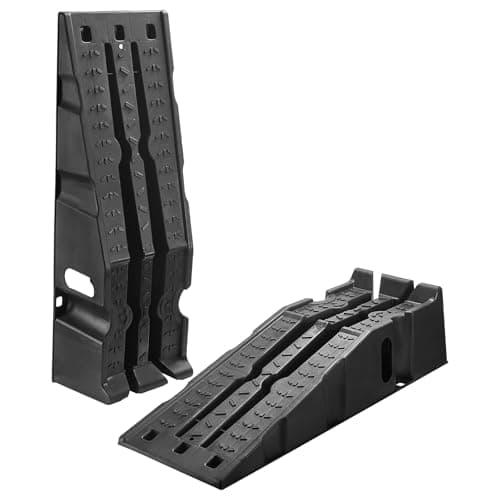
VEVOR Car Service Ramps (16,000 lb GVW, 6.7 in Lift), Amazon product photo
VEVOR Car Service Ramps (16,000 lb GVW, 6.7 in Lift)The most slope tolerance of the ramps here
16,000 lb GVW per pair8.9
2
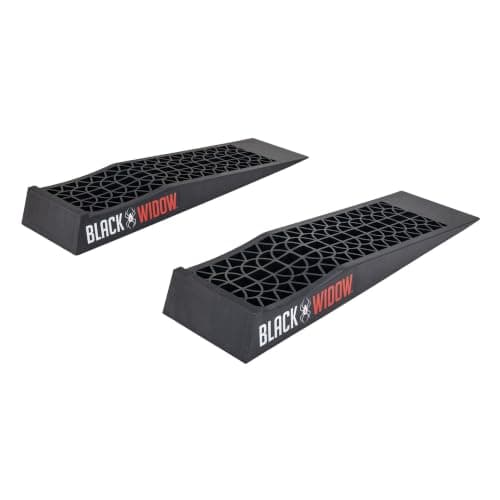
Black Widow Low-Profile Plastic Service Ramps (6009-V2), Amazon product photo
Black Widow Low-Profile Plastic Service Ramps (6009-V2)Shallowest angle, lowest lift
5,000 lb per axle (10,000 lb GVW)8.0
3
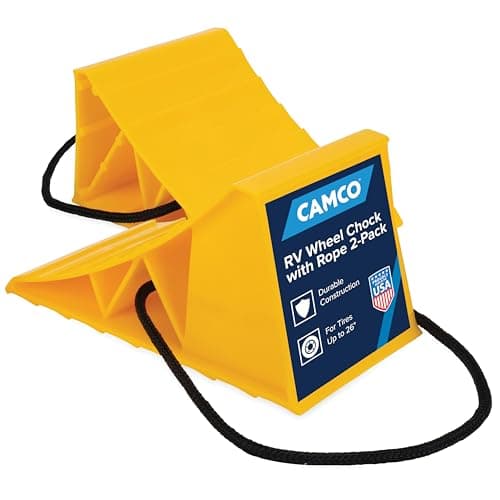
Camco 44471 Wheel Chock with Rope (2-Pack), Amazon product photo
Camco 44471 Wheel Chock with Rope (2-Pack)The part you cannot skip on a slope
2 chocks9.0

Product photographs come from each product's own Amazon listing via the Associates program. They are the seller's images, not photographs of anything we own — we have no test rig and claim none.

VEVOR Car Service Ramps (16,000 lb GVW, 6.7 in Lift), Amazon product photo

Short answer: you can, on a gentle, hard, uncracked slope, with chocks and with the geometry checked first - but it is the hardest version of this job and the honest answer on anything steep is to move the car. A gradient does two separate things. It changes the effective angle between your front bumper and the ramp face, which can turn a ramp that fits your car on the flat into one that does not. And it gives both the ramps and the car a direction to slide in, which is the failure that actually hurts people.

The short version

  • The slope adds to the ramp angle on one approach direction and subtracts on the other. Check clearance on the actual driveway, not on a flat garage floor.
  • Ramps slide. Driving up a ramp pushes it away; a slope makes that easier. Chock the ramps themselves if you can.
  • Chock the grounded wheels on the downhill side - the parking brake works on one axle only.
  • Shallower published angles leave more margin. Black Widow publishes 9.05 degrees; VEVOR publishes 17.
  • Across the slope is worse than along it. Never put one ramp higher than the other.

What a slope does to the approach angle

A ramp manufacturer publishes a loading angle measured on level ground: Race Ramps publishes 6.8 degrees for the RR-72-2, steepening to 10.8 degrees near the top; Black Widow publishes 9.05 degrees for the 6009-V2; VEVOR publishes a 17-degree incline. Those figures assume the car and the ramp are on the same flat plane. On a driveway with a gradient they are not.

The consequence is simple to state and easy to get backwards, so the reliable approach is to stop reasoning about it and measure instead. Put the ramps where you intend to use them, on the actual slope, in the actual direction you will drive. Then push the car to the ramp face by hand - or creep it forward until the tire just touches - and look at the gap between your front bumper, lip or air dam and the ramp surface. If the bodywork is going to contact before the tire climbs, you have your answer, and no amount of arithmetic changes it. Car ramp angle and clearance covers that check in full on level ground.

The other geometric problem is less obvious: at the top of the climb the car is sitting partly on the ramp plateau and partly on the driveway, which means its attitude is the slope plus the lift rather than just the lift. For an oil change that matters, because a tilted sump does not drain completely, and the direction of tilt decides whether that works for you or against you.

Why ramps slide, and what to do about it

Driving a car up a ramp applies a horizontal force to the ramp through the tire. On a level garage slab the ramp's footprint and the friction under it resist that force. Add a gradient and three things change at once: the friction available is reduced, gravity is already pulling the ramp in one direction, and the tire now meets the ramp face at a different angle so more of the force is pushing rather than lifting.

Light ramps are worse here, and the published weights say so: Black Widow publishes 4-1/2 lb per ramp for the 6009-V2, and Race Ramps publishes 14 lb for the RR-72-2. A 4-1/2 lb ramp has almost no mass to resist being shoved. The practical fixes, in order of how much they help:

  1. 1.Back the ramps against something immovable

    A garage threshold, a curb, a wall. If the ramp physically cannot slide away because something solid is behind it, the problem is solved rather than managed. This is the only fix we would describe as reliable.

  2. 2.Chock behind the ramps

    A wheel chock, a length of timber battened to the driveway, anything that stops the ramp traveling. Not as good as a curb, considerably better than nothing.

  3. 3.Have a second person watch the ramps, not the car

    Movement is easy to see and almost impossible to feel from the driver's seat. Agree on a stop signal before you start.

  4. 4.Drive up slowly, in one continuous movement

    Stopping halfway up and restarting applies a fresh shove to a ramp that is already loaded. A single slow, steady climb is both easier on the ramp and easier to abort.

  5. 5.Stop at the first sign of movement

    Reverse off, reposition, and reconsider whether the driveway is suitable at all. A ramp that moved once will move again.

Which way should the car point?

Point it up the slope if you have the choice, for two reasons that have nothing to do with the ramps. First, a car facing uphill with its drive wheels up on ramps leaves the grounded wheels downhill, which is where chocks are easiest to place effectively. Second, if anything does let go, a car facing uphill rolls backwards off the ramps rather than forwards off the plateau - a drop of a couple of inches rather than a fall off the end.

What you should never do is put the ramps across the slope, with one ramp sitting higher than the other. That loads the ramps unevenly, puts the car off level sideways, and leaves it leaning on the downhill ramp - which is the one with the least resistance to sliding. The car has to be square to the gradient.

Slope is not the same problem as surface

Worth separating, because a sloped driveway is often also a gravel or an old cracked one, and those are different failures. A gradient is a geometry and friction problem. A soft or loose surface is a load-spreading problem - the ramp sinks or the stones roll under it regardless of how level the ground is. Can you use car ramps on gravel? deals with that properly, and the short version there is that gravel is a no. If your driveway is both sloped and loose, you have two problems and the answer is to find somewhere else to work.

Hot asphalt is the specific case worth naming. A ramp footprint on softened asphalt in summer presses in, which both tilts the ramp and reduces its contact area. On a slope that tilt is in the direction gravity already wants, so the two effects compound.

What to do instead

Three options, in the order we would try them. Move the car - most houses have somewhere flatter within a short drive, and a level public car park or a friend's garage floor turns a marginal job into a routine one. Use the flattest part of the driveway, which on many drives is the apron right at the garage door, where you also get a threshold to back the ramps against. Or switch tools entirely: a jack and stands on a level surface is safer than ramps on a slope, and car ramps vs jack stands compares the two honestly.

The one thing we would not recommend is building up the downhill ramp with boards to level the car. Stacked timber under a ramp adds another interface that can slide, concentrates load on whatever is under it, and is exactly the kind of shortcut that turns a stable setup into an unstable one.

The rule

Gentle slope, hard uncracked surface, car pointing uphill, ramps backed against something solid, grounded wheels chocked, and the bumper clearance checked on the driveway itself rather than assumed from the published angle: that is a job you can do. Anything steeper, looser, or across the gradient, and the right answer is to move the car. Ramps are the easiest tool in this category precisely because they are used on level ground; a slope takes that advantage away.

The picks in full

Every pick, in detail

VEVOR Car Service Ramps (16,000 lb GVW, 6.7 in Lift), Amazon product photo

1. The most slope tolerance of the ramps here

VEVOR Car Service Ramps (16,000 lb GVW, 6.7 in Lift)

VEVOR · score 8.9/10

16,000 lb GVW rating, a 17-degree incline and a deep-grooved honeycombed surface — the default answer for oil changes on anything that is not slammed.

VEVOR publishes a 17-degree incline, 6.7 in of lift, 4,000 lb per ramp and a 35.8 in length in impact-resistant PP. A short, steep ramp is the worst choice for a car with a low front lip on the flat - but on a slope its shortness is an advantage, because a 35.8 in ramp needs far less level ground under it than a 72 in one. If your driveway has a flat landing at the top of the slope that is only a few feet deep, this is the shape of ramp that fits on it. The steep angle is still steep; check your bumper clearance before you buy.

Published specifications

Capacity
16,000 lb GVW per pair VEVOR
Per ramp
4,000 lb VEVOR
Incline
17 degrees VEVOR
Lift height
6.7 in VEVOR
Dimensions
35.8 in x 12 in x 8.5 in VEVOR
Material
Impact-resistant PP VEVOR

What works

  • GVW rating covers almost any car, crossover or half-ton pickup
  • Deep-grooved honeycombed surface holds the tire instead of letting it creep
  • Stackable shape stores against a garage wall or in a trunk

What you give up

  • A 17-degree incline is too steep for low front bumpers
  • Ramps only ever support the front axle — wheels stay on
  • VEVOR publishes no non-skid base, so these need flat, clean ground

Our scoring

  • Fit & reach8.4
  • Safety margin8.8
  • Beginner ease9.4
  • Build quality8.4
  • Value9.2
$71.50 · View on Amazon

#ad Price as of October 17, 2026. How this is funded

Specifications published by VEVOR — we earn nothing from that link.

Black Widow Low-Profile Plastic Service Ramps (6009-V2), Amazon product photo

2. Shallowest angle, lowest lift

Black Widow Low-Profile Plastic Service Ramps (6009-V2)

Black Widow · score 8.0/10

A 9.05-degree loading angle at 4-1/2 lb per ramp — the gentlest approach angle you can buy cheaply, at the cost of only 2-1/2 in of lift.

Black Widow publishes a 9.05-degree loading angle, 2-1/2 in of lift, 5,000 lb per axle and 4-1/2 lb per ramp across a 27-1/2 in length. On a gradient the shallow angle is the useful half: a slope effectively adds to or subtracts from the angle your car meets, and starting from 9 degrees leaves you margin that a 17-degree ramp does not. The trade-off is in the same specification - 2-1/2 in of lift is not much working room, and at 4-1/2 lb these are light enough to be nudged out of position.

Published specifications

Capacity
5,000 lb per axle (10,000 lb GVW) Retail listing
Lift height
2-1/2 in Retail listing
Loading angle
9.05 degrees Retail listing
Dimensions
27-1/2 in x 7-3/4 in x 3 in Retail listing
Weight
4-1/2 lb per ramp Retail listing

What works

  • 9.05-degree angle is gentler than most ramps costing many times more
  • Honeycomb channels stop water pooling in storage
  • Light enough to carry in one hand

What you give up

  • 2-1/2 in of lift is a clearance aid, not a working height
  • A 10,000 lb GVW rating is the lowest here — check your vehicle's weight first
  • Long and thin, so it needs a flat run-up

Our scoring

  • Fit & reach7.8
  • Safety margin7.4
  • Beginner ease9.0
  • Build quality7.6
  • Value9.0
$47.99 · View on Amazon

#ad Price as of October 17, 2026. How this is funded

Specifications published by Black Widow — we earn nothing from that link.

Camco 44471 Wheel Chock with Rope (2-Pack), Amazon product photo

3. The part you cannot skip on a slope

Camco 44471 Wheel Chock with Rope (2-Pack)

Camco · score 9.0/10

A pair of UV-stable plastic chocks with pull ropes, sized for tires up to 26 in — the cheapest part of a safe lift and the one people skip.

Two hard plastic chocks with UV inhibitors, a rope handle for retrieval, fitting tires up to 26 in in diameter, made in the USA. On level ground chocks are good practice. On a gradient they are the component doing actual work: the wheels still on the ground are the ones holding the car, the parking brake acts on one axle only, and gravity now has a direction it prefers. Buy a pair, use them on the downhill side of the grounded wheels, every time.

Published specifications

Quantity
2 chocks Camco listing
Fits tires
Up to 26 in diameter Camco listing
Removal
Attached rope handle Camco listing
Material
Hard plastic with UV inhibitors Camco listing
Origin
Made in the USA Camco listing

What works

  • The rope means you can pull it out without reaching under the car
  • Two in the box, which is the number you actually need
  • UV inhibitors mean it survives being left outside

What you give up

  • Rated for tires up to 26 in — too small for a truck tire
  • Plastic can slide on a dusty or oily floor
  • Camco publishes no chock dimensions or rope length

Our scoring

  • Fit & reach8.8
  • Safety margin8.8
  • Beginner ease9.6
  • Build quality8.2
  • Value9.6
$18.25 · View on Amazon

#ad Price as of October 17, 2026. How this is funded

Specifications published by Camco — we earn nothing from that link.

Method

How these picks were chosen

We did not test these tools. We do not run a laboratory, we have not loaded a jack to failure or checked a wrench on a calibration bench, and we will not tell you otherwise. What we did instead is read the published manufacturer specifications, check the figures that matter against the safety standard that applies to portable automotive lifting equipment, and work out which tool suits which job. Every number on this page links to where it came from, so you can check us.

The five things we score are the five that decide a first purchase: will it fit under and lift your car, how much safety margin the rating and the locking mechanism leave you, how hard it is to get right alone in a driveway, what the materials and published standards say about how long it lasts, and what the money buys against the rest of the field.

Read the full method — including how we pick a top pick, and how prices get on the page.

Questions

Frequently asked questions

+Can you use car ramps on a sloped driveway?

On a gentle, hard, uncracked slope, yes - with the car pointing uphill, the ramps backed against something solid, the grounded wheels chocked, and your bumper clearance checked on the actual driveway. On a steep slope, a loose surface, or across the gradient, no.

+Which way should the car face on a slope?

Uphill. The grounded wheels end up downhill where chocks work best, and if anything lets go the car rolls backwards off the ramps rather than forwards off the plateau.

+Why do my ramps slide when I drive up them?

Because driving up a ramp pushes it away, and a slope reduces the friction resisting that while gravity is already pulling it downhill. Light ramps slide most - Black Widow publishes 4-1/2 lb per ramp for the 6009-V2. Back them against a curb or threshold.

+Does a slope change whether my bumper clears the ramp?

Yes. Published loading angles are measured on level ground, so a gradient changes the angle your bodywork meets the ramp face. Check the clearance on the driveway itself, in the direction you will drive, before you commit.

+Can I put boards under the downhill ramp to level the car?

We would not. Stacked timber adds another surface that can slide and concentrates load on whatever is beneath it. Move the car to level ground instead.

Sources

Where these figures come from

Read next

Related reading