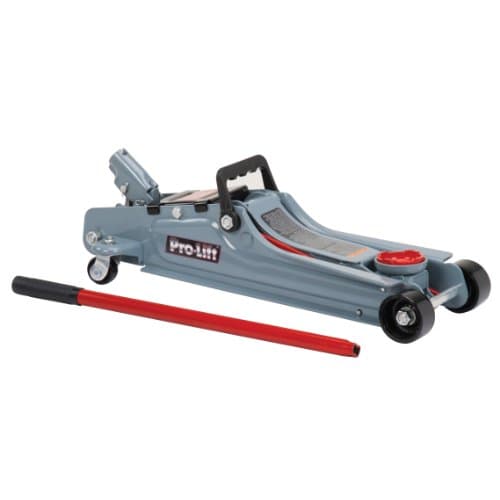
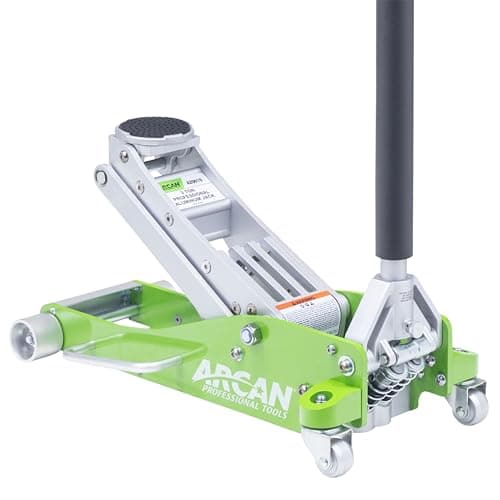
Short answer: open the release valve a few degrees - not all the way - and let the car settle slowly. On most trolley jacks the handle is the tool that turns the valve: drop it into the socket at the base of the handle sleeve and turn it counter-clockwise just far enough for the saddle to start moving. The valve is a tap that controls the rate of descent, so the whole skill is in opening it a little. Dumping it fully open with a car on the jack drops the vehicle fast, and that is where damage and injuries come from.
Find the release valve before you need it
There are two common arrangements and it is worth knowing which one you own before the car is in the air. On most hydraulic trolley jacks the release valve is a stem at the base of the handle sleeve, and the handle doubles as the tool that turns it - you seat the handle, twist counter-clockwise to lower, clockwise to close. On some jacks, particularly bottle jacks and a few compact floor jacks, the release is a separate knob or screw on the body, turned by hand or with a screwdriver.
Your jack's own manual is the authority on which it is, and it is worth reading once. Harbor Freight publishes a full owner's manual for its PITTSBURGH 3-ton low-profile jack covering the release valve, lowering and the bleeding procedure; it is the most complete maintenance document we have found in this category and the one the maintenance pages on this site lean on.
How to lower slowly and under control
The rate of descent is set by how far the valve is open, and nothing else. Open it a tiny amount and the car creeps down; open it fully and the car drops at whatever rate its own weight and the oil flow allow. For a wheel-off job on a driveway, creeping is what you want. Practice it once with no car on the jack: raise the saddle to full height, then open the valve the smallest amount that moves it and feel where that point is on your particular jack.
Two things make the descent less controllable than people expect. The first is a cold jack in a cold garage - oil is thicker, the first movement is slower, and the temptation is to open the valve further, which then releases faster than intended. The second is a jack that needs bleeding: air in the system makes the descent uneven and jerky rather than smooth, and the right fix is the maker's bleeding procedure rather than more valve. Why your floor jack leaks down covers that procedure and the fluid question.
Lowering onto jack stands
This is the version of the job that actually matters, because it is the moment the car transfers from a lifting device to a holding one. The sequence is: raise the car above the stand height you want, slide the stands in under the manufacturer's support points, then lower the car onto them slowly - a few degrees of valve at a time - until the stands are carrying the load and the jack is not.
Then stop. Do not continue lowering the jack away from the car. Leave it in place, just touching the lift point but carrying nothing, as a third component in the load path. It costs nothing and it is free insurance. The arithmetic to check first: Torin publishes an 11-1/4 in to 16-3/4 in range on its common 3-ton stands, so a jack has to lift past 16-3/4 in to use the top notch, which is why Arcan's published 18 in maximum is comfortable and a 13-3/8 in jack is not. How to use jack stands safely is the full procedure, and best double-locking jack stands covers the hardware.
Lowering a floor jack without the handle
A common search, and it deserves a straight answer rather than a trick. The release valve still has to be turned; the handle is only the lever that turns it. If the handle is genuinely lost, the valve stem on most jacks can be turned with a socket, a short length of pipe or - carefully - large pliers or a screwdriver, depending on the stem shape. Look at the stem before you improvise: a squared stem wants a socket, a slotted one wants a screwdriver.
Two honest warnings. First, you have far less feel through a short improvised tool than through a 24 in handle, so it is much easier to open the valve too far - which is exactly the failure mode this page is about, and it is worse with a car in the air. If the vehicle is loaded, get a proper handle or a replacement before lowering it rather than improvising. Second, pliers on a soft valve stem round it off, and a rounded stem is a jack you can no longer lower at all.
If the handle is missing because it was never supplied with the right length, that is worth noting as a buying criterion: Torin publishes a 24.5 in handle on the T83006, and handle length is both a leverage figure and a storage problem.
What if it will not lower?
Work through this in order rather than forcing anything. A jack that will not come down is usually one of four things. The valve is not actually open, because the handle is not seated in the stem properly - the most common cause and the easiest to miss. The saddle is loaded against something that is holding it up, in which case lifting slightly to free it is the answer, not more valve. The jack has been overloaded and the overload bypass has engaged - Pro-Lift and Torin both publish bypass systems on their jacks, and the bypass is doing its job. Or there is a hydraulic fault, which is a bleeding or fluid problem rather than a technique problem.
What you should never do is get under a car to investigate a jack that will not lower, or lever against the saddle while the vehicle is loaded. If the car is in the air and the jack will not come down, put stands under the support points first so the vehicle is held independently - then you can work on the jack with the car no longer depending on it.
Store it lowered and closed
Two small habits that prevent most of the problems above. Store the jack with the saddle fully down, so the ram is retracted and the seals are not sitting extended. And store it with the release valve closed, because an open valve invites dirt into the one part of the jack that has to seal. The same is true of the handle: keep it with the jack rather than somewhere else in the garage, which is how the no-handle problem starts.