Skip to content
JACK & TORQUE

Use-case roundup

Best Jack Stands for Pinch Welds

The standard curved saddle is the wrong shape for a folded seam. Two fixes, and one of them costs almost nothing.

By Ryder M. · Published September 29, 2026 · Last reviewed September 29, 2026

We earn a commission when you buy through the Amazon links on this page, at no extra cost to you. It never changes which tool we put first, and we publish no price we have not verified. How this site is funded.

Best Jack Stands for Pinch Welds — ranked picks with scores and a price check for each
#PickCapacityScorePrice
1
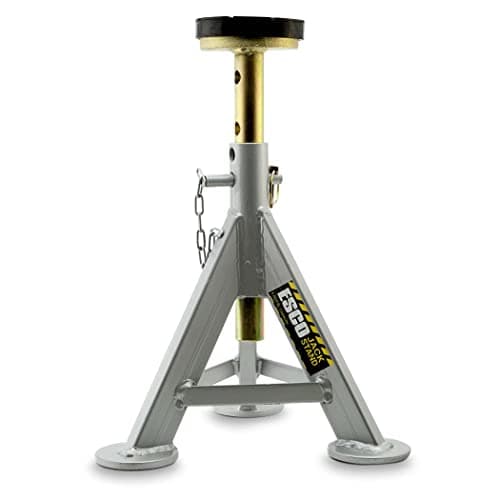
ESCO 10498 3-Ton Performance Jack Stand, Amazon product photo
ESCO 10498 3-Ton Performance Jack StandBest stand for a pinch weld
3 ton per stand8.8
2
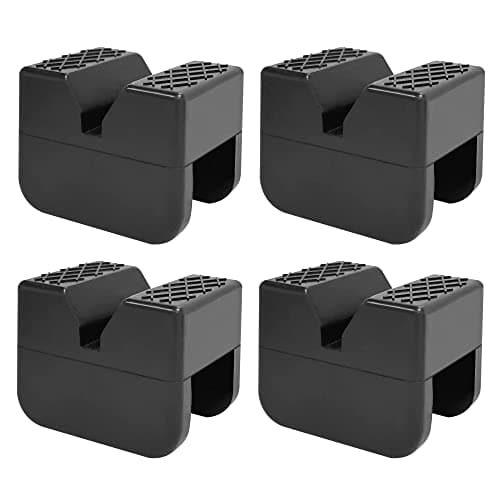
TONDA Slotted Rubber Pinch Weld Pads (4-Pack), Amazon product photo
TONDA Slotted Rubber Pinch Weld Pads (4-Pack)Best fix for stands you already own
4 pads8.8
3
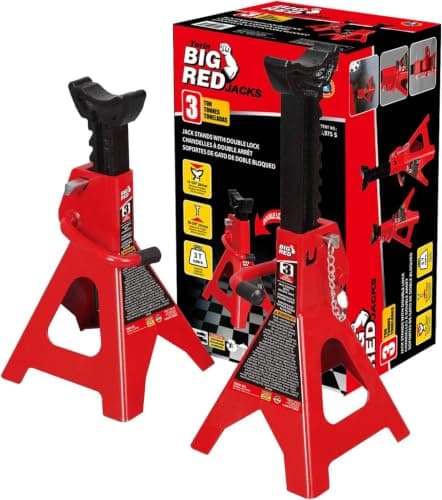
BIG RED T43002A 3-Ton Double-Locking Jack Stands, Amazon product photo
BIG RED T43002A 3-Ton Double-Locking Jack StandsBest value pair with an adapter
3 ton (6,000 lb) per pair9.1
4
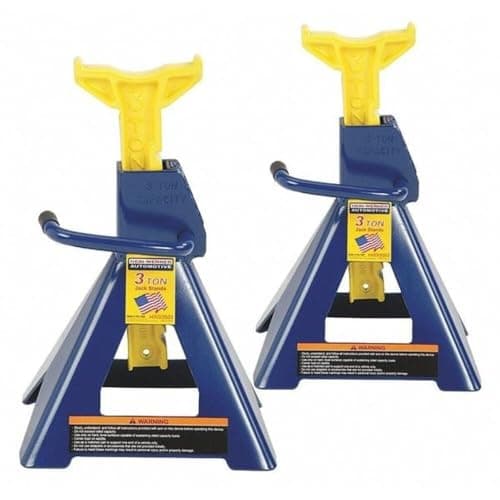
Hein-Werner HW93503 3-Ton Jack Stand, Amazon product photo
Hein-Werner HW93503 3-Ton Jack StandBest for matching two stands exactly
3 ton8.7

Product photographs come from each product's own Amazon listing via the Associates program. They are the seller's images, not photographs of anything we own — we have no test rig and claim none.

ESCO 10498 3-Ton Performance Jack Stand, Amazon product photo

A pinch weld is the folded seam where two body panels are welded together along the bottom of the sill. On most unibody cars a short, reinforced section of it — usually marked with a notch, an arrow or a plastic tab — is the manufacturer's designated lift point. It is strong in the right place and very easy to bend everywhere else.

The problem is shape, not strength. A standard jack stand saddle is a curved steel cradle designed for a round axle tube. Put a thin vertical seam into a V-shaped notch and the load lands on a knife edge, which is exactly how the classic folded-over pinch weld happens.

The two things that actually work

A flat saddle

A flat rubber face bears against the reinforced panel either side of the seam instead of pinching the seam itself. That is the ESCO's removable flat-top cushion, and it is the reason a stand costing more than a budget pair earns the difference on this specific car.

A slotted pad

A slotted pinch weld pad has a groove cut down the middle. The seam drops into the groove and the load is carried by the flat shoulders on either side. It converts any curved cradle into something safe for this job for a fraction of the price of new stands, which is why it is the pick most readers should buy.

What each option does

How each approach handles a pinch weld, and what it costs you
ApproachHow it carries the seamTrade-off
Flat-top stand saddleBears on the panel either side of the foldCosts more; taller lowest setting
Slotted pad on a curved cradleSeam sits in the groove, load on the shouldersAdds about 1 in of height; one pad per point
Bare curved cradle on the seamLoad concentrates on the foldBends the pinch weld — do not do this
Hockey puck or wood blockDepends entirely on what you cutNo slot unless you make one; easy to get wrong
How each approach handles a pinch weld, and what it costs you

The height cost, which is real

A pad adds roughly an inch between the saddle and the car. On a stand already starting at 11 in or more, that is an inch you have to lift past before the stand will slide under. On a low car it can be the difference between a workable lift and an impossible one — see jack stands for low cars if that is your situation.

Find the reinforced section first

Not all of the pinch weld is a lift point. The reinforced part is usually a few inches long and marked; the rest of the seam will fold under load. Car jack points shows how to find yours, and where to put jack stands covers the difference between a lift point and a support point, which are not always the same place.

If you already own conventional stands with curved cradles, you do not necessarily need new ones — jack stand pads and adapters covers the slotted pad that fixes the geometry for a few dollars, including the height it costs you and how many you actually need.

The picks in full

Every pick, in detail

ESCO 10498 3-Ton Performance Jack Stand, Amazon product photo

1. Best stand for a pinch weld

ESCO 10498 3-Ton Performance Jack Stand

ESCO · score 8.8/10

A removable flat rubber saddle instead of the usual curved axle cradle, rated 3 ton per stand and tested to ASME standards by an A2LA-certified lab.

The reason it is here is the saddle: a removable flat-top rubber cushion instead of the usual curved steel axle cradle. A flat rubber face spreads load across the reinforced area around the seam rather than concentrating it in the fold. Rated 3 ton per stand, 13.2 in to 21.5 in across ten positions, and ESCO states the design is tested to ASME standards by an A2LA-certified facility. It is the most expensive stand here and 13.2 in is a tall lowest setting.

Published specifications

Capacity
3 ton per stand ESCO
Height range
13.2 in – 21.5 in ESCO
Positions
10 adjustable positions ESCO
Saddle
Removable flat-top rubber cushion ESCO
Weight
11.4 lb ESCO
Testing
Tested to ASME standards by an A2LA-certified facility ESCO

What works

  • Flat rubber saddle sits against a sill or subframe without digging in
  • Rated per stand rather than per pair — easier to reason about
  • Third-party ASME testing named on the manufacturer listing

What you give up

  • 13.2 in minimum is the tallest low setting of the car stands here
  • Pin-and-post adjustment is slower than a ratchet
  • The most expensive stand in this set

Our scoring

  • Fit & reach8.4
  • Safety margin9.4
  • Beginner ease8.2
  • Build quality9.2
  • Value7.8
$69.99 · View on Amazon

#ad Price as of October 17, 2026. How this is funded

Specifications published by ESCO — we earn nothing from that link.

TONDA Slotted Rubber Pinch Weld Pads (4-Pack), Amazon product photo

2. Best fix for stands you already own

TONDA Slotted Rubber Pinch Weld Pads (4-Pack)

TONDA · score 8.8/10

Slotted rubber pads that straddle the pinch weld so the jack saddle cannot fold it over — the cheapest way to avoid the classic first-jack mistake, four to a box.

A 3 in slotted pad that straddles the seam so the cradle grips either side of it rather than crushing it flat. It is the cheapest correct answer on this page by a wide margin and it works with a jack or a stand you already have. One pad covers one point, so buy the number of points you lift from, and remember it adds 1 in of height — which matters on a low car.

Published specifications

Quantity
4 pads
Type
Slotted rubber pinch-weld pad
Fitment
Sits between a jack or jack-stand saddle and the vehicle

What works

  • The slot captures the pinch weld instead of crushing it
  • Works with a jack you already own
  • Four pads covers all four lift points for the price of a coffee

What you give up

  • TONDA publishes no dimensions, so check your saddle size
  • Any pad adds height, which matters on a low car
  • Does nothing for a car without a pinch weld

Our scoring

  • Fit & reach8.6
  • Safety margin8.8
  • Beginner ease9.2
  • Build quality8.6
  • Value9.2
$11.99 · View on Amazon

#ad Price as of October 17, 2026. How this is funded

BIG RED T43002A 3-Ton Double-Locking Jack Stands, Amazon product photo

3. Best value pair with an adapter

BIG RED T43002A 3-Ton Double-Locking Jack Stands

Torin (BIG RED) · score 9.1/10

A ratchet bar plus a separate safety pin — two independent locks instead of one — at the height range a car actually needs, and Torin states they meet ASME safety standards.

A ratchet bar plus a separate safety pin — two independent locks — at 11-1/4 in to 16-3/4 in, which is the range a car actually needs, and Torin states they meet ASME safety standards. The saddle is the conventional curved cradle, so pair them with the slotted pads above rather than setting the seam straight into the notch. Rated 3 ton per pair, not per stand.

Published specifications

Capacity
3 ton (6,000 lb) per pair Torin
Min height
11-1/4 in Torin
Max height
16-3/4 in Torin
Base footprint
7-11/16 in x 6-7/8 in Torin
Standards
Meets ASME safety standards Torin

What works

  • Two independent locking mechanisms, not one
  • 11-1/4 in to 16-3/4 in matches what a 3-ton floor jack can reach
  • The cheapest way to buy a genuinely double-locked stand

What you give up

  • Rated per pair, not per stand — read the rating before loading two corners
  • 11-1/4 in minimum is taller than some low cars want
  • Torin's own listing says this size is not intended for SUVs or trucks

Our scoring

  • Fit & reach8.6
  • Safety margin9.2
  • Beginner ease9.0
  • Build quality8.2
  • Value9.4
$35.99 · View on Amazon

#ad Price as of October 17, 2026. How this is funded

Specifications published by Torin (BIG RED) — we earn nothing from that link.

Hein-Werner HW93503 3-Ton Jack Stand, Amazon product photo

4. Best for matching two stands exactly

Hein-Werner HW93503 3-Ton Jack Stand

Hein-Werner · score 8.7/10

11/16 in height increments and a formed base that resists sinking, made in the USA — the stand to buy if you want engineering rather than the lowest price.

11/16 in height increments, which is finer than most stands offer and genuinely useful here: on a pinch weld you want both stands bearing evenly, and coarse notches make that harder than it sounds. A formed base spreads load on asphalt. Ratchet bar only, with no separate secondary pin, and Hein-Werner publishes no ASME PASE compliance statement for this model.

Published specifications

Capacity
3 ton Hein-Werner
Min height
11-1/2 in Hein-Werner
Max height
17 in Hein-Werner
Height increments
11/16 in Hein-Werner
Base size
7-5/8 in x 8-3/4 in Hein-Werner
Weight
19 lb gross Hein-Werner

What works

  • Fine 11/16 in increments let you match two stands to the same height
  • Formed base is shaped to spread load on asphalt
  • Hein-Werner publishes "assembled in the US with US and global components" for it

What you give up

  • Sold as a single stand, so you buy two — which is most of the price gap
  • Ratchet bar only — no separate secondary pin
  • Hein-Werner does not publish an ASME PASE compliance statement for this model

Our scoring

  • Fit & reach8.6
  • Safety margin8.6
  • Beginner ease8.8
  • Build quality9.4
  • Value8.0
$153.87 · View on Amazon

#ad Price as of October 17, 2026. How this is funded

Specifications published by Hein-Werner — we earn nothing from that link.

Method

How these picks were chosen

We did not test these tools. We do not run a laboratory, we have not loaded a jack to failure or checked a wrench on a calibration bench, and we will not tell you otherwise. What we did instead is read the published manufacturer specifications, check the figures that matter against the safety standard that applies to portable automotive lifting equipment, and work out which tool suits which job. Every number on this page links to where it came from, so you can check us.

The five things we score are the five that decide a first purchase: will it fit under and lift your car, how much safety margin the rating and the locking mechanism leave you, how hard it is to get right alone in a driveway, what the materials and published standards say about how long it lasts, and what the money buys against the rest of the field.

Read the full method — including how we pick a top pick, and how prices get on the page.

Questions

Frequently asked questions

+Can you put a jack stand on a pinch weld?

Yes, on the reinforced section your manual marks, and only with the right saddle. A flat-top rubber saddle or a slotted pad carries the seam safely; a bare curved cradle folds it over.

+What is a pinch weld adapter?

A pad with a groove down the middle that sits between the jack or stand saddle and the car. The seam drops into the groove and the flat shoulders either side carry the load. It is the cheapest way to make stands you already own correct for this job.

+Will a hockey puck work on a pinch weld?

Only if you cut a slot in it, and then only as well as you cut it. A plain puck has no groove, so the seam is still bearing on a flat face edge-on. The purpose-made pad costs little and is already the right shape.

+How do I know if my car has pinch welds?

Look along the bottom of the sill between the wheels. A thin vertical lip of doubled metal running the length of the car is a pinch weld; most unibody cars have them. See the pinch weld guide.

Sources

Where these figures come from

Read next

Related reading