Short answer: on uneven ground the specification that matters is base area, and the Hein-Werner HW93503 publishes the largest for a car at 7-5/8 in by 8-3/4 in — roughly 67 square inches per stand, with a formed base Hein-Werner describes as shaped to spread load on asphalt. But the honest answer is bigger than any product: no stand is safe on a surface that can give way, and the correct fix is a sheet of plywood or a paving slab under each stand, on every surface that is not sound concrete.
The arithmetic that decides whether a stand sinks
A jack stand concentrates a large load into a small area, and whether the ground holds depends on the pressure — the load divided by that area. Work it through with real numbers and the problem becomes obvious.
A 3,600 lb car on four stands puts roughly 900 lb on each. On a Torin T43002A base of 7-11/16 in by 6-7/8 in, that is about 53 square inches, so the pressure is around 17 psi. On the Hein-Werner's 67 square inches it is around 13 psi. Now put the same stand on a 24 in by 24 in plywood pad: the area becomes 576 square inches and the pressure falls to about 1.6 psi. The plywood is not a refinement — it is a tenfold change in the number that determines whether the ground gives.
What we judged these on
1. Published base footprint
The headline criterion, and one that very few makers publish at all — which is why this page has four picks rather than six. Of the stands on this site, Hein-Werner and Torin publish base dimensions and the others do not, so we ranked on what is stated rather than on how wide a photograph looks.
2. Base geometry
A pyramid base, which Torin specifies on the 6-ton stand, resists tipping better than a flat plate of the same area because the load path is more direct. A formed base, which is how Hein-Werner describes the HW93503's, is shaped to spread load rather than cut into a surface. Both are design responses to exactly this problem.
3. Height increments, which matter more here
On level concrete you set both stands to the same notch and the car sits square. On uneven ground you may need one stand a notch higher than the other, and the finer the increments the better you can match the vehicle's actual attitude. Hein-Werner's 11/16 in increments are the finest here; ESCO's 10 positions are the coarsest.
4. Published standards testing
When the ground is adding uncertainty, reduce it everywhere else. ESCO states third-party ASME testing by an A2LA-certified facility, and Torin states its stands meet or are tested to ASME standards. ASME PASE is the US standard covering portable hand jacks, automotive stands and ramps. Safest jack stands compares the locking mechanisms in detail.
The four picks on published footprint
| Pick | Base footprint | Height range | Standards statement |
|---|---|---|---|
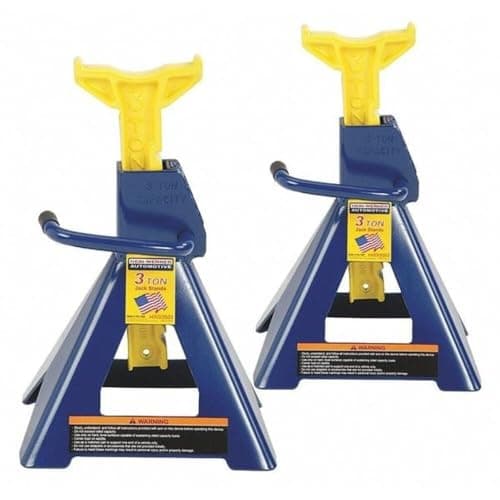
| Hein-Werner HW93503 | 7-5/8 in x 8-3/4 in, formed base | 11-1/2 in – 17 in | No ASME PASE statement published |
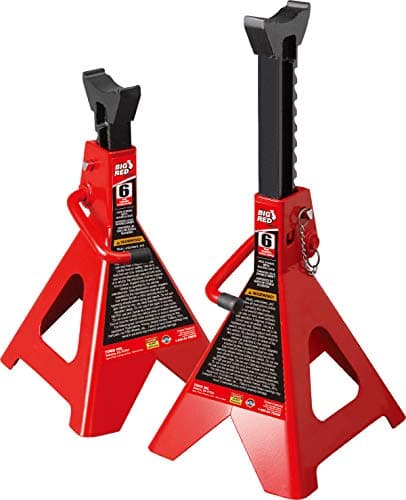
| BIG RED T46002A (6 ton) | Forged steel pyramid base | 15-3/8 in – 23-13/16 in | Tested to meet ASME standards |
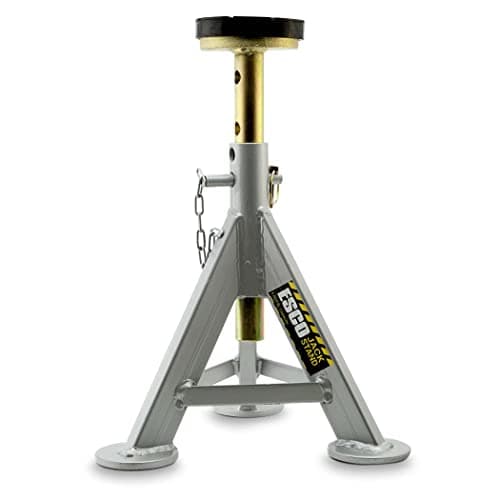
| ESCO 10498 | Not published | 13.2 in – 21.5 in | ASME testing by an A2LA-certified facility |
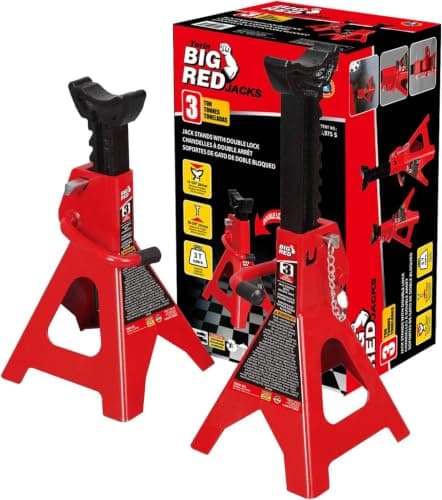
| BIG RED T43002A (3 ton) | 7-11/16 in x 6-7/8 in | 11-1/4 in – 16-3/4 in | Meets ASME safety standards |
The honest reading of that table: the difference between the largest and smallest published car-stand footprint here is about 25%, and a plywood pad changes the pressure by roughly 1,000%. Buy the stand with the bigger base if you have the choice, and buy the plywood either way.
Surface by surface
| Surface | Verdict | What to do |
|---|---|---|
| Sound concrete, level | Suitable | Use the stands as supplied |
| Asphalt, cool day | Usually acceptable | Use the largest base you have; check for sinking |
| Asphalt, hot day | Risky — it softens | Plywood or slabs under every stand |
| Gravel | Not suitable as-is | Plywood or slabs; level the gravel first |
| Compacted dirt | Not suitable as-is | Slabs; re-check after a few minutes |
| Grass or soft soil | Not suitable | Do not. Move the car |
| Any noticeable slope | Not suitable | Move the car. Pads do not fix slope |
Grass and slope are the two rows with no workaround, and they are the two people most often try to work around. A car on a slope can roll off its stands as the suspension settles, which is why wheel chocks are necessary even on concrete and insufficient on a hill.
If you are lifting all four corners
Uneven ground and four stands interact badly: with four supports and an imperfect surface, the car finds three of them and rocks on the fourth. On anything other than level concrete we would strongly prefer doing one end at a time, with the other end on its wheels and chocked. How many jack stands do I need works through when four corners is genuinely necessary.
What we would buy
For a car: the Hein-Werner HW93503, on plywood. It has the largest published footprint of the car stands here, a base Hein-Werner says is formed to spread load, and the finest height increments for matching two stands on an imperfect surface. For a truck or a van: the BIG RED T46002A, whose pyramid base and height range are both built for the job. If the budget is tight, the T43002A plus two sheets of 3/4 in plywood is a better purchase than a single more expensive stand without them — the pad does more for stability than the stand does.