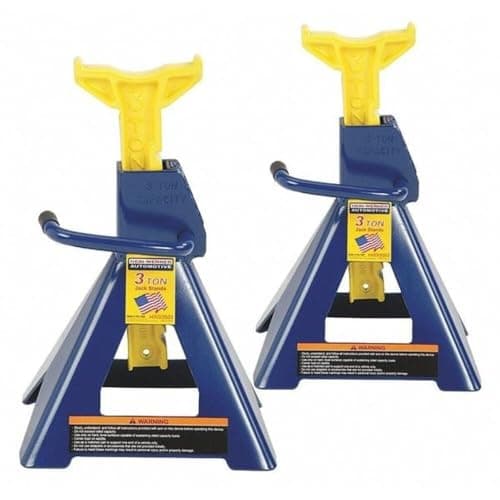


Short answer: two jack stands for any job that lifts one end of the car, which is most of them — wheels off, brakes, an oil change, an exhaust hanger. Four if you ever need the whole car in the air at once, and four is what we would buy from the start, because the moment you need a third stand and do not have one is the moment people start stacking bricks.
How many, by job
| Job | Stands | Why |
|---|---|---|
| Oil change / drain plug | 2 | Front end only, lifted just far enough for the pan and your shoulders |
| One brake corner | 2 | Lift one end; the second stand supports the other side so the car is not on a single point |
| Front or rear brakes, both sides | 2 | One end up, both sides supported |
| Tire rotation, front to back | 4 | All four wheels off at once, or two stands and two cycles |
| Exhaust, fuel or transmission work | 4 | You need the car level and the whole underside reachable |
| Suspension work on one corner | 2 | Plus a second jack or stand to support the control arm separately |
| Long-term storage off the tires | 4 | The vehicle sits level with the load shared across four points |
The pattern is simple: stands come in pairs because the car has to sit on two supports at one end, never one. Supporting a single corner on a single stand puts the whole end of the car on one point and lets it pivot — the car can roll off the stand sideways even though the stand itself is fine.
Why never one
The one legitimate exception is leaving the jack in contact under the lift point as a redundant backup after the stands are carrying the load — not holding the car, just touching it. That costs nothing and it is good practice.
The case for buying four
The short version
- Rotating tires front to back needs all four wheels off, and doing it in two cycles doubles the number of lifts — which is the risky part of the job, not the working part.
- A level car makes a difference to anything involving fluids: gearbox fills, coolant bleeds and brake bleeding all behave differently nose-down.
- A spare pair means a damaged or seized stand does not end the job. Stands do wear, and a bent ratchet bar is a retirement, not a repair.
- Four matched stands at a matched setting is the only way to put a car on all corners safely. Mixing a tall pair and a short pair does not work.
Two pairs of decent stands is one of the cheapest upgrades in a home garage, and it removes the specific temptation this site cares about most: the improvised third support. Jack stands versus wood blocks is what that temptation looks like when it goes wrong.
Putting a car on four stands
1.Set all four stands to the same height first
Before anything is lifted. You never adjust a stand that is under load, so the setting has to be right on the floor.
2.Chock the wheels at the end you will lift second
The car will be half-supported for part of this procedure, and that is when it can roll.
3.Lift one end, place two stands, lower onto them
Use the manufacturer's support points. Check the car is settled and square before you move to the other end.
4.Lift the other end and place the second pair
Lift from a rated point at that end. The first pair is already carrying load, so work smoothly and keep the jack square.
5.Test all four corners before going underneath
Push firmly at each corner, front-to-back and side-to-side. Any rock or settle means lower the car and start again.
Lifting the whole car is a slower, more deliberate job than lifting one end, and it is worth reading the full lifting procedure before the first attempt. If your jack cannot reach the stand height at the second end, stop — that is the jack telling you it is the wrong size, and what size floor jack do I need covers the fix.
What to buy
Buy four stands in two matched pairs, the same model, rated per stand for at least half your vehicle's loaded weight at one end — and check whether the headline number is per stand or per pair before you do the arithmetic. If budget only stretches to two, buy two good ones rather than four cheap ones, and plan jobs that only need one end of the car in the air until the second pair arrives.