Short answer: pick the adapter, not the app. The adapter decides which networks in the car can be read at all, and no app — free or paid, iPhone or Android — can show you data its hardware cannot reach. For most people the BlueDriver Pro is the right pair, because it is one dongle and one app with no subscription and published enhanced ABS, airbag and transmission coverage. If you want to choose your own app, buy the OBDLink MX+ and then decide.
Why the adapter is the real decision
Every car sold in the US since 1996 exposes engine and emissions data over a legislated protocol. Manufacturers put their own modules — ABS, airbag, TPMS, transmission, body control — on additional networks. A cheap adapter speaks only the legislated protocols, so every app paired with it reads engine codes and nothing else, no matter what the app store listing claims.
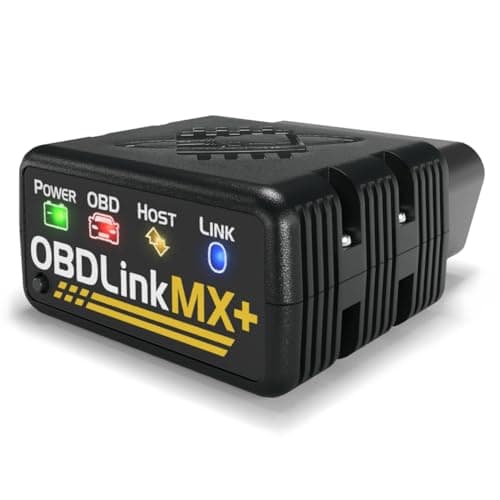
OBDLink publishes the clearest example of the difference: the MX+ supports all legislated OBD-II protocols plus Ford MS-CAN and GM SW-CAN, and the enhanced parameters that follow — ABS, SRS, TPMS, A/C, transmission temperature, wheel speeds. Pair the same app with a cheap generic dongle and those parameters simply are not there to display.
The short version
- Protocol support is hardware. No app upgrade adds a network your adapter cannot speak.
- Sample rate is hardware. OBDLink publishes up to 100 samples per second, which is what makes live-data graphs meaningful rather than decorative.
- Bi-directional control needs both halves: hardware that can transmit commands and software that knows which to send.
- Enhanced coverage is make-dependent at every price, on every adapter. Check your own vehicle against the maker's lookup.
- A manufacturer's own app is a known quantity; a third-party app is a moving target. Both are valid, but only one is a fixed purchase.
- Your phone is now a single point of failure. A dead battery means no scanner at all.
iPhone and Android are not the same purchase
The practical difference is the radio. Apple does not expose classic Bluetooth serial profiles to third-party apps in the way Android does, which is why many cheap dongles are Android-only or need a Wi-Fi variant to work with an iPhone. The adapters on this page are the ones whose makers publish iOS support explicitly: BlueDriver states Bluetooth to iOS and Android, and that stated support is the thing worth paying for.
The cheap-dongle failure mode here is familiar: a listing claims iPhone compatibility, the device pairs at the system level but the app never sees it, and you spend an evening on it. Why won't my OBD2 scanner connect walks through the diagnosis.
The three adapters on what they publish
| Adapter | App | Protocols and reach the maker publishes | Subscription |
|---|---|---|---|
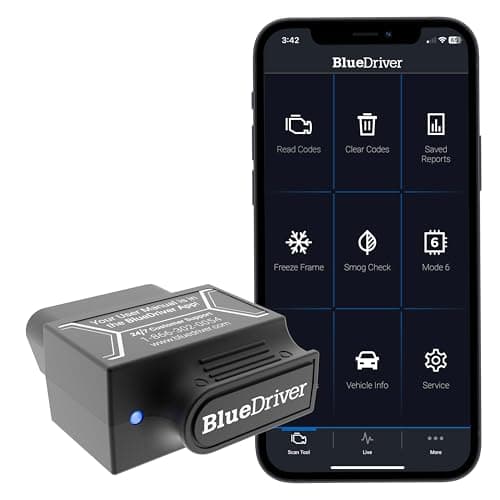
| BlueDriver Pro | BlueDriver, iOS and Android | 1996+ North American cars, SUVs, light trucks; enhanced ABS, airbag, transmission | None, per BlueDriver |
| OBDLink MX+ | OBDLink app, plus third-party apps | All legislated OBD-II, Ford MS-CAN, GM SW-CAN; up to 100 samples/sec | Not stated as required |
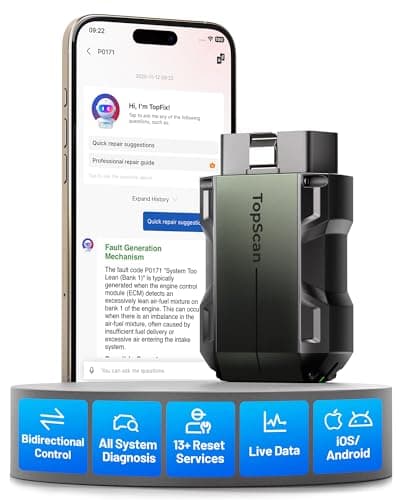
| TOPDON TopScan Pro | TopScan app | Full-system code reading, bi-directional control | 1 year included, then yearly by tier |
What we judged these on
1. Published protocol support
A named protocol is a checkable claim; "works with all cars" is not. Two of these three name specific manufacturer networks, which is the only way to know in advance whether your ABS light is readable.
2. Stated iOS and Android support
Not inferred from a review. BlueDriver states both platforms in its own specification, which is the standard we applied.
3. Whether the app is a product or a dependency
BlueDriver ships one app and owns the whole experience, which is why it suits a first-time user. The MX+ is deliberately app-agnostic, which suits someone who wants to change software later. Neither approach is wrong; they are different purchases.
4. What it costs in year two
BlueDriver lists subscription as none. TOPDON's US store states one year of updates included and then yearly renewal, priced by tier. OBD2 scanners without a subscription compares those terms across the field.
When not to buy an app-based scanner at all
Three situations. If you want a tool that works when your phone is dead or cracked, buy a handheld. If you want to hand the tool to someone else and have them succeed with it, buy a handheld — a corded reader with a readiness hot key needs no explaining. And if you only ever want to read a check-engine code before booking a garage, a handheld does that for less money and never asks you to update anything. Bluetooth vs wired OBD2 scanners is the full comparison.
What we would buy
The BlueDriver Pro for most people: one adapter, one app, both platforms, no subscription, and enhanced ABS and airbag access published rather than implied. The OBDLink MX+ if you want the deepest hardware on this page and intend to pick your own software — the named Ford and GM networks and the 100 samples per second are real, checkable specifications. The TOPDON TopScan if bi-directional control from a phone is what you came for, with the tier and renewal terms read first.