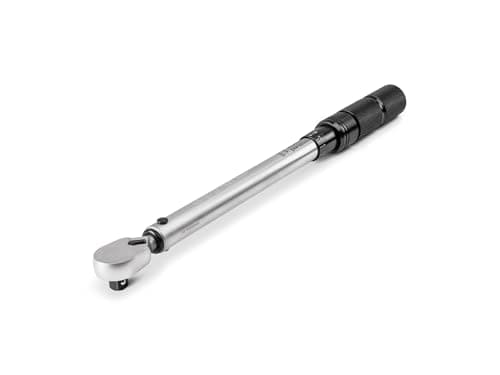
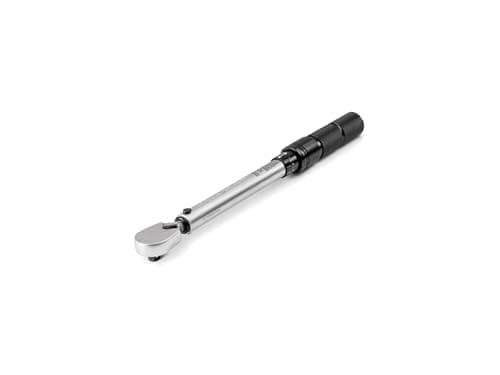
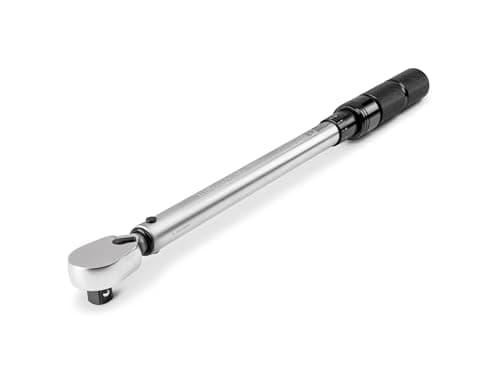
Short answer: start with the TEKTON TRQ52402 — a 1/2 in drive, 40-200 ft-lb click wrench — and add the 3/8 in TRQ51402 second. Those two cover almost every fastener a home mechanic torques on a car. A "torque wrench set" is not really a product category: it is a decision about which drive sizes you own, and most bundled kits sell you sockets you already have rather than a second wrench you do not.
What we judged these on
A set is only worth the money if the pieces cover different work. These are the criteria, in the order they matter for a first garage.
1. Ranges that meet without overlapping
The point of a second wrench is reaching torques the first cannot. A 1/2 in wrench starting at 40 ft-lb and a 3/8 in starting at 10 ft-lb divide the work cleanly. Two 1/2 in wrenches with ranges of 25-250 and 40-200 ft-lb do not — you have paid twice for the same span. The useful set is the one with no holes and no duplication.
2. Whether anyone publishes an accuracy figure
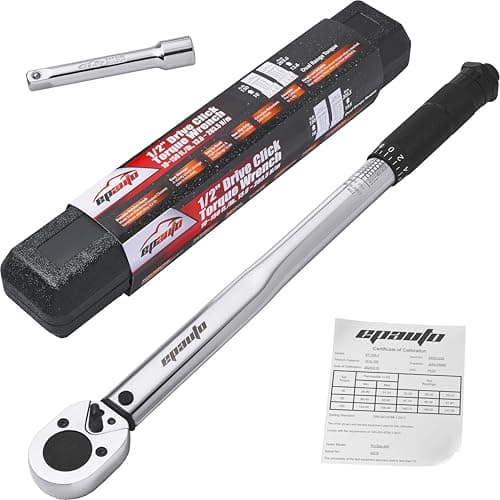
Most wrenches in this price class do not. Of the picks above, the 1/4 in TEKTON names the standards it is certified against, the Precision Instruments wrench publishes +/- 4% and ships a dated certificate, and EPAuto states pre-calibration to 4% in its manual. TEKTON's larger micrometer wrenches do not publish a percentage, and we say so rather than assume one. Best torque wrench brands sorts the field by exactly this.
3. Whether the pieces behave the same way
Two wrenches from the same family click with the same sound and adjust the same way, which matters more than it sounds. A set assembled from three brands means three different scales to read and three different feels to learn — on a tool whose entire job is to tell you when to stop.
4. Whether storage can ruin it
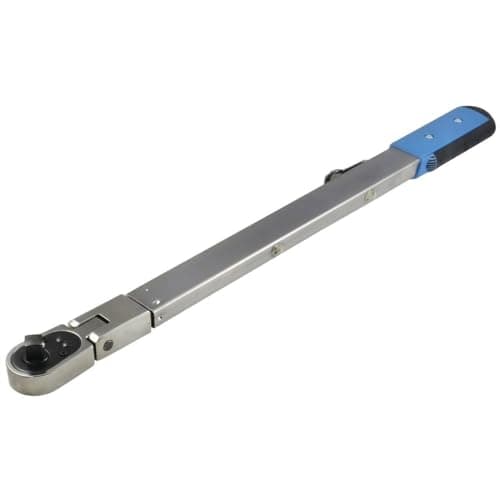
A micrometer click wrench must be wound back to its lowest setting after every use, and the single commonest way to wreck one is to leave it loaded in a drawer. A split-beam wrench does not care. On a multi-wrench set that failure mode multiplies, which is a real argument for the split-beam at the top of the range.
The five picks on the numbers
| Pick | Drive | Range | Published accuracy |
|---|---|---|---|
| TEKTON TRQ52402 | 1/2 in | 40 – 200 ft-lb | Not published |
| TEKTON TRQ51402 | 3/8 in | 10 – 100 ft-lb | Not published |
| TEKTON TRQ50402 | 1/4 in | 20 – 200 in-lb | +/- 3%, ISO 6789-1:2017 / ASME B107.300-2021 |
| Precision Instruments C3FR250F | 1/2 in | 40 – 250 ft-lb | +/- 4%, dated certificate supplied |
| EPAuto 1/2 in click | 1/2 in | 10 – 150 ft-lb (13.6 – 203.5 Nm) | Pre-calibrated to 4% |
Read the Drive and Range columns together and the sets build themselves. The three TEKTONs tile the whole span from 20 in-lb to 200 ft-lb with no gap and no overlap. The Precision Instruments wrench plus the 3/8 in TEKTON is the two-piece version. The EPAuto on its own spans most of what a beginner does, which is why it appears on a page about sets.
The order to buy them in
The short version
- First: 1/2 in drive, roughly 40-200 ft-lb. Wheels. This is the wrench 90% of owners only ever need.
- Second: 3/8 in drive, roughly 10-100 ft-lb. Brakes, drain plugs, suspension. Buy it when you start a brake job.
- Third: 1/4 in drive, in-lb. Valve covers, sensors, trim, anything a ft-lb scale cannot resolve.
- Not worth it: a second 1/2 in wrench with a similar range. You are paying twice for one span.
- Not worth it on day one: a digital wrench, unless you specifically want the published accuracy figure.
- Rarely worth it: the bundled 'set' of one wrench plus sockets, if you already own sockets.
If you are not sure which band your jobs fall in, what size torque wrench do I need works through it by job, and best torque wrench for lug nuts covers the first purchase on its own.
What a set still will not include
Two things, and both catch people out. The first is sockets: a torque wrench takes ordinary sockets, and a wrench sold "with case" frequently ships with none. If you are buying a 1/4 in wrench as your third piece, check whether you own 1/4 in sockets at all — many people own 3/8 in and 1/2 in and nothing smaller.
The second is a thin-wall socket for alloy wheels. A standard impact socket can mark a wheel face, and the torque wrench does nothing about that. The full job list for a wheel is in the tire rotation tool list, and the brake job tool list covers the second wrench's job.
What we would buy
The TEKTON TRQ52402 on its own, then the TRQ51402 the first time you touch a brake caliper, then the TRQ50402 if your work ever reaches valve covers and sensors. That is a real three-piece set, bought over a couple of years, with no overlap and one accuracy certificate in the box. If you would rather buy two wrenches once and never think about winding them down, the Precision Instruments C3FR250F plus the 3/8 in TEKTON is the better pair — at noticeably more money.
And if you are standing in front of a "complete torque wrench set" wondering whether to just take it: count the wrenches. One wrench and a tray of sockets is not a set, and it is not the purchase this page is recommending.