Short answer: buy the TEKTON TRQ50402 — a 1/4 in drive, 20-200 in-lb wrench certified to +/- 3% against ISO 6789-1:2017 and ASME B107.300-2021. It is the only tool on this page that names the standards behind its accuracy claim, and 1 in-lb increments mean you can actually hit a spec rather than land near it. The reason you need a separate wrench at all is that a click wrench is only accurate over roughly the top 80% of its scale, so a 40-200 ft-lb tool does not become inaccurate at 15 ft-lb — it cannot be set there.
Which fasteners actually need one
Most car owners never do. If your work is wheels, brakes and suspension, a foot-pound wrench covers you completely and an inch-pound wrench will sit in a drawer. The jobs that genuinely need one share a characteristic: a small fastener threaded into something that will strip, crack or distort.
The short version
- Valve cover bolts, which thread into aluminum and are frequently specified under 100 in-lb.
- Sensor housings and sender units, where the body is often plastic or thin alloy.
- Intake and throttle-body fasteners on a plastic manifold.
- Oil pan and transmission pan bolts on some designs, where a sequence and a low figure both matter.
- Interior and trim fasteners into clips and plastic bosses.
- Bicycle and motorcycle components, which are specified in Nm almost universally and overlap this band heavily.
What is not on that list is anything structural on a car. If a fastener's spec is in inch-pounds, the reason is almost always that over-tightening it would break the part rather than that under-tightening it would be dangerous.
What we judged these on
1. How low the scale actually starts
This is the whole purchase. A wrench that starts at 20 in-lb and one that starts at 300 in-lb are not competitors — and plenty of listings advertise an inch-pound display on a tool whose mechanism cannot go anywhere near those numbers. Read the minimum, not the units list.
2. Increment size, which matters more down here
At 200 ft-lb, a 5 ft-lb increment is 2.5% of the setting and nobody notices. At 40 in-lb, a 5 in-lb increment is 12.5% and you have lost the point of owning the tool. 1 in-lb steps are what makes the TEKTON usable at the bottom of its range.
3. A published, standards-referenced accuracy claim
Accuracy claims at this end of the market are frequently unsupported. We weighted a named standard heavily, because at 30 in-lb a 10% error is the difference between a sealed cover and a cracked one. The TEKTON names ISO 6789-1:2017 and ASME B107.300-2021; the Park Tool driver publishes +/- 4%; GEARWRENCH publishes +/- 2% but only from 25 ft-lb up.
4. Whether it fits where small fasteners live
Small fasteners are in awkward places. A 4-degree swing arc and a 10 in body get into an engine bay; a 22 in flex-head wrench does not. The Park Tool driver goes further still, because a driver with hex bits reaches things no socket will.
The four picks on the numbers
| Pick | Range | Lowest setting in ft-lb | Published accuracy |
|---|---|---|---|
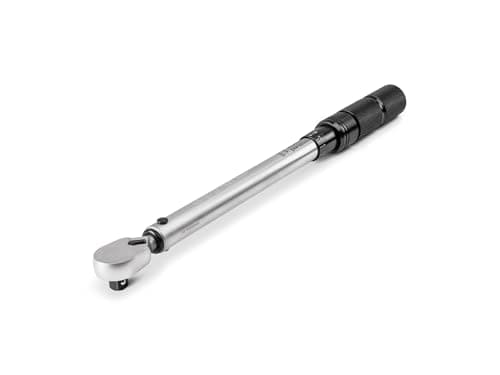
| TEKTON TRQ50402 (1/4 in) | 20 – 200 in-lb | 1.7 ft-lb | +/- 3%, ISO 6789-1:2017 / ASME B107.300-2021 |
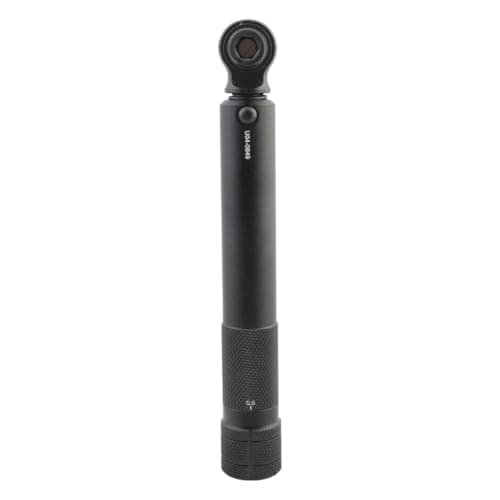
| Topeak Torq Stick | 2 – 10 Nm adjustable | About 1.5 ft-lb | +/- 4% |
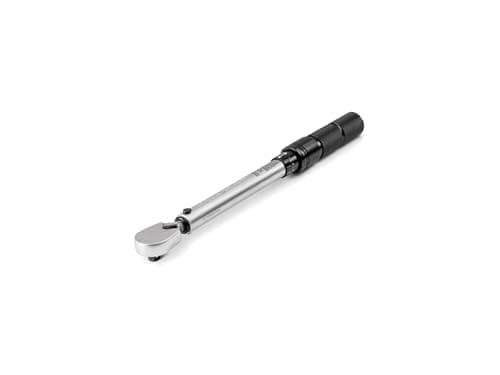
| TEKTON TRQ51402 (3/8 in) | 10 – 100 ft-lb | 10 ft-lb | Not published |
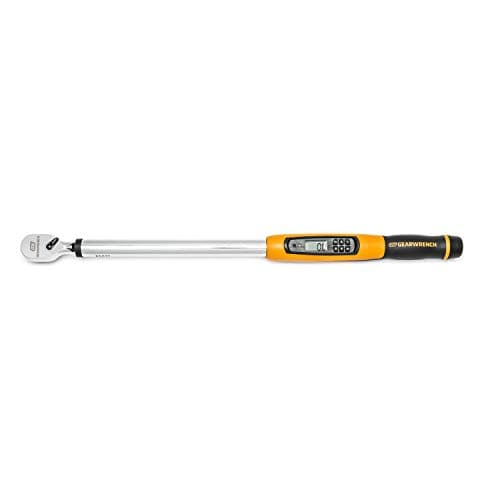
| GEARWRENCH 85077 (1/2 in) | 25 – 250 ft-lb | 25 ft-lb | +/- 2% CW, +/- 3% CCW (20-100% of scale) |
The third column is the one to read. Two of these four tools genuinely operate in the inch-pound world; the other two are listed because they are what people buy by mistake when the listing says "in-lb" somewhere. The GEARWRENCH is an excellent wrench that cannot be set below 300 in-lb.
Why your big wrench cannot just be set lower
Two reasons, and the second is the one people miss. First, mechanically: a micrometer click wrench has a spring and a scale, and the scale stops where it stops — a 40-200 ft-lb wrench has no setting at 15 ft-lb. Second, and worse: even where a wrench's scale does extend low, accuracy claims are typically specified over a fraction of the span. GEARWRENCH states its +/- 2% from 20% to 100% of scale, which is an honest way of saying the bottom fifth is not covered by the claim. A wrench used at the very bottom of its range is being used outside the figure the maker published.
The same logic is why we do not recommend stretching a 1/2 in wrench down to brake-caliper torques. What size torque wrench do I need maps ranges to jobs, and best torque wrench sets covers building coverage in order.
Why a drive adapter does not solve this
The obvious shortcut is to fit a 1/2 in to 1/4 in step-down adapter to the wrench you already own and use small sockets with it. It will physically work, and it changes nothing about the problem. An adapter changes the socket interface; it does not change the wrench's spring, its scale or its minimum setting. A 40-200 ft-lb wrench with a 1/4 in adapter on the end is still a 40-200 ft-lb wrench, and it still cannot be set to 60 in-lb.
The one adapter that does change the reading is an offset one — a crow's foot or a flare-nut fitting that moves the socket away from the wrench's centerline and lengthens the effective lever. That genuinely alters the torque delivered and needs compensating for, which is a different problem from the one on this page. A straight in-line extension, by contrast, does not change the figure meaningfully because it does not change the lever length.
So the answer stays the same: to measure below the bottom of your wrench's range you need a wrench whose range goes there. Buy the small one, and keep your 1/4 in sockets with it — most people who own 3/8 in and 1/2 in sockets own nothing smaller, and a certified wrench with no sockets to fit it is a wasted purchase.
What we would buy
The TEKTON TRQ50402, and only if you have a job that needs it. It is the one tool here that is both genuinely an inch-pound wrench and certified against named standards, with increments fine enough to be worth the certification. If your small-fastener work is bicycle or carbon components rather than engine bay, buy the Topeak Torq Stick instead — a 2-10 Nm driver with the right bits beats a long wrench when the consequence of over-torque is a cracked part. And if the smallest figure in your manual is 15 ft-lb, buy neither: the 3/8 in TEKTON covers you for less.