Skip to content
JACK & TORQUE

Reference

Nm to ft-lb on a Torque Wrench

The arithmetic is one multiplication. The mistakes come from the scale printed on the wrench, not the math.

By Ryder M. · Published October 10, 2026 · Last reviewed October 10, 2026

We earn a commission when you buy through the Amazon links on this page, at no extra cost to you. It never changes which tool we put first, and we publish no price we have not verified. How this site is funded.

Nm to ft-lb on a Torque Wrench — ranked picks with scores and a price check for each
#PickDriveScorePrice
1
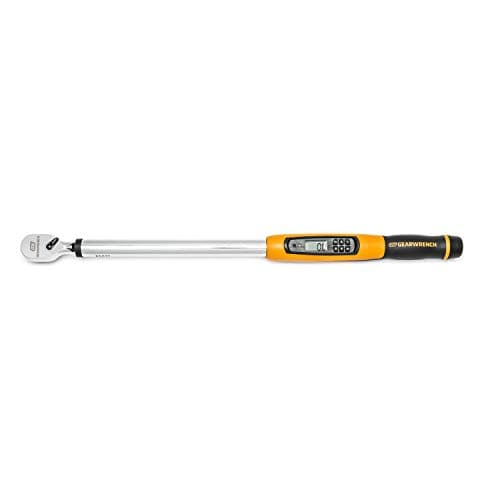
GEARWRENCH 85077 1/2 in Electronic Torque Wrench, Amazon product photo
GEARWRENCH 85077 1/2 in Electronic Torque WrenchThe wrench that removes the conversion entirely
1/2 in8.9
2
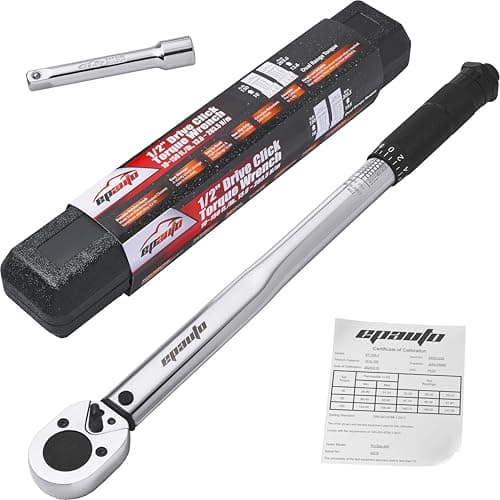
EPAuto 1/2 in Drive Click Torque Wrench (10-150 ft-lb), Amazon product photo
EPAuto 1/2 in Drive Click Torque Wrench (10-150 ft-lb)The cheap dual-scale option, read carefully
1/2 in8.4
3
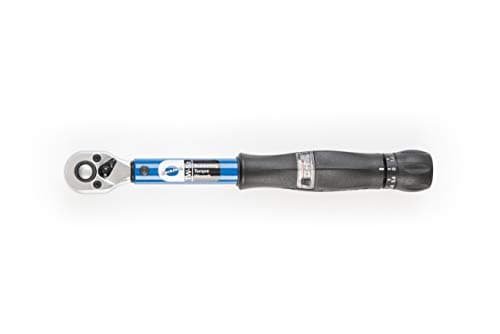
Park Tool TW-5.2 Ratcheting Click-Type Torque Wrench, Amazon product photo
Park Tool TW-5.2 Ratcheting Click-Type Torque WrenchWhen the spec was only ever in Nm
3/8 in9.0

Product photographs come from each product's own Amazon listing via the Associates program. They are the seller's images, not photographs of anything we own — we have no test rig and claim none.

GEARWRENCH 85077 1/2 in Electronic Torque Wrench, Amazon product photo

Short answer: to convert newton meters to foot-pounds, multiply by 0.7376. To go the other way, multiply foot-pounds by 1.355818. Those come from NIST's own SI conversion tables, which give 1 pound-force foot = 1.355 818 newton meters. So 100 Nm is about 74 ft-lb, and 100 ft-lb is about 136 Nm. For practical garage work, rounding to 0.74 and 1.36 is close enough — the error is well inside any wrench's published tolerance.

The conversions you actually meet

Common car torque figures in both units, from the NIST factor of 1.355 818
Newton metersFoot-poundsTypically
5 Nm3.7 ft-lbSmall covers, sensorsNeeds an in-lb or Nm wrench
10 Nm7.4 ft-lbValve covers, trimNeeds an in-lb or Nm wrench
25 Nm18.4 ft-lbBrake caliper hardware3/8 in wrench
45 Nm33.2 ft-lbCaliper brackets, drain plugs3/8 in wrench
110 Nm81.1 ft-lbPassenger-car wheel nuts1/2 in wrench
120 Nm88.5 ft-lbPassenger-car wheel nuts1/2 in wrench
140 Nm103.3 ft-lbLarger wheels, light trucks1/2 in wrench
200 Nm147.5 ft-lbTruck wheels, hub nuts1/2 in wrench
Common car torque figures in both units, from the NIST factor of 1.355 818

The third and fourth columns are there because the conversion is rarely the real question. What people actually want to know is whether the wrench they own can be set to the number in front of them, and that depends on which drive size they are holding. What size torque wrench do I need maps ranges to jobs.

The dual-scale reading error

Here is the mistake that matters, and it has nothing to do with arithmetic. Most click wrenches sold in the US print two scales: foot-pounds on one side of the handle and newton meters on the other, or one above the other on the same barrel. The EPAuto wrench's manual, for example, states its range as both 10-150 ft-lb and 13.6-203.5 Nm — the same wrench, the same mechanism, two printed rows.

Set 120 on the Nm scale when you meant 120 ft-lb and you have tightened a wheel to 89 ft-lb instead of 120 — low, but survivable. Set 120 on the ft-lb scale when the spec was 120 Nm and you have applied 163 Nm, which is 36% over, and that is how studs stretch and rotors distort. The second error is far more likely, because the ft-lb scale is usually the prominent one on a US-market wrench.

The short version

  • Decide which unit your spec is in before you touch the wrench, not during.
  • Say the unit out loud when you set the handle. It sounds silly and it works.
  • Check the direction of the error: if the Nm number is bigger than the ft-lb number for the same job, you are reading the right rows.
  • Nm figures are always numerically larger than the ft-lb equivalent. A spec of 120 that you think is Nm but is actually ft-lb is a 36% over-torque.
  • If your car's data is metric and you do this often, buy a wrench whose primary scale matches — or a digital one that switches.
  • Never set a click wrench between its marked graduations and hope. Round to the nearest marked value.

Which cars publish which unit

Nearly every manufacturer now publishes torque in newton meters, including the US domestic makers, because vehicle engineering is metric worldwide. What varies is the owner's handbook: a US-market handbook usually gives the wheel-nut figure in foot-pounds for the driver, while the workshop service data behind it is in Nm. So the unit you meet depends on which document you are reading rather than which badge is on the car.

Two places this bites. Online forum figures are quoted in whatever the poster had, frequently without a unit at all. And bicycle, motorcycle and carbon-component specs are metric-only — there is no foot-pound convention in those categories, which is why a dedicated Nm wrench exists for them. Best torque wrenches for bikes covers that end.

Why the conversion is not quite the end of it

Having converted a figure, you still have to set it on a scale that may not have a mark where your number lands. A micrometer click wrench adjusts in fixed graduations — 1 ft-lb on the EPAuto, 5 ft-lb on the Precision Instruments split-beam, 1 in-lb on the TEKTON 1/4 in — and a converted metric figure almost never falls neatly on one.

Convert 110 Nm and you get 81.1 ft-lb. On a wrench with 1 ft-lb graduations you set 81 and the 0.1 is irrelevant, because it is a tenth of a percent and the wrench is certified to several percent at best. On a wrench with 5 ft-lb graduations your choices are 80 or 85, and you take 80 — round down, always, because under-torque on most fasteners is correctable and over-torque frequently is not. What you must not do is try to set the handle between two marks: the mechanism is not designed to resolve that and the resulting figure is not the one printed on it.

A digital wrench removes this entirely by accepting any value in any unit, which is a quieter argument for one than the accuracy spec usually quoted. For click wrenches, the practical rule is to check your wrench's graduation size before you decide whether its scale is fine enough for metric work — click vs digital goes through the trade in full.

The spec that no conversion helps with

Some modern metric specifications are not a single figure at all. A torque-to-yield fastener — common on cylinder heads and some suspension hardware — is specified as a torque followed by an angle: tighten to 40 Nm, then a further 90 degrees. The first number converts; the second does not, because degrees are degrees in both systems and no foot-pound figure substitutes for them.

If you meet a spec like that, the honest answer is that a plain click wrench cannot complete the job. You need an angle gauge or an electronic wrench with an angle mode, and torque-to-yield fasteners are usually single-use and must be replaced rather than re-torqued. It is worth recognizing the format so you stop before you strip something, rather than converting the first half and improvising the second.

The other units you may run into

Two more appear occasionally. kg-m (kilogram-meter) turns up in older Japanese service data; 1 kg-m is about 9.807 Nm, or 7.233 ft-lb. And in-lb (inch-pounds) is the US small-fastener unit: twelve inch-pounds to a foot-pound, so 89 in-lb is 7.4 ft-lb or 10 Nm. The GEARWRENCH 85077 displays all five units, which is the tidiest solution if your sources are mixed. Best inch-pound torque wrenches covers the low-torque tools.

What we would do

Write your car's wheel-nut figure on a strip of tape stuck to the inside of your toolbox lid, in both units, taken from the owner's handbook. That removes the conversion from the moment you are crouched beside a wheel, which is the moment the mistake gets made. If your service data is metric and you work from it often, the GEARWRENCH 85077 switching to Nm is worth the money; otherwise a printed dual scale is fine as long as you read the right row.

The picks in full

Every pick, in detail

GEARWRENCH 85077 1/2 in Electronic Torque Wrench, Amazon product photo

1. The wrench that removes the conversion entirely

GEARWRENCH 85077 1/2 in Electronic Torque Wrench

GEARWRENCH · score 8.9/10

The only wrench here with a published accuracy spec — ±2% clockwise, ±3% counter-clockwise from 20% to 100% of scale — and it warns you before you reach target.

25-250 ft-lb with selectable ft-lb, in-lb, Nm, kg-m and kg-cm display modes, at a published +/- 2% clockwise and +/- 3% counter-clockwise from 20% to 100% of scale. If your car's service data is in Nm and you would rather not do arithmetic on a driveway, a digital wrench that switches units is the cleanest answer available. It needs batteries, and GEARWRENCH warrants the calibration for 90 days.

Published specifications

Drive
1/2 in GEARWRENCH
Range
25 – 250 ft-lb GEARWRENCH
Accuracy
±2% CW, ±3% CCW (20-100% of scale) GEARWRENCH
Units
ft-lb, in-lb, Nm, kg-m, kg-cm GEARWRENCH
Alerts
Vibration, buzzer and LED at target GEARWRENCH
Warranty
1 year; calibration warranted 90 days GEARWRENCH

What works

  • Publishes its accuracy spec, which most brands in this price class do not
  • Target-torque alert makes over-tightening much harder
  • Three-way feedback — you cannot miss the target in a noisy garage

What you give up

  • Needs batteries, which is one more thing to fail mid-job
  • Calibration is only warranted for 90 days
  • Costs several times a basic click wrench

Our scoring

  • Fit & reach9.0
  • Safety margin9.2
  • Beginner ease9.0
  • Build quality9.0
  • Value7.4
$189.00 · View on Amazon

$239.00 21% off

#ad Price as of October 17, 2026. How this is funded

Specifications published by GEARWRENCH — we earn nothing from that link.

EPAuto 1/2 in Drive Click Torque Wrench (10-150 ft-lb), Amazon product photo

2. The cheap dual-scale option, read carefully

EPAuto 1/2 in Drive Click Torque Wrench (10-150 ft-lb)

EPAuto · score 8.4/10

Pre-calibrated to 4% with 1 ft-lb increments and a 10 ft-lb floor — the cheapest wrench here that can still do a brake caliper and a lug nut.

10-150 ft-lb, which EPAuto's manual also states as 13.6-203.5 Nm, in 1 ft-lb increments and pre-calibrated to 4%. A printed dual scale works perfectly well as long as you know which of the two rows you are reading — and that is exactly the error this page exists to prevent. The 4% claim carries no third-party certificate.

Published specifications

Range
10 – 150 ft-lb (13.6 – 203.5 Nm) EPAuto instruction manual
Accuracy
Pre-calibrated to 4% EPAuto instruction manual
Increments
1 ft-lb EPAuto instruction manual
Material
Chrome vanadium steel EPAuto instruction manual

What works

  • 10 ft-lb floor means one wrench covers brakes and wheels
  • 1 ft-lb increments are finer than several wrenches costing more
  • Extension bar included

What you give up

  • 4% accuracy claim comes with no third-party certificate
  • Must be wound back to its lowest setting after every use
  • Case latches are the first thing to wear out

Our scoring

  • Fit & reach8.8
  • Safety margin7.8
  • Beginner ease8.8
  • Build quality7.4
  • Value9.6
$36.87 · View on Amazon

#ad Price as of October 17, 2026. How this is funded

Specifications published by EPAuto — we earn nothing from that link.

Park Tool TW-5.2 Ratcheting Click-Type Torque Wrench, Amazon product photo

3. When the spec was only ever in Nm

Park Tool TW-5.2 Ratcheting Click-Type Torque Wrench

Park Tool · score 9.0/10

2-14 Nm in 0.2 Nm steps, calibrated to +/- 4% — the band every stem, seatpost and carbon clamp on a bicycle is specified in, and nothing from the car aisle covers it.

2-14 Nm in 0.2 Nm steps at +/- 4%, with Park Tool's own in-lb equivalent of 18-124 printed alongside. Bicycle and carbon-component specs are published in newton-meters and nothing else, so a wrench whose primary scale is Nm removes the conversion step rather than hiding it. The 14 Nm ceiling means it only ever does small fasteners.

Published specifications

Drive
3/8 in Park Tool
Range
2 – 14 Nm (18 – 124 in-lb) Park Tool
Accuracy
+/- 4% Park Tool
Increments
0.2 Nm Park Tool
Length
229 mm (9 in) Park Tool
Direction
Reads left-hand and right-hand threading Park Tool

What works

  • Starts at 2 Nm, which is where carbon component specs actually live
  • 0.2 Nm increments let you hit 5 Nm exactly rather than near it
  • Reads both thread directions, so left-hand pedal threads are covered

What you give up

  • 14 Nm ceiling means it cannot do cassette lockrings or crank bolts
  • +/- 4% is looser than a certified automotive wrench
  • Costs more than a 1/4 in automotive wrench with a similar span

Our scoring

  • Fit & reach9.4
  • Safety margin8.8
  • Beginner ease9.2
  • Build quality9.2
  • Value7.8
$99.95 · View on Amazon

#ad Price as of October 17, 2026. How this is funded

Specifications published by Park Tool — we earn nothing from that link.

Method

How these picks were chosen

We did not test these tools. We do not run a laboratory, we have not loaded a jack to failure or checked a wrench on a calibration bench, and we will not tell you otherwise. What we did instead is read the published manufacturer specifications, check the figures that matter against the safety standard that applies to portable automotive lifting equipment, and work out which tool suits which job. Every number on this page links to where it came from, so you can check us.

The five things we score are the five that decide a first purchase: will it fit under and lift your car, how much safety margin the rating and the locking mechanism leave you, how hard it is to get right alone in a driveway, what the materials and published standards say about how long it lasts, and what the money buys against the rest of the field.

Read the full method — including how we pick a top pick, and how prices get on the page.

Questions

Frequently asked questions

+How do I convert Nm to ft-lb?

Multiply the newton-meter figure by 0.7376. NIST gives the exact factor the other way: 1 pound-force foot equals 1.355 818 newton meters. For garage work, taking three quarters of the Nm number is accurate to within about 2%, which is tighter than most wrenches are certified to.

+Is 100 Nm the same as 100 ft-lb?

No, and this is the error that matters. 100 Nm is 73.8 ft-lb; 100 ft-lb is 135.6 Nm. Treating the two numbers as interchangeable on a wheel means either a 26% under-torque or a 36% over-torque, depending on which direction you got it wrong.

+Which scale should I use on a dual-scale torque wrench?

Whichever matches the unit of the figure you were given. Decide before you set the handle, and say the unit out loud as you set it. Remember that the Nm number for any given job is always the larger of the two — if your reading looks small, you are probably on the wrong scale.

+What is a kg-m, and how does it convert?

Kilogram-meter, a unit that appears in older Japanese service data. One kg-m is about 9.807 Nm or 7.233 ft-lb. The GEARWRENCH 85077 is one of the few consumer wrenches that will display it directly.

+Do I need a metric torque wrench for a European car?

Not necessarily — any wrench with a Nm scale, printed or digital, covers it. What you do need is to know which unit the figure you are working from is in. Modern service data from every manufacturer, including US ones, is published in newton meters.

Sources

Where these figures come from

Read next

Related reading