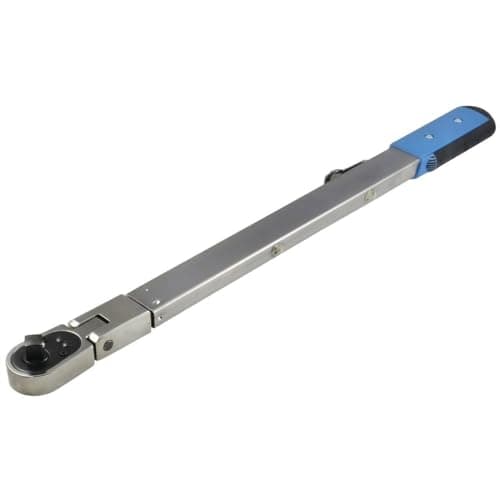
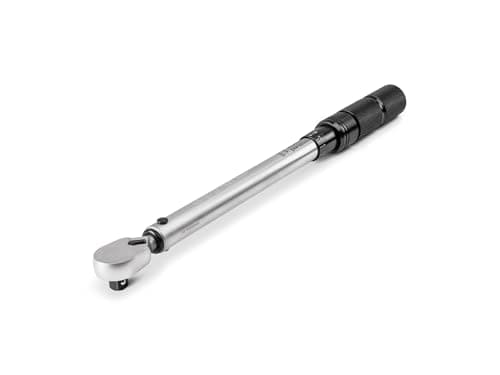
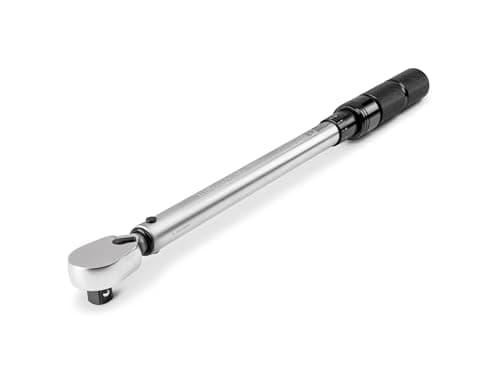
Short answer: they are not alternatives. A ratchet is a driving tool for getting fasteners in and out quickly; a torque wrench is a measuring instrument whose job is to tell you when to stop, and most of them happen to have a ratchet head so that they can do the last part of the tightening. Use a ratchet for everything up to the final tighten, then swap to the torque wrench for the final figure. Using the torque wrench for the whole job — and especially for breaking fasteners loose — is how an accurate tool becomes an inaccurate one without ever looking broken.
The short version
- A ratchet applies torque. A torque wrench measures it. Only one of them is a measuring instrument.
- Never break a fastener loose with a torque wrench. Use a breaker bar. That is the one rule on this page that matters.
- A torque wrench's ratchet exists for the last few degrees of tightening, not for running a bolt down from nothing.
- A click wrench must be wound back to the low end of its scale for storage. A split beam does not.
- The three-tool answer: ratchet, breaker bar, torque wrench. They cost less together than one ruined torque wrench.
What each tool is actually for
| Tool | Job | Measures torque | Safe to break bolts loose | Needs care in storage |
|---|---|---|---|---|
| Ratchet | Run fasteners in and out | No | Not really — it is not built for it | No |
| Breaker bar | Break seized fasteners loose | No | Yes — this is its only job | No |
| Click torque wrench | Final tighten to a figure | Yes | No | Yes — wind down after use |
| Split beam torque wrench | Final tighten to a figure | Yes | No | No spring to relax |
Read the third and fourth columns together. The two tools that measure torque are the two tools you must not use to break a fastener loose, and that is not a coincidence: the mechanism that makes a reading possible is the mechanism that a sudden high load damages.
Why using a torque wrench as a ratchet is a problem
Three separate reasons, and only the first is the one people have heard.
1. Breaking a bolt loose can overload the mechanism
A seized lug nut or a rusted suspension bolt can need several times the torque it was tightened to. A click wrench set to 90 ft-lb does not stop you applying 200 ft-lb in the loosening direction — there is nothing in the mechanism to prevent it, and the internal components are being loaded well beyond the range the tool is calibrated across. Park Tool's published use-and-care guidance for torque wrenches is explicit that the tool is for final tightening, not for loosening or general work. Use a breaker bar, which is a solid steel lever with nothing inside it to hurt.
2. Ratcheting a bolt all the way in wears the instrument out
Running a bolt down thirty turns with a torque wrench puts thirty turns of wear through a ratchet mechanism that exists to deliver the final few degrees. It is not dramatic and it is not immediate; it is simply a measuring tool being used for a job a five-dollar ratchet does better and faster. Keep the cycles on the cheap tool.
3. You lose the information in the pull
This one is underrated. Running a fastener down with a plain ratchet tells you whether the thread is clean, whether the bolt is cross-threaded, and whether something is binding — all of it in your hand, before any torque figure is involved. A torque wrench masks that, because you are watching for a click rather than feeling the thread. Most stripped threads are detectable on the way in, with the right tool in your hand.
"Dual direction" does not mean "use it to loosen"
A real source of confusion, because the phrase appears in the specifications of good tools. TEKTON publishes dual-direction heads on its micrometer wrenches, which means the wrench measures in both clockwise and counter-clockwise directions — useful on left-hand threaded fasteners, and the reason GEARWRENCH publishes separate clockwise and counter-clockwise accuracy figures. It is a measurement capability, not permission to use the tool as a breaker bar. The same wrench that measures accurately counter-clockwise is still damaged by a 200 ft-lb heave on a seized nut.
The three-tool answer
A ratchet, a breaker bar and a torque wrench, in that order of how often you will touch them. The ratchet runs fasteners in and out. The breaker bar handles anything seized, and because it is a long solid lever it does the job with less effort and no risk to anything calibrated. The torque wrench comes out once per fastener, at the end, for the final pull to the figure — and then goes back in its case. Torque wrench vs breaker bar is the dedicated comparison, and torque wrench vs impact wrench covers the powered option.
The one thing that genuinely reduces how often you reach for the wrong tool is owning a torque wrench whose range covers the fasteners you actually work on. Most people buy a 1/2 in wrench for lug nuts, discover it cannot be set below 40 ft-lb, and start using a plain ratchet and judgment for everything smaller. A 3/8 in wrench covering 10 to 100 ft-lb closes that gap, and what size torque wrench do I need works out which ranges you need.
What if you have already done it?
Do not panic and do not throw the wrench away. A click wrench that has been used to loosen fasteners may read exactly as it should, or may have drifted; the only way to know is to check it. There is a rough comparison check you can do at home against a second wrench, and there are paid calibration services — Park Tool publishes one for torque devices — for an actual certified answer. How to check torque wrench calibration covers both routes honestly, including what the home check can and cannot tell you.
The verdict
Keep a ratchet for driving, a breaker bar for loosening, and reserve the torque wrench for the final pull. If you only own a 1/2 in torque wrench and keep finding yourself using a plain ratchet and guesswork on smaller fasteners, the fix is a 3/8 in wrench rather than more care. And if you would rather own one wrench that tolerates being handled like a tool, a split beam has no spring to leave compressed, which removes the most common way a click wrench quietly goes out of specification.