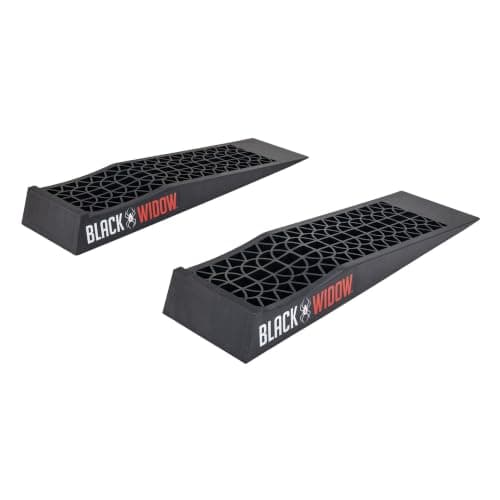
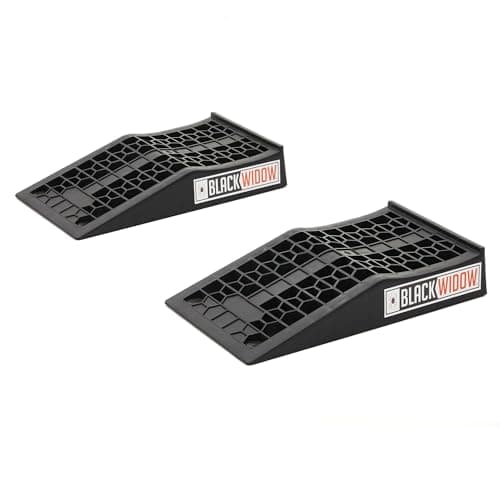
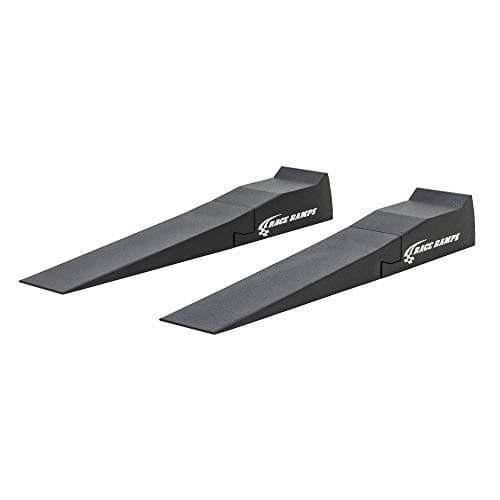
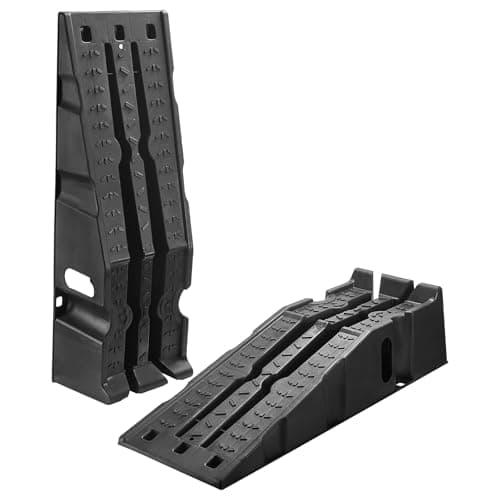
Short answer: for most home garages the VEVOR pair is the pick — 16,000 lb GVW per pair, a 17-degree incline and a deep-grooved surface that addresses the one thing people are actually afraid of on a smooth concrete floor. The reason this page exists separately from the main roundup is that a garage imposes two constraints a specification sheet never mentions: how much floor length the run-up needs, and where the ramps live for the other 364 days of the year.
What we judged these on
The first three criteria are the standard ones and they decide whether a ramp suits your vehicle. The last two are the garage-specific ones, and they are why this list is ordered differently from the main roundup.
1. Grip on a garage floor specifically
A garage floor is the smoothest surface a ramp will ever meet, and a painted or epoxied one is smoother still. The failure mode is the ramp shooting forward as the tire first loads it. A deep-grooved, honeycombed ramp surface is a direct answer to that, and it is the feature we weighted highest for this use. On a sealed floor, backing the ramps against a wall or a curb is the belt to that braces.
2. Approach angle against your front bumper
The published figures here run from 9.05 degrees to 17 degrees, which is an enormous spread. A 17-degree ramp will scrape the front lip of a low sedan before the tire reaches the incline. Car ramp angle and clearance works through how to check it against your own car, and best car ramps for low cars is the page if yours is genuinely low.
3. Capacity, read in the units the maker used
This is the trap in the category. VEVOR publishes 16,000 lb GVW per pair, Race Ramps publishes 1,500 lb per ramp, Black Widow publishes 5,000 lb per axle for its low-profile ramps. Those are not comparable numbers until you convert them, and getting it wrong on the lowest-rated ramp here is how a ramp cracks.
4. Run-up length, the garage-specific one
A 27-1/2 in ramp and a 72 in ramp are different pieces of furniture. The longer ramp gives a gentler angle for the same lift — that is the whole trade — but it needs the floor to deliver it. Measure before you buy.
5. Where they live afterwards
Nobody thinks about this and everybody deals with it. Nesting plastic ramps stack flat against a wall. The 4-1/2 lb Black Widows go on a shelf or in a drawer. A pair of 72 in foam ramps occupies a corner permanently. In a one-car garage that difference is more important than two degrees of approach angle.
The four picks on all five criteria
| Pick | Capacity, as published | Angle | Lift | Length |
|---|---|---|---|---|
| VEVOR car ramps | 16,000 lb GVW per pair | 17 degrees | 6.7 in | 35.8 in |
| Black Widow 6009-V2 | 5,000 lb per axle | 9.05 degrees | 2-1/2 in | 27-1/2 in |
| Black Widow low-profile | 5,000 lb per axle | Not published | 3 in | Not published |
| Race Ramps RR-72-2 | 1,500 lb per ramp | 6.8 degrees | 8 in | 72 in |
Read the Lift column before anything else, because it sorts these into two different products. The VEVOR ramps and the Race Ramps are service ramps — they get the car high enough to work under. The two Black Widows give 2-1/2 to 3 in, which is a clearance aid: enough to slide a floor jack under a low sill, not enough to get yourself under the car. Both are useful; they are not substitutes.
The floor matters more than you would think
| Floor | Verdict | What to do |
|---|---|---|
| Bare or sealed concrete, level | Ideal | Sweep it first; chock the rear wheels |
| Epoxy or garage paint | Slippery | Back the ramps against a wall or curb before driving up |
| Interlocking floor tiles | Not suitable | Lift the tiles or use a different spot — the ramp can shift the tile |
| Concrete with a drainage slope | Marginal | Point the car up the slope, not across it; re-check for creep |
| Asphalt driveway, hot day | Risky | Ramps can press in. Use concrete |
| Gravel or dirt driveway | Not suitable | See the gravel page — ramps need a flat, hard run |
Interlocking floor tiles are the one most people get caught by, because a tiled garage floor looks like the best surface in the house. The problem is that the tile can slide relative to the concrete under it, taking the ramp with it. Can you use car ramps on gravel covers the unpaved end of the same question.
The part people leave out
Ramps lift one axle. The other axle stays on the ground, which means the car is on a two-degree nose-up attitude with its drivetrain parked and nothing stopping it rolling backwards off the ramps except the parking brake. Two wheel chocks behind the rear wheels are the cheapest safety purchase in this whole category, and the Camco 44471 with a rope is the one we keep coming back to because you can retrieve it without crawling. The wheel chocks guide explains why the parking brake alone is not the answer.
What we would buy for a home garage
The VEVOR pair, on bare or sealed concrete, plus two wheel chocks. The GVW rating covers whatever is on your driveway, a swept floor deals with the smooth floor, and they stack flat against a wall when you are done. If your garage floor is painted or epoxied, buy the same ramps and back them against a wall every time. If the car is low enough that a 17-degree incline scrapes, the Black Widow 6009-V2 at 9.05 degrees is the swap — accepting that 2-1/2 in of lift gets a jack under the car rather than you. And if you have a deep garage and a low car, the Race Ramps RR-72-2 is the best tool on this page and the one that needs the most floor to use.