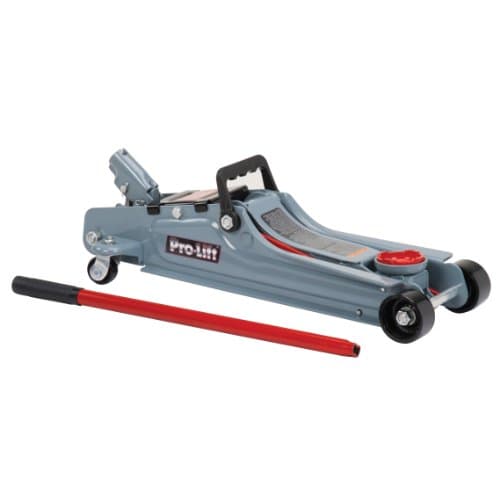
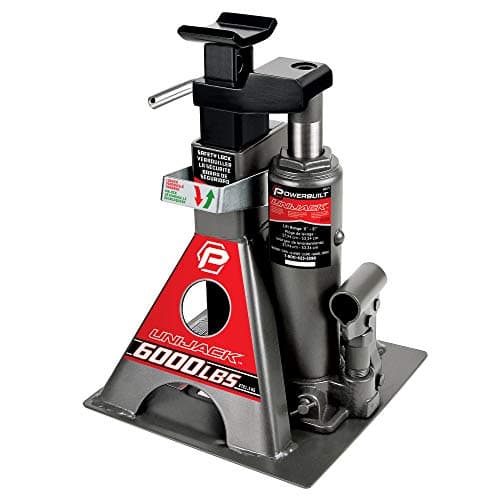
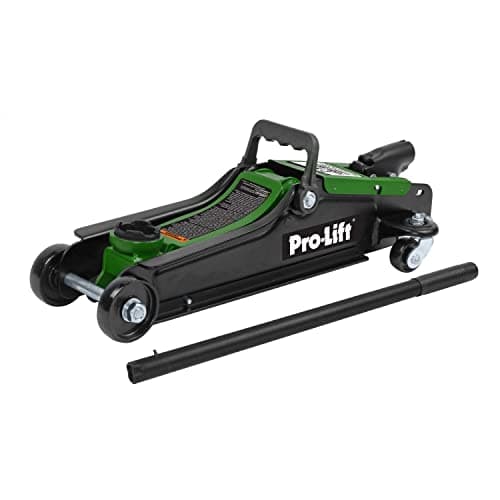
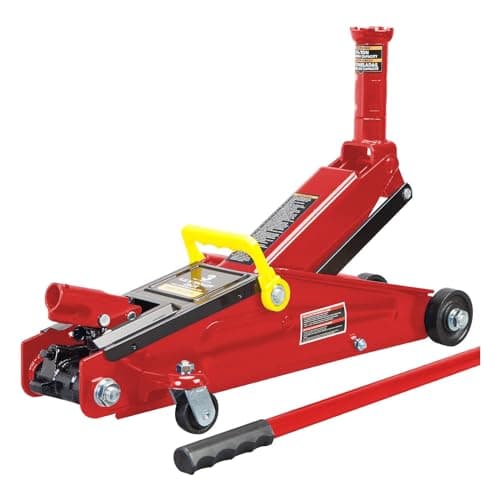
Short answer: the BIG RED T83006 is the best floor jack under $200 for most buyers - 3 ton of capacity and 20-7/8 in of lift, which is more reach than anything else in the band. If your car sits low, buy the Pro-Lift F-767 instead: it starts at 3-1/2 in, where the BIG RED starts at 5-7/8 in. If you would rather buy one tool that lifts and then mechanically holds, the Powerbuilt Unijack is the only unit here with a published ASME and PALD statement. The budget pick is the Pro-Lift F-757G, the cheapest jack on this page that still starts low enough to be useful. Every price cell in the table above is read from the live listing and stamped with the date it was read.
What we judged these on
1. Minimum saddle height - does it fit under your car at all?
This is the specification that silently disqualifies a jack. Pro-Lift publishes 3-1/2 in for the F-767 and 3-5/8 in for the F-757G. Torin publishes 5-7/8 in for the T83006. Powerbuilt publishes 11 in for the Unijack. A stock sedan typically leaves four to five inches of clearance at the jacking point, so the two Pro-Lifts go under it and the other two do not - not without ramping the front wheels up first. Measure the gap at your own lift point with a tape measure before you choose; it costs nothing and it is the only number nobody can guess for you.
2. Maximum lift - does the wheel actually leave the ground?
The mirror image of the first problem. Getting a tire clear of the floor needs more lift than people expect, because the suspension droops as the body rises. Torin publishes 20-7/8 in and Powerbuilt publishes 21 in; Pro-Lift publishes 14 in on the F-767 and 13-3/8 in on the F-757G. On a car those lower ceilings are usually workable. On a crossover, a van or a pickup they are not, and no amount of pumping changes it. How high does a floor jack lift goes through the arithmetic.
3. Capacity, and why the rating is not the headline
A jack lifts one corner, and one corner of a 4,000 lb car is well under a ton. So a 2-ton jack is not under-rated for a sedan on paper. What the extra ton buys is margin and rigidity: a 3-ton chassis flexes less under the same load, and the pump works less hard. Torin and Powerbuilt publish 3 ton here; both Pro-Lifts publish 2 ton. Treat capacity as a tie-breaker between jacks that already fit, not as the first filter.
4. What the maker publishes about overload
Every jack in this band publishes something, and the wording differs in a way that is worth reading. Powerbuilt states the Unijack meets or exceeds ASME and PALD standards - a named standard, which is the strongest claim on this page. Torin publishes a safety bypass system, Pro-Lift publishes a safety valve and bypass on the F-767 and an overload valve bypass system on the F-757G. A bypass is a mechanism; a standards statement is a mechanism plus a test regime. Neither Pro-Lift publishes an ASME PASE compliance statement for these models, and we say so rather than reading one in.
The four inside the cap, on published numbers
| Jack | Capacity | Lift range | Overload statement |
|---|---|---|---|
| BIG RED T83006 | 3 ton (6,000 lb) | 5-7/8 in - 20-7/8 in | Safety bypass system |
| Pro-Lift F-767 | 2 ton | 3-1/2 in - 14 in | Safety valve and bypass |
| Powerbuilt 620471 Unijack | 3 ton (6,000 lb) | 11 in - 21 in | Meets or exceeds ASME and PALD |
| Pro-Lift F-757G | 2 ton (4,000 lb) | 3-5/8 in - 13-3/8 in | Overload valve bypass |
Read the third column as a pair of numbers rather than a range. The left-hand figure decides whether the jack can be used on your car; the right-hand figure decides whether it can finish the job. Nothing in this band is strong at both ends.
What you give up by capping at $200
Three things, all of them real. The first is the low-and-tall combination described above. The second is weight: the jacks that start low in this band do it by being small, and the ones that lift high do it by being steel and heavy, where an aluminum jack buys you both at a price well past the cap. Aluminum vs steel floor jacks is the trade in detail. The third is the pump: a single-piston pump needs noticeably more strokes per inch than a dual-piston one, which you feel most on a tall vehicle. If none of those three matter to you, the band is genuinely enough jack. Best floor jacks under $300 is the band where the trade-off starts to disappear.
What we would buy
The BIG RED T83006 if the car is a crossover, an SUV or anything with normal ride height, because 20-7/8 in of lift is the one spec in this band you cannot work around. The Pro-Lift F-767 if your car is low, because 3-1/2 in of minimum height is the other one. The Powerbuilt Unijack if you want a single tool with a published standards statement and a mechanical hold, and you are working on something tall enough to clear its 11 in minimum. And the Pro-Lift F-757G if the budget is the budget: it starts low, it weighs 22 lb, and it is the cheapest honest hydraulic jack we can point you at.