Short answer: probably not. You need a long-reach jack if your vehicle's lift point sits well inboard - a central front crossmember or subframe mount rather than a reinforced point on the sill - or if the vehicle is wide enough that a standard chassis cannot put the saddle under it from where you can kneel. For the majority of cars, which are jacked a few inches in from the sill, a standard-chassis jack reaches the point and a long-reach jack costs you weight and floor space for nothing.
The short version
- Reach is horizontal. It is how far the saddle sits from the handle end, not how high the jack lifts.
- Check your lift point first. Sill point a few inches in: standard chassis. Central crossmember: reach helps.
- Reach costs weight. Arcan publishes 92.59 lb for the long-chassis A20016 against 56 lb for the A20019.
- Reach costs floor space behind the jack, because the handle still has to swing.
- Chassis figures are not comparable between makers - they do not publish them on the same basis.
What "long reach" actually means
It means the distance from the end of the jack you stand at to the saddle that contacts the car. A compact jack puts the saddle close to its own front wheels, which is fine if the point you are lifting is near the edge of the vehicle. A long-chassis jack carries the saddle further forward, so you can roll the jack further under the car before the saddle is where it needs to be - and critically, so the handle is still out in the open where you can pump it.
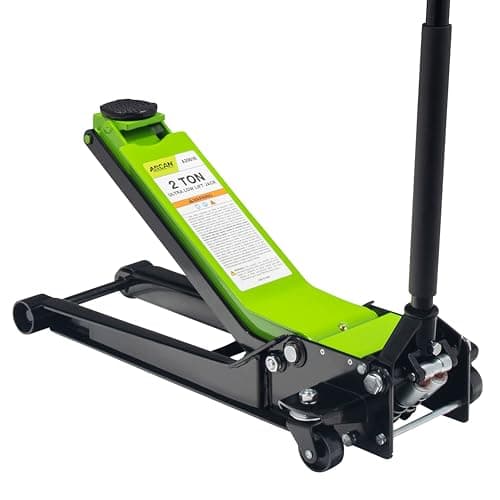
It is not the same thing as lift height and it is not the same thing as a low-profile jack. A low-profile jack is thin so it can get under a car; a long-reach jack is long so it can get in to the middle of one. Some jacks are both - Arcan publishes 2.75 in minimum and a 32 in chassis on the A20016 - and some are neither. Low profile floor jacks is the page for the height problem.
Who genuinely needs it
1. Cars lifted at a central crossmember
Plenty of vehicles name a central front crossmember or subframe mount as the lift point for raising the whole front end at once, rather than two separate sill points. That point can sit a foot or more in from the front of the car, behind a bumper cover and an undertray. Getting a saddle there with a compact jack means pushing the jack so far under the vehicle that the handle ends up under the bumper too. Car jack points covers finding the point your manufacturer actually names.
2. Trucks, vans and anything wide
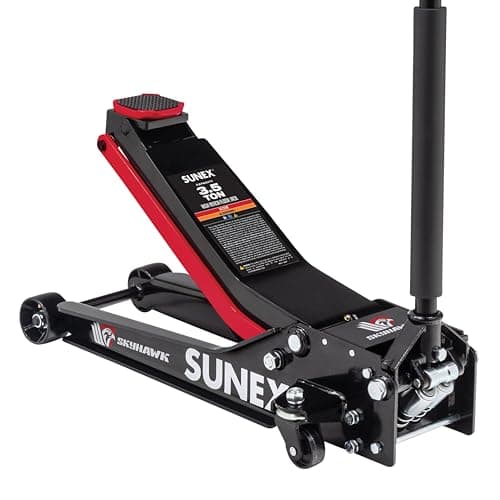
On a pickup the frame rail runs the length of the vehicle, but the useful lift points are often set inboard of the rocker panel, and the vehicle is wide enough that a short jack simply cannot be positioned. This is the case where reach and height are both needed, which is why Sunex pairs an 18 in extended chassis with 24.4 in of lift on the 66035HR. Where to jack up a truck covers the points.
3. Cars with deep front aprons
A low front lip does not change where the lift point is, but it changes how much of the jack has to disappear under the car to get there. Reach buys you the ability to stand clear of the bodywork while the saddle is in position - which is a convenience argument, not a safety one, but it is the reason people with low cars often end up with long jacks.
4. Almost everybody else
If your owner's manual names a reinforced point on the sill a few inches in from the edge of the car - which is the common case on a modern unibody vehicle - a standard-chassis jack reaches it with room to spare. Buying reach you do not need is not dangerous. It is 36 lb of jack you have to move and a longer tool to store, in exchange for nothing.
What the makers publish
| Jack | Chassis figure published | Lift range | Capacity | Published weight |
|---|---|---|---|---|
| Arcan A20016 | 32 in extra-long chassis | 2.75 – 24 in | 2 ton | 92.59 lb |
| Sunex 66035HR Skyhawk | 18 in extended chassis | 3.58 – 24.4 in | 3.5 ton | Not published |
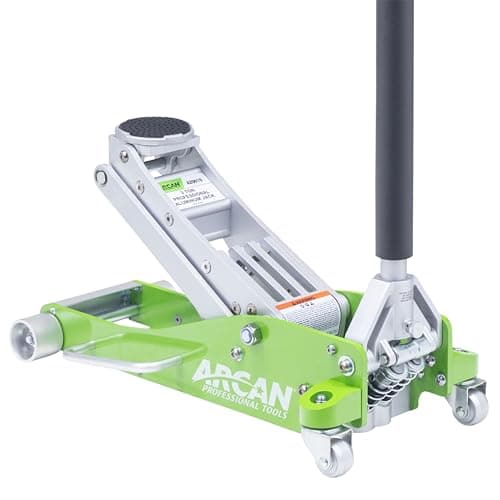
| Arcan A20019 | None published | 3.75 – 18 in | 3 ton | 56 lb |
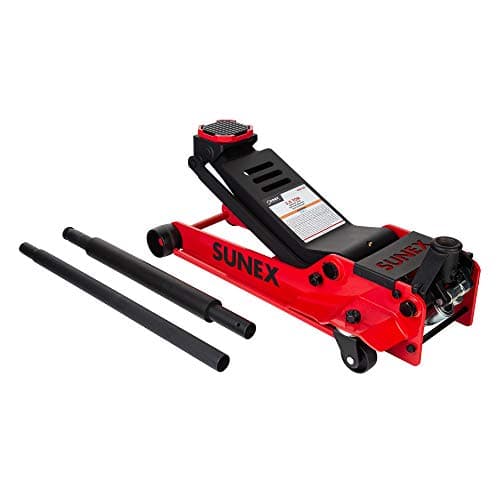
| Sunex 66035SJ | None published | 3.85 – 21.2 in | 3.5 ton | Not published |
A word on that second column, because it is the honest heart of this page. Arcan's "32 in extra-long chassis" and Sunex's "18 in extended chassis" are not the same measurement - one reads as an overall chassis length and the other as an extension figure, and neither maker publishes enough detail for us to convert between them. So we are not going to rank them against each other on reach, and anybody who does is making the number up. Treat both as "longer than standard" and measure your own car.
How to find out in five minutes
1.Find the lift point your manufacturer names
Owner's manual, not guesswork. Note whether it is a sill point, a central crossmember or a subframe mount.
2.Measure how far in it is
Tape measure from the outer edge of the vehicle at that station to the center of the lift point. A few inches: standard chassis is fine. A foot or more: reach is going to matter.
3.Measure the gap to the floor at that point
Car cold, on the flat, normal tire pressures. That figure has to be above the jack's published minimum saddle height. What size floor jack do I need works through all three numbers together.
4.Check you have floor space behind the jack
A long chassis still needs the handle swung, and the handle swings outside the car. Measure from the lift point out to the nearest wall or bench. This is the constraint that catches people with single-car garages.
The short version
Measure before you buy. If the lift point is on the sill, buy the standard jack and spend the difference on better stands. If the point is a central crossmember, or the vehicle is a truck, reach stops being a luxury and the Arcan A20016 or the Sunex 66035HR are the two tools on this site that have it - chosen between on capacity and height, since their published reach figures cannot be compared directly. And in every case, check you have floor space to swing the handle before the jack arrives.