Skip to content
JACK & TORQUE

Buying guide

What Size Jack Stands Do I Need?

Two numbers, not one: the rating you will never reach, and the height range that decides whether you can use them at all.

By Ryder M. · Published October 17, 2026 · Last reviewed October 17, 2026

We earn a commission when you buy through the Amazon links on this page, at no extra cost to you. It never changes which tool we put first, and we publish no price we have not verified. How this site is funded.

What Size Jack Stands Do I Need? — ranked picks with scores and a price check for each
#PickCapacityScorePrice
1
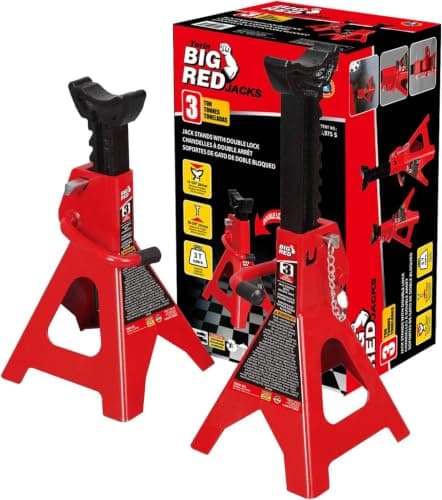
BIG RED T43002A 3-Ton Double-Locking Jack Stands, Amazon product photo
BIG RED T43002A 3-Ton Double-Locking Jack StandsThe size that fits most cars
3 ton (6,000 lb) per pair9.1
2
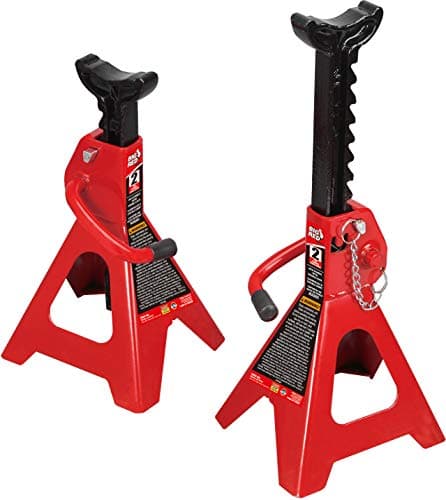
BIG RED T42002A 2-Ton Double-Locking Jack Stands, Amazon product photo
BIG RED T42002A 2-Ton Double-Locking Jack StandsWhen the car sits low
2 ton (4,400 lb) each8.5
3
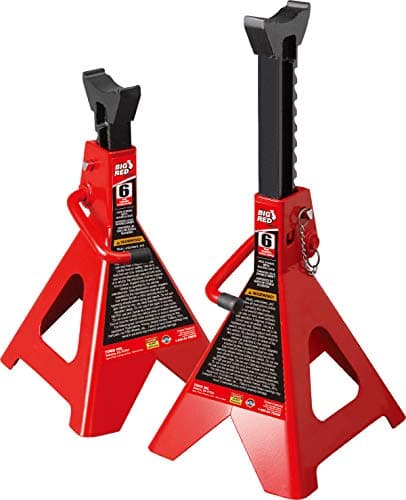
BIG RED T46002A 6-Ton Double-Locking Jack Stands, Amazon product photo
BIG RED T46002A 6-Ton Double-Locking Jack StandsTrucks, vans and body-on-frame SUVs
6 ton (12,000 lb)8.8
4
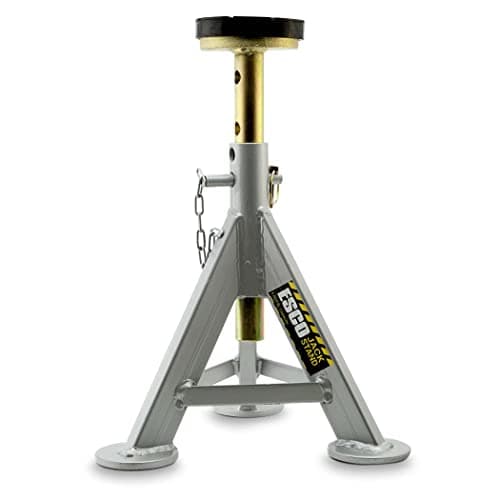
ESCO 10498 3-Ton Performance Jack Stand, Amazon product photo
ESCO 10498 3-Ton Performance Jack StandWhen you want the rating per stand, in writing
3 ton per stand8.8

Product photographs come from each product's own Amazon listing via the Associates program. They are the seller's images, not photographs of anything we own — we have no test rig and claim none.

BIG RED T43002A 3-Ton Double-Locking Jack Stands, Amazon product photo

Short answer: a pair of 3-ton stands for almost any car, crossover or small SUV, and 6-ton stands for a pickup, van or body-on-frame SUV. But tonnage is the easy half of this question and it is almost never the constraint — you are holding one end of the vehicle, not all of it, so a 3-ton pair is already several times what a car asks for. The number that decides whether the stands actually work on your vehicle is the height range: the stand has to go low enough to slide under your lift point, high enough to give you room to work, and your floor jack has to out-lift the notch you want to use.

The short version

  • Car, crossover, small SUV: 3-ton pair. More than enough capacity; check the minimum height against your sill.
  • Low or lowered car: look for a published minimum under 11 in — the 2-ton Torin starts at 10.8 in.
  • Pickup, van, body-on-frame SUV: 6-ton, for the 15-3/8 in to 23-13/16 in height range rather than the tonnage.
  • Always check the rating basis. "3 ton" means 6,000 lb per pair on some stands and 6,000 lb per stand on others.
  • Check your jack reaches. It has to lift the car past the stand notch, not just to it.

Tonnage: why it is the easy half

Here is the arithmetic that makes this clear. A typical mid-size sedan weighs somewhere around three and a half thousand pounds. Weight is not split evenly front to rear, and when you lift one end you are carrying rather more than half of the vehicle's weight across two stands — call it a thousand pounds a stand as a working figure, more on a front-heavy car. A 3-ton-per-pair stand is rated at 3,000 lb each. You are using roughly a third of its stated capacity.

Which means buying 6-ton stands for a car is not safer in any way you will notice. It is taller, heavier, and in the one respect that matters it is worse: a 6-ton stand with a published 15-3/8 in minimum will not go under most cars at all. Capacity is a floor to clear, not a score to maximize. Jack stand weight ratings goes through the load path in detail.

The one place tonnage becomes a real constraint is a truck. A half-ton pickup can weigh well over five thousand pounds before anything is in the bed, and a three-quarter-ton truck considerably more. There, 3 ton per pair starts to be a number you are genuinely using, and 6 ton is the sensible purchase — but note that you would be buying it for the height anyway.

Per pair or per stand: read it before you buy

This is the single most common misreading in the category and the listings do not help. Torin quotes 3 ton (6,000 lb) per pair on the T43002A — so 3,000 lb a stand. ESCO quotes 3 ton per stand on the 10498 — so 6,000 lb a stand, twice the figure for the same three words. The 2-ton Torin T42002A is quoted at 4,400 lb each. Find the basis in the manufacturer's own specification, not in a marketplace title.

Height: the number that actually decides it

Published height ranges and rating basis for the stands on this site
StandMinimum heightMaximum heightRatingBasis
Torin T42002A (2 ton)10.8 in16.5 in4,400 lbPer stand
Torin T43002A (3 ton)11-1/4 in16-3/4 in6,000 lbPer pair
Hein-Werner HW93503 (3 ton)11-1/2 in17 in3 tonPer pair
ESCO 10498 (3 ton)13.2 in21.5 in3 tonPer stand
Torin T46002A (6 ton)15-3/8 in23-13/16 in12,000 lbPer pair
Published height ranges and rating basis for the stands on this site

Two things fall out of that table. First, the useful minimum heights are all clustered between about 10.8 in and 13.2 in, and the difference between the top and bottom of that cluster is the difference between a stand that fits under a low car and one that does not. Second, the 6-ton stand's range barely overlaps the others — it is a different tool for a different vehicle, not a stronger version of the same one.

How to size them in five minutes, before you buy

  1. 1.Find your vehicle's support points

    The owner's manual names them. On most unibody cars they are reinforced points on the sill or a subframe mount; on a truck they are the frame rails. Where to put jack stands covers finding them, and car jack points covers the jacking points that go with them.

  2. 2.Measure the gap to the floor, car cold and on the flat

    Tape measure from the floor to the support point, with normal tire pressures. That figure has to be above the stand's published minimum height, with enough margin to slide the stand in without catching.

  3. 3.Decide how high you need the car

    A wheel-off job needs enough room to get the wheel out. Working under the car needs enough room for your shoulders and whatever you are holding. That target has to be within the stand's maximum.

  4. 4.Check your jack out-lifts the notch you want

    This is the step people discover late. To seat the car on a 16-3/4 in notch, the jack has to raise the support point past 16-3/4 in and hold it there. Arcan publishes 18 in of maximum lift on the A20019, which clears it. A jack topping out at 13-3/8 in cannot use the top half of that stand's range at all. What size floor jack do I need is the other side of this purchase.

  5. 5.Buy two pairs if you are lifting all four corners

    Four stands, not two, and all four at the same height on the same surface. How many jack stands do I need works through when that is needed.

Saddle shape is part of "size"

A number people never think of as a size question. Most stands have a curved cradle designed to sit under a round solid axle, which modern unibody cars do not have. Under a flat sill the curved cradle contacts on two edges and concentrates load exactly where you least want it. A flat pad — ESCO publishes a removable flat-top rubber cushion on the 10498 — spreads it. If your car has pinch-weld lift points, a slotted pad is the accessory that makes the difference, and jack stand pads covers them.

The short version

Buy 3-ton stands for a car and 6-ton stands for a truck, then check three numbers before you order: the published minimum height against the measured gap under your support point, the published maximum against how high you need to be, and your jack's maximum lift against the notch you intend to use. If the car is low, prioritize the minimum height over everything else — the 2-ton Torin's 10.8 in exists for exactly that case, and its per-stand rating means you are not giving up capacity to get it.

The picks in full

Every pick, in detail

BIG RED T43002A 3-Ton Double-Locking Jack Stands, Amazon product photo

1. The size that fits most cars

BIG RED T43002A 3-Ton Double-Locking Jack Stands

Torin (BIG RED) · score 9.1/10

A ratchet bar plus a separate safety pin — two independent locks instead of one — at the height range a car actually needs, and Torin states they meet ASME safety standards.

3 ton quoted per pair, 11-1/4 in to 16-3/4 in, ratchet plus safety pin, and Torin states these meet ASME safety standards. For a sedan, hatchback or crossover this is the answer to the question: the bottom of the range slides under a stock car, the top gives enough room to work, and 3,000 lb a stand is roughly three times what a corner of a normal car puts on it.

Published specifications

Capacity
3 ton (6,000 lb) per pair Torin
Min height
11-1/4 in Torin
Max height
16-3/4 in Torin
Base footprint
7-11/16 in x 6-7/8 in Torin
Standards
Meets ASME safety standards Torin

What works

  • Two independent locking mechanisms, not one
  • 11-1/4 in to 16-3/4 in matches what a 3-ton floor jack can reach
  • The cheapest way to buy a genuinely double-locked stand

What you give up

  • Rated per pair, not per stand — read the rating before loading two corners
  • 11-1/4 in minimum is taller than some low cars want
  • Torin's own listing says this size is not intended for SUVs or trucks

Our scoring

  • Fit & reach8.6
  • Safety margin9.2
  • Beginner ease9.0
  • Build quality8.2
  • Value9.4
$35.99 · View on Amazon

#ad Price as of October 17, 2026. How this is funded

Specifications published by Torin (BIG RED) — we earn nothing from that link.

BIG RED T42002A 2-Ton Double-Locking Jack Stands, Amazon product photo

2. When the car sits low

BIG RED T42002A 2-Ton Double-Locking Jack Stands

Torin (BIG RED) · score 8.5/10

10.8 in at the lowest setting — the shortest stand on this site, and the reason a low car can be supported at all without a lift.

10.8 in to 16.5 in and 2 ton (4,400 lb) each, with a 10-level ratchet bar plus a double locking pin and stated compliance with ASME PASE-2019. The useful number is the 10.8 in minimum: on a low car the problem is getting the stand under the sill at all, and half an inch decides it. Note the rating is per stand here, so 2 ton each is more capacity than the 3-ton-per-pair stands above.

Published specifications

Capacity
2 ton (4,400 lb) each Torin
Min height
10.8 in Torin
Max height
16.5 in Torin
Locking
10-level ratchet support bar plus a double locking pin Torin
Standards
Complies with ASME PASE-2019 Torin

What works

  • 10.8 in minimum clears the gap a low car leaves after a modest lift
  • Torin states compliance with ASME PASE-2019, not just a generic nod to ASME
  • Cheapest route to a stand that will actually fit under a lowered vehicle

What you give up

  • Rated 2 ton each, which is the lowest capacity of any stand here
  • Only 5.7 in of adjustment between lowest and highest
  • Too short for anything with truck or SUV ride height

Our scoring

  • Fit & reach9.2
  • Safety margin8.0
  • Beginner ease9.0
  • Build quality7.8
  • Value9.2
$31.49 · View on Amazon

#ad Price as of October 17, 2026. How this is funded

Specifications published by Torin (BIG RED) — we earn nothing from that link.

BIG RED T46002A 6-Ton Double-Locking Jack Stands, Amazon product photo

3. Trucks, vans and body-on-frame SUVs

BIG RED T46002A 6-Ton Double-Locking Jack Stands

Torin (BIG RED) · score 8.8/10

15-3/8 in to 23-13/16 in is the range a pickup actually sits at, on 12,000 lb of rated capacity — buy this instead of stretching a 3-ton stand.

15-3/8 in to 23-13/16 in, 6 ton (12,000 lb) per pair, forged steel on a wide pyramid base, tested to meet ASME standards per Torin. Buy these for height, not tonnage — a pickup frame rail sits where no 3-ton stand reaches. The same number is the limit: 15-3/8 in at the bottom is too tall for a car.

Published specifications

Capacity
6 ton (12,000 lb) Torin
Min height
15-3/8 in Torin
Max height
23-13/16 in Torin
Construction
Forged steel, welded frame, pyramid base Torin
Standards
Tested to meet ASME standards Torin

What works

  • Height range genuinely fits trucks, vans and body-on-frame SUVs
  • Wide pyramid base is the most stable footprint in this set
  • Capacity headroom you will not run out of on a light-duty vehicle

What you give up

  • 15-3/8 in minimum is far too tall for a car
  • Heavy enough to be awkward to position one-handed
  • Overkill, and over-tall, for sedan work

Our scoring

  • Fit & reach8.0
  • Safety margin9.4
  • Beginner ease8.4
  • Build quality8.6
  • Value9.0
$67.49 · View on Amazon

#ad Price as of October 17, 2026. How this is funded

Specifications published by Torin (BIG RED) — we earn nothing from that link.

ESCO 10498 3-Ton Performance Jack Stand, Amazon product photo

4. When you want the rating per stand, in writing

ESCO 10498 3-Ton Performance Jack Stand

ESCO · score 8.8/10

A removable flat rubber saddle instead of the usual curved axle cradle, rated 3 ton per stand and tested to ASME standards by an A2LA-certified lab.

3 ton per stand, 13.2 in to 21.5 in over 10 pin positions, a removable flat-top rubber cushion, 11.4 lb each, and testing to ASME standards by an A2LA-certified facility. If the ambiguity between per-pair and per-stand ratings is what is bothering you, this is the stand that removes it, and the flat saddle suits a modern unibody sill better than a curved cradle.

Published specifications

Capacity
3 ton per stand ESCO
Height range
13.2 in – 21.5 in ESCO
Positions
10 adjustable positions ESCO
Saddle
Removable flat-top rubber cushion ESCO
Weight
11.4 lb ESCO
Testing
Tested to ASME standards by an A2LA-certified facility ESCO

What works

  • Flat rubber saddle sits against a sill or subframe without digging in
  • Rated per stand rather than per pair — easier to reason about
  • Third-party ASME testing named on the manufacturer listing

What you give up

  • 13.2 in minimum is the tallest low setting of the car stands here
  • Pin-and-post adjustment is slower than a ratchet
  • The most expensive stand in this set

Our scoring

  • Fit & reach8.4
  • Safety margin9.4
  • Beginner ease8.2
  • Build quality9.2
  • Value7.8
$69.99 · View on Amazon

#ad Price as of October 17, 2026. How this is funded

Specifications published by ESCO — we earn nothing from that link.

Method

How these picks were chosen

We did not test these tools. We do not run a laboratory, we have not loaded a jack to failure or checked a wrench on a calibration bench, and we will not tell you otherwise. What we did instead is read the published manufacturer specifications, check the figures that matter against the safety standard that applies to portable automotive lifting equipment, and work out which tool suits which job. Every number on this page links to where it came from, so you can check us.

The five things we score are the five that decide a first purchase: will it fit under and lift your car, how much safety margin the rating and the locking mechanism leave you, how hard it is to get right alone in a driveway, what the materials and published standards say about how long it lasts, and what the money buys against the rest of the field.

Read the full method — including how we pick a top pick, and how prices get on the page.

Questions

Frequently asked questions

+Are 3-ton jack stands enough for a car?

Comfortably. Lifting one end of a typical sedan puts roughly a thousand pounds on each stand, against a 3,000 lb per-stand figure on a 3-ton-per-pair set. Height, not tonnage, is what decides whether they suit your car.

+Should I buy 6-ton stands to be safe?

Not for a car. A 6-ton stand's published minimum height is around 15-3/8 in, which will not fit under most cars at all — so the extra capacity buys nothing and costs you the ability to use them. Buy 6-ton for a truck, van or body-on-frame SUV, where you need the height anyway.

+What size jack stands do I need for a truck?

6-ton, chosen for the height range rather than the rating — a pickup frame rail sits in the 15 in to 24 in band that 6-ton stands cover and 3-ton stands do not reach. On a heavier truck the tonnage matters too.

+Does 3 ton mean per stand or per pair?

It depends on the maker, which is why it has to be checked. Torin quotes 3 ton per pair on the T43002A; ESCO quotes 3 ton per stand on the 10498 — twice the capacity for identical wording. Read the manufacturer's own specification.

+How tall should jack stands be for an oil change?

High enough that a drain pan and your forearms fit under the sump, which in practice means the upper notches of a 3-ton stand rather than the lowest one. That is also why your jack's maximum lift matters: best floor jack for an oil change does that arithmetic.

Sources

Where these figures come from

Read next

Related reading