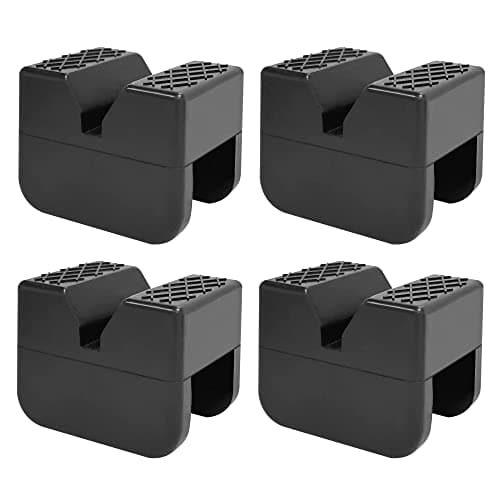

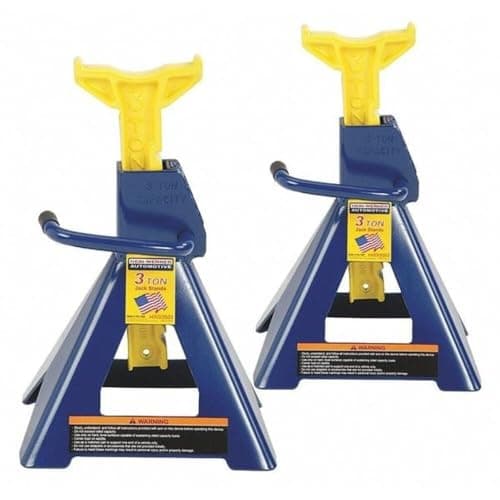
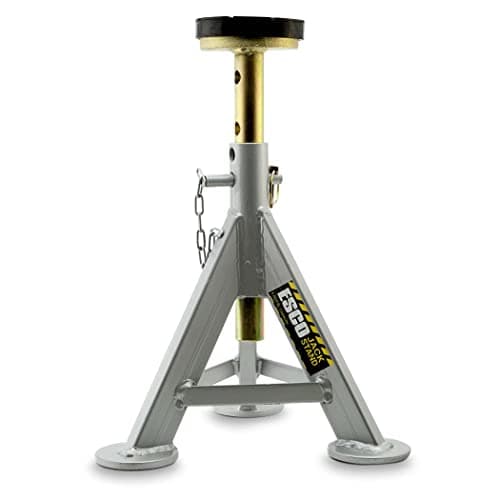
Most modern BMWs lift from four small reinforced pads on the sill, usually marked and often fitted with a plastic plug or a notch in the underbody trim. They are designed for a flat-faced lift pad. They are not designed for the V-shaped steel cradle on a generic jack stand, and the result of using one is a crushed plug and a bent seam.
So the useful answer to "best jack stands for a BMW" is mostly about saddle shape and a cheap adapter, not about capacity. Every stand we cover has far more rating than one corner of a 3 Series needs.
Why the saddle shape decides this
| Saddle | What happens at the pad | Verdict |
|---|---|---|
| Flat rubber top | Load spreads across the pad face | What you want |
| Slotted pad over a curved cradle | Seam sits in the groove, shoulders carry | Correct, and cheap |
| Bare curved steel cradle | Load concentrates on the plug and the fold | Damages the pad |
| Improvised block | Depends entirely on what you cut | Avoid unless slotted properly |
Height, and the inch the pad costs
A slotted pad adds roughly an inch between saddle and car. On a lowered car that is meaningful, and it is the reason the lowest-starting stands matter — see jack stands for low cars. On a standard-height sedan it is a non-issue.
The jack needs the same treatment
Whatever protects the pad under the stand has to protect it under the jack as well, because the jack touches the same place first. A pad on the jack saddle and pads on both stands is the complete answer; the pinch weld guide explains the geometry, and low-profile floor jacks covers getting under the car in the first place.
Ratings are not the constraint here
One corner of a mid-size sedan is well under 1,000 lb. Every stand on this page has multiples of that. Do still read whether the number is per pair or per stand, because the same "3 ton" label means different things across brands — jack stand weight ratings takes it apart.